Balanced budget relies on smoke and mirrors; 'wall of debt'
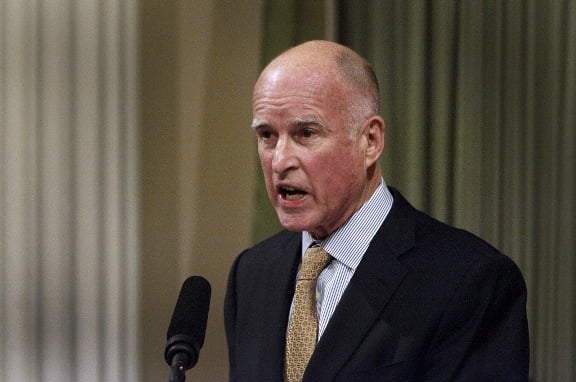
A cursory glance at Governor Jerry Brown's new budget could make you believe that California's days of fiscal gloom are over as he champions a balanced budget and newfound “fiscal restraint.”
California had been floating in debt. Then Brown persuaded voters in November to increase sales and income taxes. Now he releases a budget that, as Brown said at a news conference last week, advances a progressive agenda but does so based on available dollars.
Is California on to something? Is Brown's formula -- a combination of government idealism, tax increases and tough- minded budget choices -- the answer for the nation, as well?
As tempting as it might be to buy this story line, the answer is no. In reality, the Brown approach is the latest in a series of “kick the can down the road” budgets that ignore the buildup of debts. It rewards public-employee unions with pay and benefit increases -- while shielding them from desperately needed pension reforms -- and ignores deep problems within the state's economy.
The nonpartisan Legislative Analyst's Office agrees that the budget is basically balanced, but the agency's head, Mac Taylor, expressed concern: “It doesn't pay all of the wall of debt within the time period. It builds up very little of a reserve by the end of that period, and it does nothing regarding our various retirement-related obligations.”
Crushing Burden
Others were blunter about California's financial health. As the Los Angeles Times reported: “It owes Wall Street more per resident than almost every other state. And it has accumulated a crushing load of debt for retiree pensions and health care, now totaling more than taxpayers spend each year on all state programs combined.”
The Times compares the state's situation to that of the California cities of Vallejo, Stockton and San Bernardino, which all became insolvent largely because of their inability to pay for public-employee pensions and health care.
State Senate Republican Leader Bob Huff, writing in the Republican-leaning Flash Report, accused Brown of playing a shell game with the tax-increase funds, which were promised to public schools but are now being used to reward public employees. “Pay raises and lifting of the monthly personal leave day without pay for state employees certainly is a payback to the state unions who helped pass Prop 30,” said Huff, referring to the tax increases and pointing to projections that state spending will rise by $25 billion over the next four years.
Voters in November also approved a tax increase for out-of- state businesses in order to fund green-energy projects. Brown includes environmental upgrades at schools as part of the state's per-pupil spending formula -- something that raised questions from the Legislative Analyst's Office and others.
The budget indicates that California's recovery is bolstered by rising home values, better credit conditions, stronger household spending, and modest, but improved, job creation. But this rosy view doesn't take into account the negative effects of new taxes and regulations, said David Wolfe, the legislative director of the Howard Jarvis Taxpayers Association. California's cap-and-trade system, the first plan in the nation to combat global warming by imposing costs on greenhouse-gas emitters, will slow manufacturing, he said in an interview.
The state's forecasters assume that people don't change their behavior in the face of new taxes and fees, Wolfe said. It's too early to know the fallout of California's higher income-tax rate. What if the millionaires move?
Property Taxes
As California's real-estate market rebounds, Democratic legislators are already talking about eroding the protections from Proposition 13, enacted in 1978. That measure capped taxes at 1 percent of the sales price of a property (plus voter- approved local bonds and parcel taxes), with tax increases limited to 2 percent a year until the property is sold. Fiddling with that law will probably push property values lower.
Some Democratic legislators want to start with a ballot initiative that would remove Proposition 13 protections from commercial properties, while leaving them on homes. Governor Brown might not want to deal with the potential implications of such a measure during his re-election bid in 2014, according to the San Jose Mercury News, but the newspaper sees efforts to soften Proposition 13's protections against local parcel taxes - - a form of across-the-board property tax -- heating up this year. “The third rail of California politics may not be as deadly as once thought,” the Mercury News concludes.
This touches on perhaps the biggest challenge to the state's fiscal health: Democratic supermajorities in both houses of the state Legislature, combined with Democratic control of all constitutional offices. With Republicans now irrelevant, Democrats can raise taxes and ramp up spending at will, meaning that the cycle of artificially produced fiscal crises will speed up, with a legislative majority committed to the endless growth in government and the protection of public-employee pay and privilege at all costs.
Until California's leaders tackle the state's enduring debt issues and view the private sector as the generator of economic growth, rather than as a means to fund government, California's next fiscal crisis will always be just around the corner.
--Bloomberg News--
(Steven Greenhut, a Bloomberg View contributor based in Sacramento, is vice president of journalism at the Franklin Center for Government and Public Integrity. The opinions expressed are his own.)