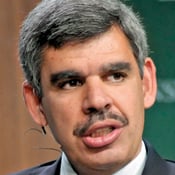
Pacific Investment Management Co.'s Mohamed A. El-Erian said business is booming at the world's largest manager of bond funds and that isn't a good sign for the U.S. economy.
Net inflows into bond funds reached $120 billion year to date at the end of August as investors became more risk averse, Pimco's chief executive and co-chief investment officer said in a radio interview today on “Bloomberg Surveillance” with Tom Keene. Newport Beach, California-based Pimco oversees more than $1.1 trillion of assets and runs the $248 billion Total Return Fund, the biggest bond fund by assets.
“It has a bad impact on the economy as a whole,” El-Erian said. “The average investor is de-risking their portfolio, moving from equities into cash and bonds and that is not a good sign for the economy if people becomie more and more risk- averse.”
The perception that economic policy responses by the administration of President Barack Obama have been piecemeal and reactive is discouraging investors and consumers, El-Erian said. International investors are also concerned that U.S. companies are hoarding cash rather than investing for growth, he said.
Treasuries have handed investors a return of 7.4 percent this year, after losing 3.7 percent in 2009, according to indexes compiled by
Bank of America Merrill Lynch. The Standard & Poor's 500 Index has risen 0.82 percent during the same period once dividends are included.
Fund Inflows
“We continue to see solid inflows” into bond funds, El- Erian said. “It has to do with people being uncertain and wanting more self-insurance.”
Under what Pimco calls the “new normal,” global growth will be below historical averages during the next three to five years as developed economies struggle with mounting deficits and increased regulation in the wake of the 2008 collapse of credit markets. El-Erian is co-chief investment officer with Pimco co- founder Bill Gross, who runs the Total Return Fund.
Pimco has received about $1 billion from investors since it began offering equity funds in April, El-Erian said. The firm moved into stocks to allow customers to diversify their holdings as the global economy changes and areas such as emerging markets outperform developed regions.
The economy of the Group of Seven nations may grow at an annualized rate of about 1.5 percent in the second half, below the 1.7 percent previously estimated and the 3 percent rate of the first six months of the year, the Paris-based Organization for Economic Cooperation and Development said yesterday.
Quantitative Easing
Reports over the past few weeks showed slow inflation and a weakening housing market, raising the chance that
Federal Reserve Chairman Ben S. Bernanke will again inject cash into the economy through a process known as quantitative easing.
“There's going to be a distinction though between the impact of QE2 on financial markets, which will be to lower yields and raise the price of Treasuries, and the impact of QE2 on the economy, which is going to be muted,” El-Erian said. He called for policy makers to reevaluate their instruments, since policy actions thus far have fallen short of expectations.
The likelihood of a second round of easing increased after the Fed adopted a policy of reinvesting the maturing proceeds from its holdings of mortgage-backed securities into Treasuries.
Treasury 10-year yields dropped on Aug. 10, when the Fed said at the conclusion of its policy meeting that it would keep its bond holdings level by resuming the purchase of U.S. debt to support a recovery it described as weaker than earlier anticipated. Household purchases will cool and the jobless rate will hold above 9 percent, according to a Bloomberg News survey of 59 economists taken Sept. 1 through Sept. 9.
The yield on the benchmark 10-year Treasury note may fall to 2.5 percent or below, El-Erian said. The yield rose 4 basis points, or 0.04 percentage point, to 2.80 percent at 11:34 a.m. in New York, according to BGCantor Market Data.