
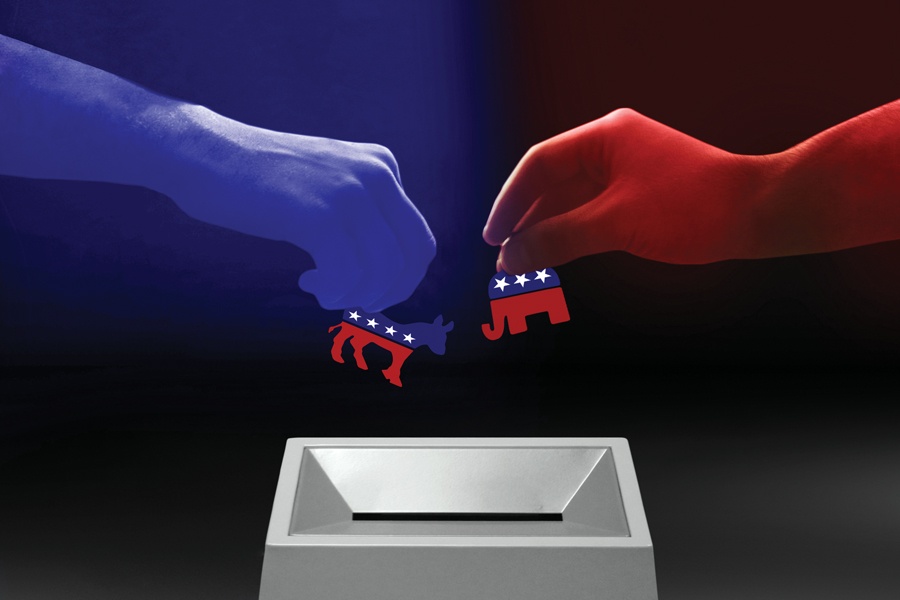
Rising uncertainty around the US election could endanger some of this year’s most popular macro trades as investors rush to cut exposures, according to Morgan Stanley.
A number of crowded trading strategies — from going long the greenback versus lower-yielding peers to holding an underweight position in longer-term Treasuries — could get squeezed with investors heading to the exits ahead of November, strategists Matthew Hornbach and James Lord wrote in a report.
“Most investors will choose to pare back risk exposures in their portfolios” heading into the general election," the Morgan Stanley team wrote in a May 31 mid-year outlook. “As first-mover investors reduce popular risk exposures, macro markets could move in ways that encourage a broader swath of investors to join suit.”
Traders, they argue, don’t have the luxury of “assuming status quo” politics and need only look at the the post-pandemic period to see the outsized impact of fiscal policies on economy and monetary policy. For that reason, they will bring back exposures closer to benchmarks, or return investment durations closer to underlying liabilities, as a hedge against policy-related risks.
The following macro market positions look risky as elections near, according to Morgan Stanley:
Hornbach and Lord also argue that embedded in these positions is an implicit belief that the Fed will keep interest-rates “higher forever” as US economic growth continues to outperform against the rest of the world.
“This assumption may prove unwise at some point between now and the US election, or perhaps after the election – leaving the stance of Fed policy looking much more restrictive than currently thought,” the strategists wrote.
Morgan Stanley economists expect the Fed to begin cutting interest rates in September and the 10-year Treasury yield to end the year at 4.10% — some 30 basis points lower than current levels.
Despite the crowdedness of the long dollar trade, Hornbach and Lord still expect that the currency will nonetheless find a modest bid in the months to come as bond yields in the rest of the world fall even faster than they do in the US. Rising risk premium because of the US election should also prove supportive for the greenback, they added.

Goldman Sachs retirement survey finds 83% want guaranteed income, while the annuities providing that income increasingly hold private credit.

The AI meeting assistant's Advisor Intelligence plugin turns client conversation data into annual reviews, tax scans and attrition alerts.
Chuck Roberts and Stifel have been facing scrutiny due to sales of structured products and structured notes.

Among other updates, the proposals would let advisors to regulated funds earn performance fees and allow interval funds to offer monthly repurchases.

What will financial advice look like 20 years from now? Evan Vladem explores how AI may transform wealth management while reinforcing the enduring value of human guidance, trust, and empathy.
As AI makes financial information more accessible than ever, Lana Hock explains why human judgment, trust, and empathy remain the qualities clients value most in a financial advisor
Northern Trust’s Ken Lassner shows advisors how to convert volatility into after-tax portfolio gains

