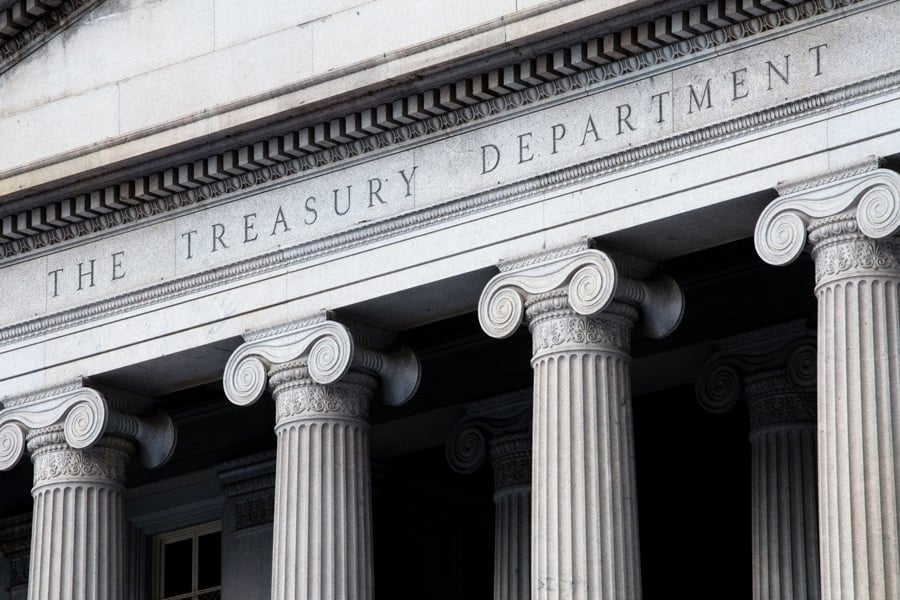
The Trump administration is giving careful thought to selling something Wall Street may not be ready to buy: ultra-long debt.
Treasury Secretary Steven Mnuchin said that offering bonds with maturities of 50 to 100 years is under "very serious consideration," with officials conducting an intensive review.
"If the conditions are right, then I would anticipate we'll take advantage of long-term borrowing and execute on that," Mr. Mnuchin said Wednesday in an interview with Bloomberg News in Washington.
Record-low interest rates make this an opportune time for the Treasury to revisit a proposal it's shelved in the past. Some observers see a window for the U.S. to issue extremely long-term debt instruments, yet some investors have been bruised by long bonds recently, and the idea has been met repeatedly with a cool reception on Wall Street.
"For the borrower, it's great. For the investors, you are taking a lot of risk for not a lot of reward," said Linda Beck, director of fixed income for Bailard Inc., a California money manager.
[More: Falling rates expose duration risk in bond funds]
The risks of the ultra-long bond include the ebb and flow of demand over the course of an economic cycle. Buyers may be enthusiastic when yields are high, but in downturns, when the
Federal Reserve is cutting rates, demand could evaporate, pushing government borrowing costs higher across different maturities.
Investors have snapped up ultra-long bonds issued by the likes of Austria and the UK, although recent experiences in Argentina and Germany underscore some of the potential pitfalls of buying such long-maturity debt.
The decision to rekindle the idea didn't stem from fresh information from market participants, according to people familiar with the matter. It followed a meeting between Mr. Mnuchin and White House economic adviser Larry Kudlow on the same week earlier this month that the yield curve inverted — news that caught the attention of President Donald J. Trump.
The U.S. has entertained the idea of issuing 50- or 100-year bonds since at least 2009, and the idea has recently gained traction within Treasury. For the Trump administration, issuing extremely long-term debt would limit the cost to taxpayers of plugging a budget deficit that's headed to $1 trillion annually. Pension funds would enjoy a few extra points of returns amid falling yields.
[More: Why Pimco fixed-income fund fell as long bonds rallied]
Long long-bond debate
Mr. Mnuchin studied the issue when he first took office in 2017, but put the idea to rest following a thorough review with the Treasury Borrowing Advisory Committee, whose members include representatives from JPMorgan Chase,
Bank of America, Pacific Investment Management Co.,
Citadel and
Goldman Sachs Group Inc. The committee has been pessimistic about the idea of ultra-longs since the debate emerged in 2009.
Mr, Mnuchin said he still hasn't made up his mind.
"It would be premature for me to comment on what our conclusion is," he said Wednesday, adding that Treasury is "actively revisiting it, and it is something that is under very serious consideration."
The U.S. Treasury issues coupon-bearing debt with maturities ranging from two to 30 years. Other countries have opted to sell bonds that mature in more than three decades, including Spain, Belgium, France, Austria and the United Kingdom.
Wagers made on Argentine debt maturing in 98 years suffered a blow earlier this week, falling 29% over just one week, though the investors have nearly a century for prices to recover.
[Recommended video: Indirect impact of trade war with China is the greatest concern]
But not everyone agrees with TBAC.
"It makes sense now to issue ultra-long term debt. Why wouldn't Treasury want to refinance debt at historically low interest rates?" said Ed Yardeni, president and founder of Yardeni Research Inc., who has been following the bond market since the 1970s.
The Treasury's announcement last Friday after markets closed that it was considering the issuance stirred some confusion among investors who questioned whether the renewed interest was a result of prompting from the TBAC or its primary dealers — or from Mr. Trump.
Mr. Mnuchin said his renewed interest in long bonds was unrelated to the drop in yields on shorter-term U.S. debt. The yield on 30-year Treasuries recently plunged below 2% for the first time, and continued its drop to a record 1.90% on Wednesday.
Mr. Trump's Treasury Department has weighed several unorthodox options for Mr. Mnuchin to pursue. Last month, White House officials confirmed that it weighed a dollar intervention to weaken the greenback.
Mr. Mnuchin said Wednesday that he has "no intention" to intervene at this time and signaled he preferred that any future move be coordinated with the Federal Reserve and global allies.
Mr. Mnuchin also has a role in the U.S. trade conflict with China. Speaking in the interview Wednesday, he said he expects Chinese negotiators to come to Washington, but he didn't say when.
At the same time, he's spoken with China's top central banker, Yi Gang, and the International Monetary Fund about China's currency after the U.S. formally labeled Beijing a currency manipulator earlier this month.
[More: Smart money is pouring into fixed income]