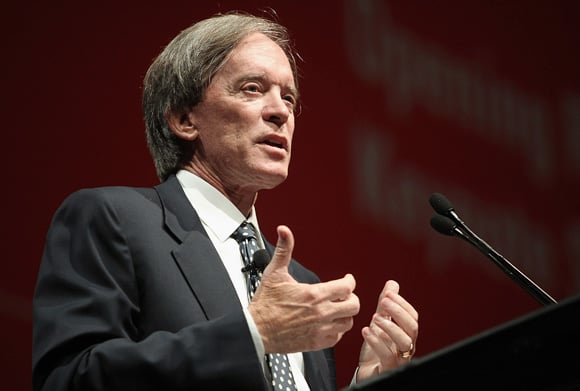
Bill Gross, manager of the world's biggest bond fund at Pacific Investment Management Co., said the additional easing programs hinted at by
Federal Reserve officials will push yields on longer-term Treasuries higher.
“Sovereign monetary and fiscal policies, while generating undersized real growth, have managed to produce disproportionally large inflation,” Gross wrote in a monthly investment outlook posted on Newport Beach, Calif.-based Pimco's website today. “Developed economies -- the U.S. included -- have experienced 3% plus inflation in the midst of a New Normal economy. Portfolios should avoid longer dated issues where inflation premiums dominate performance.”
More quantitative easing suggested by Fed officials including Vice Chairman Janet Yellen is likely to push the central bank's objective for inflation to above 2%, which will cause investors to demand higher yields on longer-term Treasuries, Gross wrote. Investors should buy “safe haven” maturities of under 10 years and in equity markets focus on
dividend-producing stocks, Gross added.
Yellen and other officials have said the central bank should be prepared to do more to spur growth as policy makers prepared for a two-day meeting that starts tomorrow. Governor Daniel Tarullo and New York Fed President William C. Dudley said this month that additional stimulus may be needed. The central bank announced in September it would replace $400 billion of short-term debt with longer-term Treasuries to contain borrowing costs.
Bonds Beat Stocks
Fixed-income investments advanced 6.25 percent this year, almost triple the 2.18 percent rise in the Standard & Poor's 500 Index through last week, according to
Bank of America Merrill Lynch indexes. Debt markets are on track to return 7.63 percent this year, the most since 2002, the data show. Long-term government bonds have gained 11.5 percent a year on average over the past three decades, beating the 10.8 percent increase in the S&P 500, said Jim Bianco, president of Bianco Research in Chicago.
The shift to debt wasn't anticipated by Gross, who as co- chief investment officer of Pimco runs the $242 billion Total Return Fund. Gross unloaded Treasuries in February before the rally, leading to returns of 2.55 percent this year in the fund, putting it in the bottom 22th percentile of similar funds, according to data compiled by Bloomberg.
Benchmark 10-year U.S. Treasury note yield fell 10 basis points, or 0.10 percentage point, to 2.21 percent at 9:25 a.m. New York time, according to Bloomberg Bond Trader prices. The 30-year bond yields dropped 13 basis points to 3.25 percent.
New Normal
Pimco outlined the firm's “new normal” scenario at its annual Secular Forum in May 2009 that set investment guidelines for the firm for the next three to five years. The forecast predicted that following the market collapse in 2008 the U.S. economy would grow at a below-average pace for the next several years as growth in the developed markets slows, unemployment stays elevated and the “heavy hand of government” would be evident in the markets.
U.S. government debt-market bets on inflation rose to a two-month high last week. The difference between yields on 10- year notes and Treasury Inflation Protected Securities, a gauge of expectations for consumer prices over the life of the debt, widened to 2.24 percentage points on Oct. 28, the most since Aug. 15. The so-called breakeven rate was at 2.14 percent today.
“With fiscal policy in most developed countries incredibly restrictive instead of stimulative, central banks have assumed the helm on their own -- but it has been a long and relatively futile watch,” Gross wrote. “Structural growth problems in developed economies cannot be solved by a magic penny or a magic trillion dollar bill.”
--Bloomberg News--