
Negative yields in the $17 trillion Treasury market are a step closer to reality after the Federal Reserve eased bank capital requirements Wednesday.
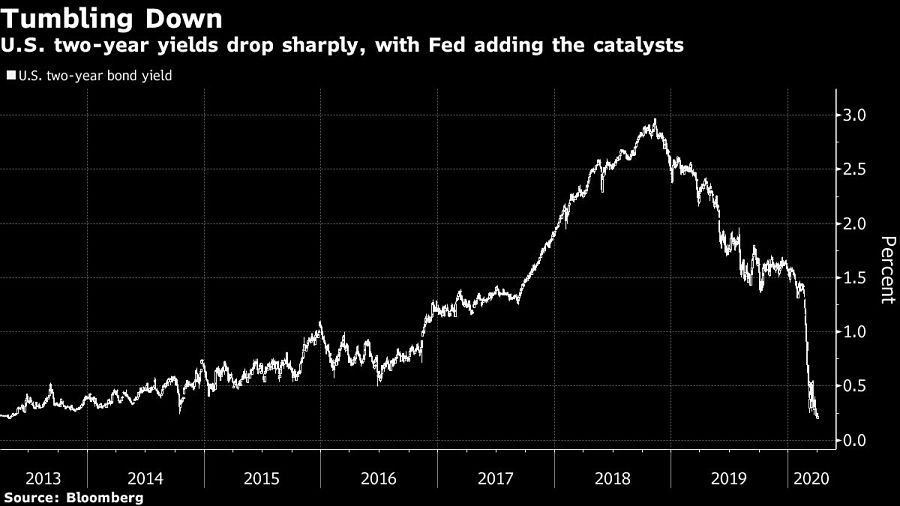
The move by the Fed allows banks to take on more leverage so they can stomach further bond purchases and absorb a lack of liquidity for Treasuries following a turbulent few weeks. That’s pushing rates down, with two-year yields touching the lowest level since 2013 after the announcement, to hover just over 20 basis points above 0% Thursday. A bigger-than-expected surge in U.S. jobless claims data Thursday also helped underpin investor appetite for Treasuries and keep yields in check.
“It is adding one more stone to the edifice,” Antoine Bouvet, senior rates strategist at ING Groep, said about the Fed’s announcement.
“With no end in sight for the economic damage of the epidemic, this is one of the best risk-reward trades out there,” he said, referring to holding two-year Treasuries.
Over $10 trillion of investment-grade bonds have negative yields globally, with Treasuries so far providing a notable exception. In Germany, the entire yield curve dipped below 0% this year, meaning that investors who intend to hold the country’s bonds to maturity may take a loss.
Technical analysis by Bank of America’s Paul Ciana shows that a 10-year yield of zero to 0.25% is “reasonable” during the second quarter under a situation in which coronavirus-related quarantines, social distancing and medical breakthroughs prevail, he wrote in a note Thursday; a worse case, however, could see the 10-year rate drop below zero.
The number of Americans applying for unemployment benefits more than doubled to a second straight record, highlighting the devastating economic impact of the coronavirus as shutdowns widened across the country. A total of 6.65 million people filed jobless claims in the week ended March 28, according to Labor Department figures released Thursday.
The Fed temporarily relaxed the so-called leverage ratio Wednesday, meaning the biggest banks no longer have to add Treasuries and reserves into the basket of assets they’re required to maintain capital for -- significantly reducing capital requirements. The Fed said it made the decision because “liquidity conditions in Treasury markets have deteriorated rapidly.”
“Two-year yields hitting zero isn’t a massive stretch, especially if equities start to register new lows,” said John Davies, a U.S. interest-rate strategist at Standard Chartered. This “makes it more likely.”

Magnificent 7 firm continues to ‘right size’ workforce in AI-related shift also seen in financial services.

Healthcare inflation running at 280% of CPI - and most HSA holders are sitting in cash.

New research identifies the practice habits driving 121% DC AUM growth among the industry's top performers.

Six-figure losses, social media lures and impostor schemes are draining older clients’ savings, report to Congress shows.

William Tunink, an industry veteran, was indicted for running a Ponzi scheme this month in Des Moines.
Knighthead Life entered the market with a competitive MYGA. A strong launch earned advisor confidence and paved the way for FIAs.
As AI makes financial information more accessible than ever, Lana Hock explains why human judgment, trust, and empathy remain the qualities clients value most in a financial advisor

