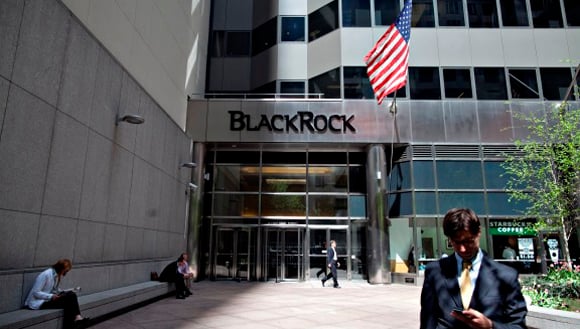
BlackRock Inc., the world's biggest money manager, is buying junk bonds after relative yields widened to levels that signal default rates more than three times the current pace and in excess of Wall Street's most bearish outlooks for the economy.
“The high-yield market is a great long-term investment at this point and these spread levels,” said James Keenan, who oversees BlackRock's $28 billion leveraged finance unit. “In July we were much more defensive, and we had sold out and built a significant cash position.”
The extra yield investors demand to hold speculative-grade, or junk-rated debt jumped 2.07 percentage points to 7.61 percentage points in the past two months on concern that Europe's leaders will be unable to prevent a sovereign-debt crisis from infecting bank balance sheets and freezing credit markets.
BlackRock joins Morgan Stanley and JPMorgan Chase & Co. in favoring securities that had their worst monthly return in August since November 2008, even as default rates remained at about 25 percent of their historical average.
“The high-yield market is in a good space,” said BlackRock's Keenan, who's based in New York. “Balance sheets today look better than they did in 2006 and 2007.”
The $3.66 trillion investment firm is targeting bonds of speculative-grade companies involved in energy, mining, oil, natural gas, cable and wireless operations, Keenan said.
BlackRock is largely shunning debt of retail restaurants and supermarkets that are more susceptible to an economic slowdown.
‘Visible Cash'
“You want companies that have more stable and visible cash flow streams, so their earnings quality is a lot higher and more stable to withstand economic downturns,” said Keenan, who manages the $5.4 billion BlackRock High Yield Bond Portfolio that's beaten 89 percent of its peers over the last five years. Those are the companies to target for “high single-digit yields” and “what we think is longer-term, relatively lower risk.”
Investors are purchasing high-yield bonds after spreads expanded to 7.64 percentage points on Sept. 12, the most since Nov. 30, 2009,
Bank of America Merrill Lynch index data show. Funds that buy the debt, ranked below Baa3 by Moody's Investors Service and less than BBB- by Standard & Poor's, reported inflows of $210 million last week following outflows of $6.4 billion in August, JPMorgan research shows.
Defaults could reach a peak of 6 percent in a U.S.
recession compared with up to 15 percent during prior downturns, JPMorgan analysts led by Peter Acciavatti, the top-ranked high- yield strategist in Institutional Investor magazine's annual poll wrote in a Sept. 16 report. Relative yields on high-yield bonds are implying default rates of 7.4 percent, six times the current pace of 1.2 percent, the New York-based analysts wrote.
Default Rates
The U.S. corporate default rate fell to 2.1 percent in August from 2.3 percent, Moody's data show. Relative yields on junk bonds are pricing in the worst five-year cumulative default rate on record, according to a Morgan Stanley report published on Sept. 4.
“The spreads are factoring in a pretty draconian scenario in the economy,” Keenan said. While high-yield bonds are a good relative investment, it “may not be a good short-term trade because of policy risks,” Keenan said. “There's still a tremendous amount of systemic risk.”
The U.S. economy may end the year with an expansion rate of 1.6 percent compared with 3 percent for 2010, according to the median estimate of 66 economists surveyed by Bloomberg.
High-yield bonds lost 0.4 percent this month following declines of 4 percent in August, Bank of America Merrill Lynch index data show.
Notes graded BB by S&P and Moody's have outperformed the lowest-rated junk debt for five consecutive months as investors continue to shed risk tied to companies that rely most on economic growth to reduce debt, the data show.
Bonds rated CCC and lower have lost 10.6 percent since the end of April following a rally that increased the value of the debt by 123.9 percent since the end of 2008.
--Bloomberg News--