
Franklin Templeton is transforming two of its mutual funds into exchange-traded vehicles as the conversion trend gathers speed.
The $1.4 trillion asset manager expects to complete the process of flipping two mutual funds with roughly $250 million of assets into ETFs by the third or fourth quarter of next year, the company said in a statement Tuesday. The plan emerged on the same week that Motley Fool Asset Management finalized a nearly $1 billion switch.
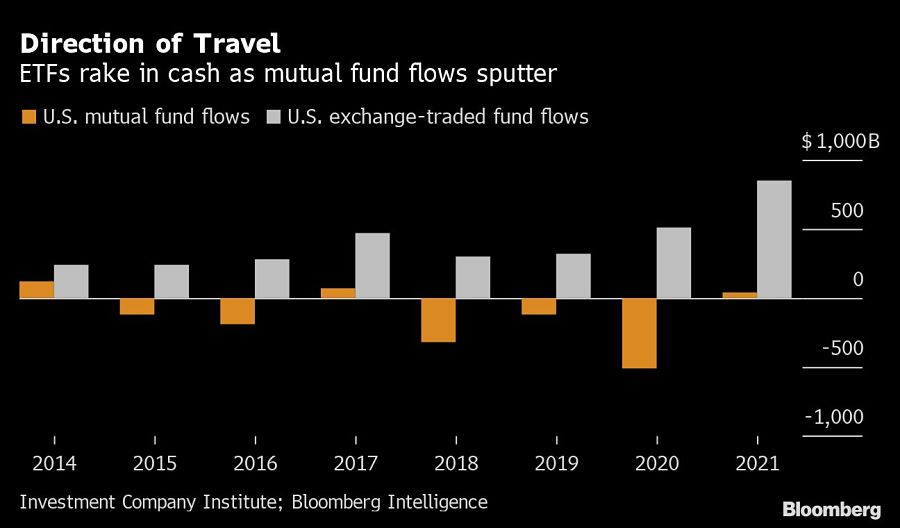
Conversions are gaining popularity as billions of dollars exit mutual funds each year, heading seemingly straight to lower-cost, tax-efficient ETFs. While Investment Company Institute data show that mutual funds are on track for $44 billion in inflowd this year, that pales in comparison with the nearly $850 billion absorbed by ETFs.
That clear investor preference for ETFs will drive more asset managers to do the same, according to Bloomberg Intelligence.
“It’s not big asset-wise, but it’s big symbolically because it’s yet another big-time name from the mutual fund world,” BI senior ETF analyst Eric Balchunas said of the Franklin Templeton conversions. “ETFs will take in close to $1 trillion in the U.S. this year. There’s no way that’s not on the mind of many mutual fund CEOs.”
Dimensional Fund Advisors has embraced conversions, flipping nearly $40 billion of assets this year alone and becoming one of the largest U.S. ETF issuers in the process. In August, JPMorgan Asset Management said it will reorganize $10 billion worth of assets next year.
Converting the BrandywineGLOBAL – Dynamic US Large Cap Value Fund and the Martin Currie International Sustainable Equity Fund will bring Franklin Templeton’s actively managed ETF lineup to 24 products, according to the release.
Citigroup Inc. expects that conversions will be one of several factors fueling a $21 trillion shift from mutual funds to ETFs over the next decade. Meanwhile, Bloomberg Intelligence forecasts that $1 trillion in conversions alone will take place over the next 10 years -- but with a couple years of lead time.
“These are massive, old companies and so many people internally have to sign off. There’s all kinds of legal logistics and hoops to jump through,” Balchunas said. “So while it will likely be a big trend, it will take time.”

Chicago-based Mesirow Fiduciary Solutions adds flexPATH's plan-level outsourced fiduciary book, boosting its retirement market reach to $164 billion.

Also, Raymond James's employee advisor channel adds breakaways from Wells Fargo and Stifel, while UBS welcomes an ex-Morgan Stanley duo in Indiana.

It promised guaranteed principal and 10% monthly returns. The SEC says it invested nothing.

Ten years after entering the fee-based annuity market, MassMutual Ascend says nearly half its lifetime sales came in the past two years alone – but barriers remain among fee-only advisors.

Amplify, WealthReach, Zeplyn and Zocks have unveiled partnerships aimed at automating portfolio management, content creation, account opening, and client communication.
Northern Trust’s Ken Lassner shows advisors how to convert volatility into after-tax portfolio gains
Dan Biagini of American Equity says the steady decline of pensions, longer lifespans and a reset in interest rates are rewriting how advisors build retirement income

