
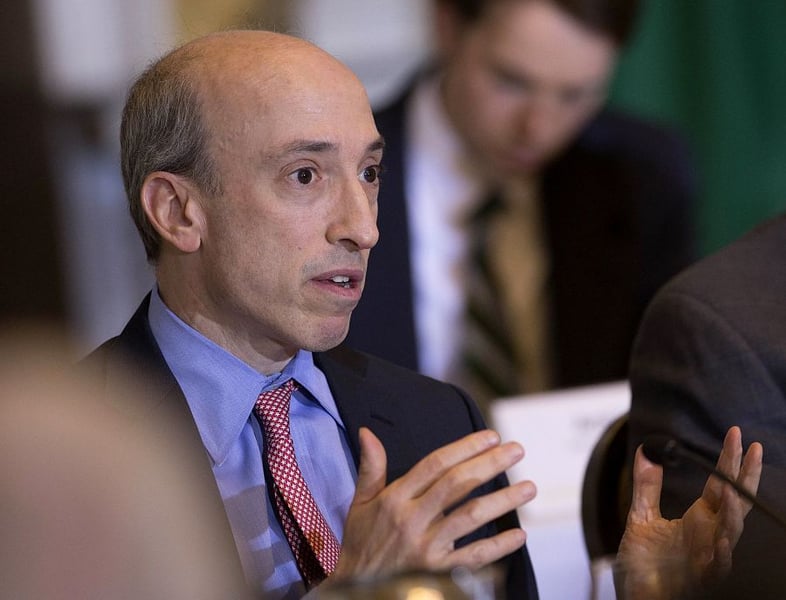
Securities and Exchange Commission Chairman Gary Gensler defended the agency’s use of tight deadlines for public input on rulemaking proposals in remarks before a group of financial industry representatives who want more time.
Gensler acknowledged that the agency has mostly used 30- to 45-day comment periods. He said doing so is in line with a congressional mandate in the Administrative Procedure Act.
“Congress is pretty straightforward,” Gensler said in an online appearance before the Exchequer Club of Washington, D.C. “They say 30 days.”
The club is made up mostly of professionals from trade associations and law firms who represent the financial industry. During the moderated Q&A portion of the event, Tom Quaadman, an executive vice president at the U.S. Chamber of Commerce, asked Gensler about comment deadlines, noting that in the Obama administration, comment periods usually lasted at least 60 days.
Quaadman’s query implied that 30 days is too short, an argument also made by the top-ranking Republicans on the House Financial Services Committee and Senate Banking Committee in a Jan. 10 letter to Gensler.
The SEC is pursuing a lengthy agenda of regulatory items. Gensler said the agency had to maintain a good pace in the rulemaking process, which includes staff reviews of comments to determine whether to modify a proposal.
“It’s really important to get the public feedback, but it’s also really important to move on,” Gensler said. “It’s a discipline to start the next stage of the work.”
The agency is transparent about proposals, Gensler said. He pointed out that the commission must approve the release of proposals, which are then posted on the SEC’s website and published within a couple of weeks in the Federal Register.
Gensler encouraged the audience to weigh in on proposals.
“We might not always go in the direction that you or your clients want, in fact, because our client is the American public,” Gensler said. “We know that there’ll be the give-and-take. We learn from your economic analysis. We learn from your point of view. We learn from your comments, even if we go in a different direction.”
Gensler did not give any clues about the timeline for some major rule proposals, including those having to do with climate risk and other environmental, social and governance disclosures for public companies.
“Staff is working hard on proposals,” Gensler said in his opening remarks. “When they and my fellow Commissioners think they’re ready, we’ll put them out for public comment and, when appropriate, finalize items. The process is intentionally flexible; it’s about getting proposals right, based upon the economic analysis and our legal authorities, and learning from public feedback.”

Eric J. Stone was fired by Fidelity in 2021 after facing claims he took loans from clients.

Chicago-based Curi Capital gets new majority owner as $14 billion RIA eyes acquisitions and expanded family office services

Partnership pairs organic lead detection with paid ad targeting to help end "spray-and-pray" marketing for growth-seeking advisory firms.

Jonathan Lewis joins the wealth management giant as it proceeds with a $2 billion AI and technology push for advisors.

Once focused on retirees, pre-retirees and risk-conscious investors, the category has widened into a wider toolkit to help reassure clients in choppy markets.
Northern Trust’s Ken Lassner shows advisors how to convert volatility into after-tax portfolio gains
Dan Biagini of American Equity says the steady decline of pensions, longer lifespans and a reset in interest rates are rewriting how advisors build retirement income

