

Global bonds are closing in on their worst month on record as investors brace for a flurry of rate hikes in the coming week, including the most aggressive U.S. tightening since May 2000.
The Bloomberg Global-Aggregate Total Return Index has lost 4.9% in April, putting it on track for the biggest monthly drop since its inception in 1990. Australia’s three-year yields climbed as much as seven basis points to 2.74%.
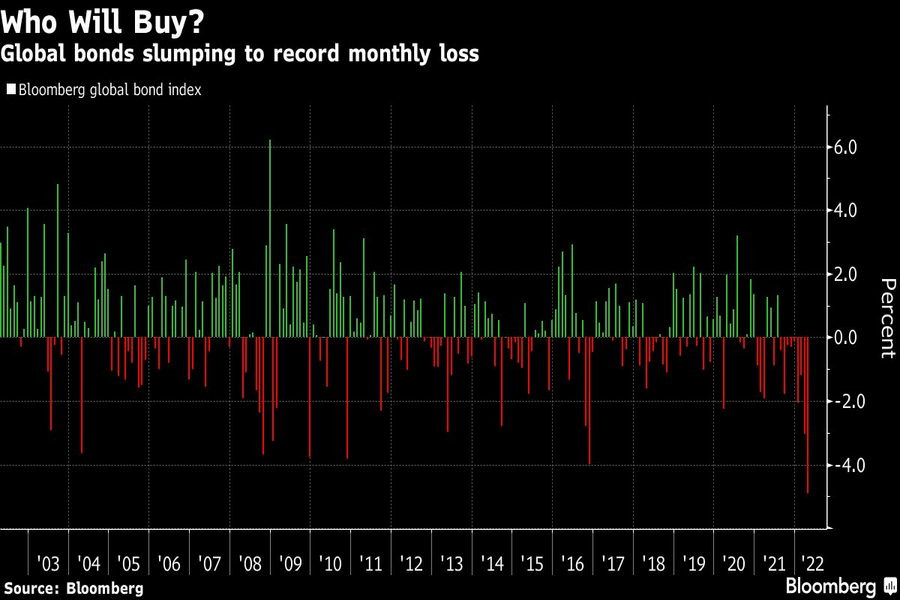
Fears of quickening inflation have torpedoed bonds worldwide, with a cut in Russian gas supply to Poland and Bulgaria and a red-hot Australian inflation print fueling expectations that the rout may continue. Swap traders are pricing in a half-point rate increase by the Federal Reserve on May 4 and also see the Reserve Bank of Australia and Bank of England raising borrowing costs next week.
“Until Fed pricing has run its course and stabilizes, global yields can rise further,” said Imre Speizer, a strategist at Westpac Banking Corp. in Auckland. “Investors will be reluctant buyers of bonds as long as Fed rate pricing keeps moving higher, or until they are more confident about pricing an eventual economic slowdown.”
Volatility in fixed-income markets is likely to remain elevated, as investors weigh the possibility that aggressive tightening by major central banks may derail global growth.
In the corporate debt universe, high-grade notes have lost 5.3% so far this month, according to a Bloomberg multi-currency global benchmark, putting it on track for their biggest monthly slump since March 2020 when the pandemic rocked financial markets.
Credit is especially vulnerable to the increasing stagflation risks generated by war in Ukraine and China’s Covid-driven woes. That’s because not only can inflation decimate investor returns, but a slumping economy also increases default risks for weaker borrowers.
“Stagflation remains our base case for the rest of the year as recession risk is increasing in Europe and central banks remaining committed to their course of policy normalization against the backdrop of very high inflation,” said Salman Ahmed, global head of macro and strategic asset allocation at Fidelity International.

Siddharth Jawahar was sentenced 11 years in prison and $31M in restitution for running Swiftarc Capital fraud scheme

Wall Street banks expand wealth services as ultra-high-net-worth client demands extend further above and beyond investment management.

The acquisition of $2 billion Gilbert & Cook extends a buying spree for the ultra-high-net-worth firm that has already touched six states this year.

After years of encouraging sacrifice and delayed gratification, advisors have to do the next emotional lift: helping clients let go of a potentially harmful scarcity mindset.

A new JPMorganChase Institute report reveals how deeply stock market wealth now drives everyday American spending, especially for retirees.
Northern Trust’s Ken Lassner shows advisors how to convert volatility into after-tax portfolio gains
Dan Biagini of American Equity says the steady decline of pensions, longer lifespans and a reset in interest rates are rewriting how advisors build retirement income

