

Now that futures have cracked $1,800 an ounce, the global gold market wants to know what the Federal Reserve may do next to rescue the U.S. economy, with minutes due Wednesday that are expected to shed light on the central bank’s willingness to embrace yield curve control.
Gold futures eased after reaching the highest level in more than eight years, with a focus on the central bank release and warnings about the coronavirus pandemic. Pinning U.S. yields down -- if that's adopted -- may aid bullion’s allure.
Fed Chair Jerome Powell stressed Tuesday that getting the virus under control was vital, while disease expert Anthony Fauci said new U.S. cases could spike.
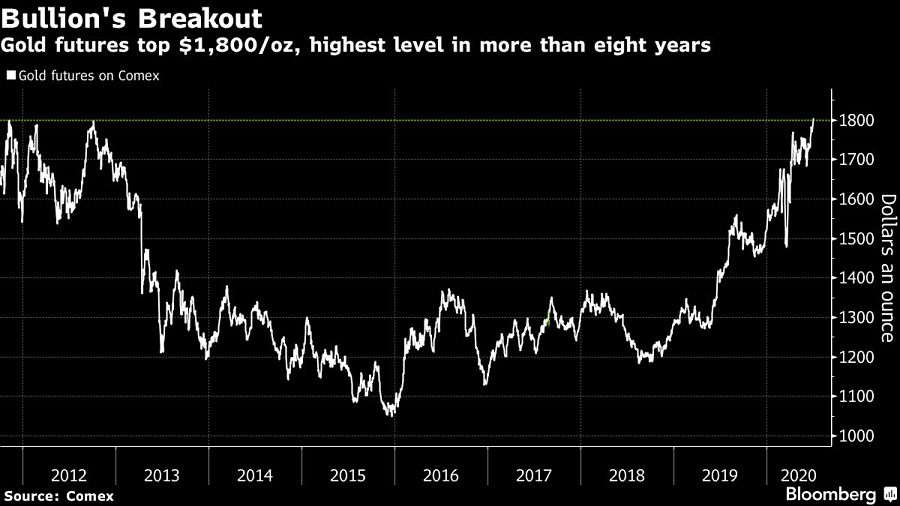
Gold’s ascent this year has been underpinned by aggressive central bank action to counter the pandemic’s economic fallout, with U.S. real interest rates already negative. The minutes of the Fed’s June 10 meeting may add detail on policy makers’ view on curve control, a strategy that involves using bond purchases to cap yields on certain maturities at a specific level.
If “the prospect of YCC draws closer and further green lights the hunt for yield,” gold will benefit, Eleanor Creagh, a market strategist at Saxo Capital Markets, said in a note. “Alongside the hedge against debt monetization and central bank largesse is also the added kickers of persistent virus uncertainties and geopolitical tensions, which continue to fuel upside momentum in gold.”
A retest of gold’s record high could happen before year-end, Creagh said.
Comex gold futures reached the highest since 2011, before easing to trade 0.3% lower at $1,795.30 by 7:08 a.m. in New York. Prices rose 13% in the three months through June to cap seven quarters of gains. Spot gold was steady at $1,782.04 an ounce.
Ahead of the minutes, bets that the Fed will implement curve control are showing up in the Treasury market. Among the signs, yields on five-year notes sank to a record low Tuesday.
“Yield curve control may be implemented in order to control or influence the yield and overall interest costs to the U.S. Treasury of future bond issuance,” said Peter Grosskopf, chief executive at Sprott Inc. “This is becoming increasingly important as deficits skyrocket.”
Just over half of the economists surveyed by Bloomberg said they anticipate the Fed will eventually set target yields for certain maturities of Treasury securities, with most saying an announcement could come in September. Should curve control go global, it could spark a “buy everything” rally that ripples across credit, equities, gold and emerging markets.
Still, Sprott’s Grosskopf said control of yields in effect may be here already. With Treasury markets so controlled by the Fed, market-based price discovery has been “crowded out” by U.S. central bank buying, he said.
“Bonds offer almost no real yield and have therefore become cash-parking assets,” Grosskopf said. “In this situation, gold becomes a much more attractive asset as a hedge to other markets and store of purchasing power.”

The financial advice industry has been facing inquiries into its cash sweep programs for years now.

Investor money allegedly went to strip clubs, exotic cars, and landscaping

Procyon adds $415 million in assets under management in New Jersey while Savant picks up a $213 million Southern California planning firm

With a growing number of real estate-rich Baby Boomers aging into retirement, some advisors may be failing to consider all the options available for those clients' assets.

Cornerstone Advisors study reveals compliance bottlenecks stall campaigns weeks after customer opportunities close.
As AI makes financial information more accessible than ever, Lana Hock explains why human judgment, trust, and empathy remain the qualities clients value most in a financial advisor
Northern Trust’s Ken Lassner shows advisors how to convert volatility into after-tax portfolio gains

