
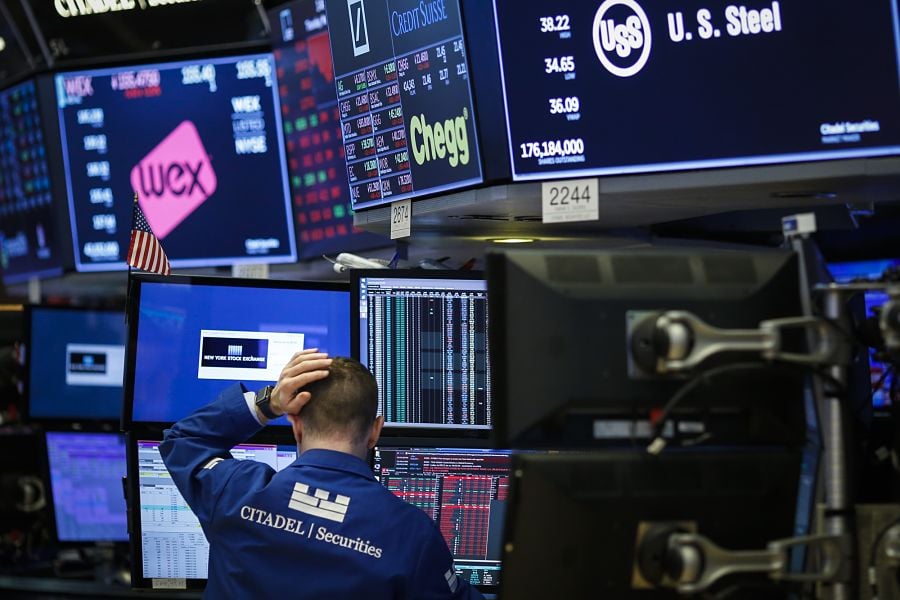
For investors asking whether Friday’s stock rally marked the bottom of the current rout, Goldman Sachs Group has an unpleasant answer: not yet.
The investment bank’s U.S. chief equity strategist, David Kostin, says the S&P 500 will likely head back down by almost 10% in the next three months to 2,450. And if the economic fallout from the spreading coronavirus deepens, the rout can take stocks down another 26% from Friday’s close to 2,000. That’s 20% lower than the bottom he called just last week.
As of 10:48 a.m. in New York, the S&P 500 was down just over 7% at 2,519.
Mr. Kostin warned that the spreading coronavirus will damage profits and harm the economy to an unpredictable extent as governments scramble to contain the outbreak and companies face forced interruptions to their businesses.
“The coronavirus has created unprecedented financial and societal disruption,” he wrote in a note to clients. “The combination of thin liquidity, high uncertainty, and positioning could cause the S&P 500 to fall below our 2,450 base case estimate of fair value and closer to a trough of 2,000.”
U.S. stocks plunged as much as 27% last week, ending the longest bull market on record as investors grew worried the Trump administration wasn’t doing enough to stave off the economic effects of the coronavirus. Stocks staged a furious rally in the final half hour of the week during a press conference where the president declared a national emergency and announced plans to provide broad financial stimulus.
Even after the rally, the S&P 500 ended the week lower by 8.8% and down 20% from its record. For Mr. Kostin’s call to come true, the rout from the Feb. 19 high record would swell to 41% and wipe out all the gains booked during Donald Trump’s presidency. The measure last touched that level in June 2016, following the first Brexit vote.
The strategist said second-quarter earnings per share could plunge 15% from the prior year as companies deal with the fallout from the rapidly spreading coronavirus. Nike Inc. said Sunday it will close all stores in North America and Western Europe, following Apple’s announcement Saturday that it’s closing all stores outside China until March 27.
Mr. Kostin did deliver a measure of hope, reiterating his stance that V-shaped recoveries in stocks usually follow “event-driven” bear markets. He expects the S&P 500 to end 2020 at 3,200 -- a 60% rally from 2,000.
“The lesson of prior event-driven bear markets is that financial devastation ultimately allows a new bull market to be born,” he writes.
A six-month surge of that magnitude has happened only once before. The index almost doubled in the 126 sessions ending Aug. 25, 1933, as the U.S. attempted to climb out of the Great Depression. The global financial crisis also gave way to a furious half-year rebound that took the S&P 500 higher by 51% through Aug. 28, 2009.
Mr. Kostin arrived at his dire forecast for the coming few months by using a combination of the Fed model, which compares the price yield on equities with the 10-year Treasury rate; the dividend discount model that values stocks on expected cash payouts; and the history of declines associated with the two most recent recessions.

Wealth Consulting Group, Coastline and Maridea report fresh capital, acquisitions and asset growth as advisor M&A keeps climbing

Carson Group's Dani Fava, Jason Pereira of Woodgate Financial, and Sally George of Convergency Partners led the raise as the growth-tech startup builds out its AI platform and leadership bench.

New teams from William Blair, Ameriprise and UBS bring more than $560 million in combined client assets to the firm's employee and independent channels.

Regulators this year approved UBS Bank USA’s conversion to a nationally chartered bank.

How a subprime lender’s car-loan bonds allegedly unraveled before bankruptcy.
Northern Trust’s Ken Lassner shows advisors how to convert volatility into after-tax portfolio gains
Dan Biagini of American Equity says the steady decline of pensions, longer lifespans and a reset in interest rates are rewriting how advisors build retirement income

