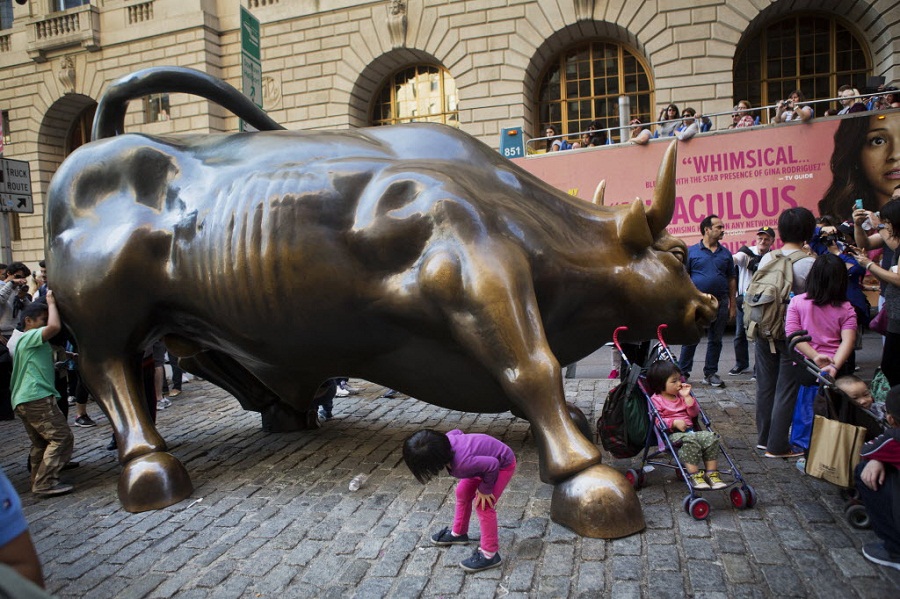
Wall Street has become the new Yellowstone: You can't turn a corner without running into a bear. But here at the 28th annual Morningstar Investment Conference, the Leuthold Group said one reliable long-term indicator has turned “wildly bullish.”
Some big names have been making gloomy moves recently. Legendary hedge-fund manager George Soros has been buying gold on worries about the United Kingdom's possible exit from the European Union. According to the perpetually gloomy Zero Hedge, hedge-fund managers
Carl Icahn and Paul Singer have also voiced concerns about the stock market. The so-called
"fear index" is also rising.
But Doug Ramsey, editor of the
Leuthold Group's highly respected Green Book, says the Very Long Term Momentum Indicator — also known as the Coppock Curve — is flashing a buy signal. The VLT is designed to show what the stock market looks like in people's minds, and was developed by Edwin “Sedge” Coppock, a quantitative technician with an unusual approach.
“He went to members of the clergy and asked about the nature of the human grieving cycle,” said Mr. Ramsey. “They said the worst was over by 11 to 14 months.” His Coppock Curve was designed to reflect a weighted rate of change over roughly that period. A buy signal means that the market is oversold over the long term, and that investors are more interested in future moves than grieving over past losses.
The VLT signal is interesting for two reasons: It doesn't flash often, and when it does, it tends to be a powerful one. “We've had 26 signals in 90 years, and the last one was in May 2009,” Mr. Ramsey said. “That worked out well, even though the market was up considerably by then.”
All other things being equal, the Coppock Curve signal should be wildly bullish. “Of course, all things are not equal,” Mr. Ramsey said. Stock valuations are much higher than they were in 2009 — and, in fact, one of the few times the signal failed was in December 2001, when valuations were even higher. The trailing 12-month price-to-earnings ratio of the Standard and Poor's 500 stock index is 24.3 times earnings, vs. a median of 16.4 since 1936.
Ramsey ran the VLT calculations on 115 industry sectors, and the 11 materials sectors were the most strongly oversold, he said. One reason for that has been the restraint in capital expenditures during this year: Companies have been reluctant to buy new machinery and equipment, or to build new factories. The most recent rise in materials prices signals that traditional late-cycle sectors — such as metals and mining — could have a ways to run.