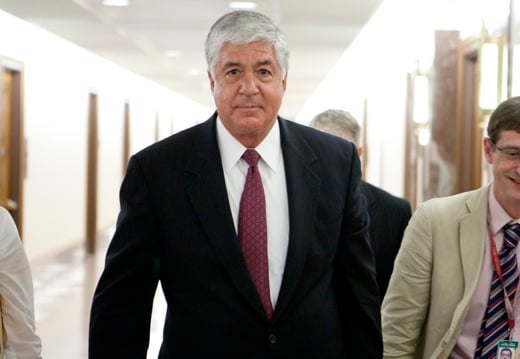
Robert Benmosche, the American International Group Inc. chief executive officer who clashed with Chairman Harvey Golub over the insurer's restructuring, may find less resistance after forcing Golub's departure.
Benmosche, 66, told the board of New York-based
AIG that his relationship with the chairman had become “ineffective and unsustainable,” Golub wrote in a resignation letter dated yesterday. Benmosche pushed for Golub's ouster after directors rebuffed a reduced takeover bid, endorsed by the CEO, for an Asia division, two people familiar with the matter said last month. Director Steve Miller replaced Golub, 71.
“It clears the deck” for Benmosche, said Gary Wolfer, senior vice president and chief economist at Univest Wealth Management & Trust Services, which owns bonds of
AIG subsidiaries. “He has a very strong personality and I think he feels he was in a tough spot. It's going to be the ‘Benmosche Show' going forward.”
Benmosche, who joined
AIG in 2009 weeks after Golub, must divest the Asia unit, AIA Group Ltd., and increase profits at remaining operations to repay the firm's $182.3 billion bailout.
AIG had planned an initial public offering of AIA until Benmosche struck a $35.5 billion deal with Prudential Plc. That agreement collapsed as the London-based insurer's investors balked at the price.
‘Responsibility to Lead'
“I'm resigning for the simple reason I believe it's easier to replace a chairman than a CEO,” Golub said in the letter to director George Miles. “Asking the board to choose between us would be an abdication of my responsibility to lead.”
Golub's resignation was announced yesterday during a board meeting, according to a person with knowledge of the event. The insurer is proceeding with a public offering of AIA, while remaining open to bids for all or part of the company, said another person with knowledge of the plans who declined to be identified because the meeting was private.
Benmosche demanded more control over AIA, including the ability to make top-level management changes, during the June 25 board meeting in which he threatened to quit unless Golub left, two people said. Benmosche pushed for the dismissal of AIA's chief, Mark Wilson, a proponent of the
IPO, according to one of the people. A spokeswoman for Hong Kong-based AIA didn't immediately return a call seeking comment.
Benmosche threatened to depart before. He said last year he may leave after Kenneth Feinberg, the Obama administration special master on compensation, slashed pay of top
AIG executives, impeding the CEO's ability to keep managers.
AIG has climbed about 38 percent through yesterday on the
New York Stock Exchange since Aug. 7, the last trading day before Benmosche replaced Edward Liddy as CEO.
Share Rally
That compares with the 34 percent decline under Liddy and the approximately 90 percent plunge under Robert Willumstad, who was ousted before he could unveil a plan to restructure
AIG. The Standard & Poor's 500 Index has advanced about 8.4 percent since Aug. 7. Benmosche is the longest-serving CEO since Martin Sullivan, who was forced out in 2008.
“Benmosche's done an excellent job of stewarding the company,” said Cliff Gallant, a KBW Inc. analyst with an “underperform” rating on
AIG shares. “He's very popular with the employees.”
Miller, 68, is
AIG's sixth chairman since 2005. He was CEO of auto-parts maker Delphi Corp. when it filed for bankruptcy protection in 2005 and is the ex-chief financial officer of Chrysler Corp. Miller joined
AIG's board last year.
The board improved
AIG “from a company being dissolved to one on the cusp of having an implementable strategy to pay back the government and stand on its own,” Golub, former CEO of credit-card lender American Express Co., said in his letter.
Bailed Out
AIG owes about $24 billion on a
Federal Reserve credit line and more than $49 billion to the Treasury Department. The company turned over a stake of almost 80 percent to the U.S. as part of its 2008 rescue.
The insurer, once the world's largest, is committed to “repaying taxpayers, meeting all of the company's obligations to its various stakeholders, and restructuring the company so that it emerges as a smaller, more focused enterprise,” Miller said yesterday in a statement.
The
Federal Reserve Bank of New York is “confident” in
AIG's management, the regulator said in a statement. Miller's experience will “serve both
AIG and the taxpayers very well,” Deputy Treasury Secretary Neal Wolin said in a separate statement. Miller was unavailable for comment,
AIG said.
Greenberg, Zarb, Willumstad
Maurice “Hank” Greenberg was chairman and CEO before stepping down in 2005 amid regulatory probes. Frank Zarb and then Robert Willumstad became chairman. Willumstad later became CEO too and was forced out of both jobs by the U.S. after
AIG agreed to the federal bailout in September 2008. Liddy held both jobs until August 2009.
Benmosche had told employees at an August 2009 meeting that he would focus on operations and asset sales while Golub would work with lawmakers.
Golub and Benmosche shared the belief that federal limits on executive pay were hindering the company's recovery. Golub wrote to shareholders in a Feb. 26 letter that Obama administration restrictions make “little business sense.”
The board was expanded to 13 members in April when the Treasury picked Donald H. Layton and Ronald A. Rittenmeyer. Treasury was allowed to add directors after
AIG skipped
dividend payments on the government's holdings for four quarters.
“The workload required of the board is as high as I've ever seen in any company, and is likely to continue for some time,” Golub said in the letter to shareholders.