
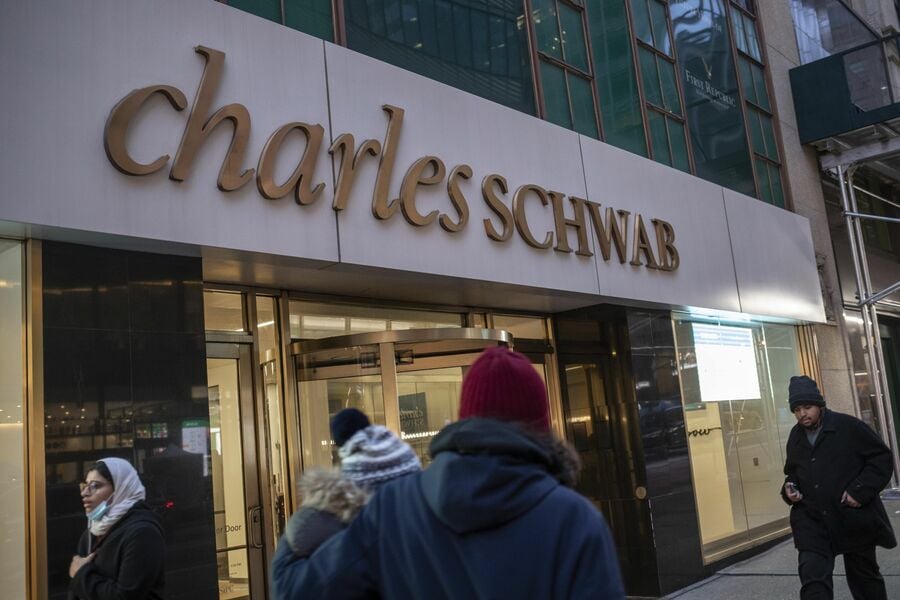
Schwab Asset Management is making an aggressive attempt to offer some of the cheapest bond exchange-traded funds on the market.
The asset manager announced Monday that it will cut fees on the $50 million Schwab High Yield Bond ETF (SCYB) and the $11.6 billion Schwab U.S. TIPS ETF (SCHP) to just 3 basis points, bringing all nine of its fixed-income funds below that threshold, according to a press release. The average expense ratio among the 633 U.S.-listed bond ETFs is about 35 basis points, Bloomberg data show.
Schwab’s move is the latest in a series of tiny fee cuts as issuers fight for space in the increasingly saturated $7.2 trillion ETF industry. Schwab has been among the most active, joining the likes of BlackRock Inc., Vanguard Group Inc. and State Street Global Advisors in trimming expense ratios by just a couple of basis points over the past few years.
While such reductions may seem small, they can translate into millions of dollars’ worth of inflows. It’s likely that Schwab sees rock-bottom fees as a worthwhile trade-off en route to asset growth, Bloomberg Intelligence’s James Seyffart said.
“Even at three basis points, they are probably operating essentially at cost, or possible below, I would think. My guess is that it would take immense scale — tens of billions of dollars — to not be operating at about cost,” Seyffart said. “This is definitely a splash to get more assets and we know for a fact that assets will flow based on just a one-basis-point cut.”
That logic was on display when State Street halved the fee on its $2 billion SPDR Portfolio High Yield Bond ETF (SPHY) to 5 basis points last month, which brought in more than $600 million worth of inflows in August — its biggest monthly haul on record.
While SPHY was momentarily the cheapest junk-bond ETF on the market, the recently launched SCYB reclaims that title with Schwab’s latest cuts.
The firm is focusing on building out its fixed-income ETF suite as the Federal Reserve’s rate hiking campaign boosts yields to cycle highs, according to Monday’s press release.
“Fixed income has been in the spotlight for investors in a higher interest rate environment,” said Nicohl Bogan, director of product strategy and development at Schwab Asset Management. “We have seized the opportunity to expand our fixed-income offerings, recently launching high-yield and municipal bond ETFs, while also helping investors save on fees.”

Iowa's Greenwood Wealth Partners exits D.M. Kelly as UBS and Ameriprise win Merrill Lynch recruits in California and Florida

Less than 1% of pool funds went to actual trading, CFTC says

Plus, SEIA builds a governed data foundation for its in-house AI and Snappy Kraken debuts a read-only marketing coworker for advisors.

He owes $364 million but pays $100 a month

Broadridge, Wedbush and Alaris Acquisitions have also filled senior wealth management roles with hires from J.P. Morgan, Osaic and SageView.
As AI makes financial information more accessible than ever, Lana Hock explains why human judgment, trust, and empathy remain the qualities clients value most in a financial advisor
Northern Trust’s Ken Lassner shows advisors how to convert volatility into after-tax portfolio gains

