

BlackRock Inc.’s climate pledge is already paying off.
An exchange-traded fund from the New York-based money manager has attracted more than $600 million this week, despite only starting trading on Friday, data compiled by Bloomberg show. That’s the best debut for any U.S. ETF this year, and a sign BlackRock isn’t the only one that sees climate change as a defining factor in companies’ long-term prospects.
Investing in companies that care about environmental, social and governance issues is finally catching on after years of sluggish growth. While only a small drop in the $4.5 trillion U.S. ETF market, sustainable funds added more than $8 billion in 2019 and their assets recently topped $20 billion. BlackRock runs multiple funds that stand to benefit from this shift, and has said that it will look to double its sustainable ETF offerings to 150.
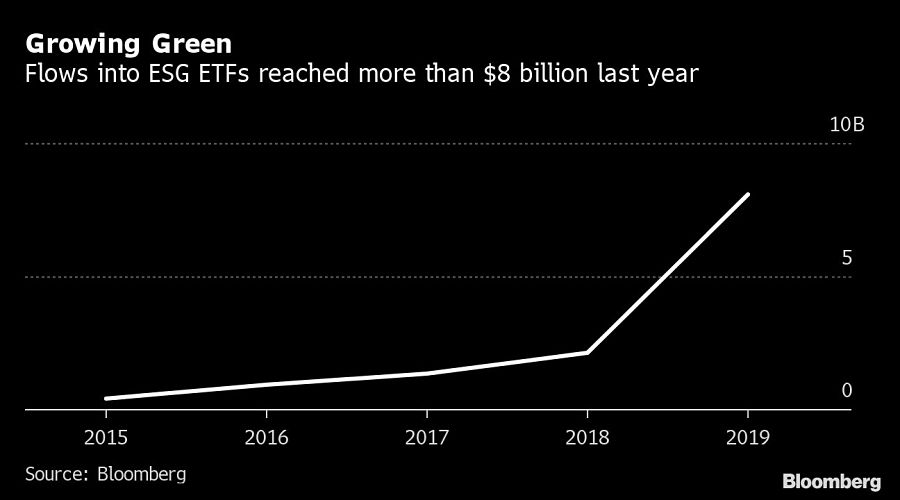
“This is likely just the beginning of the wave of money going into ESG ETFs,” said Todd Rosenbluth, CFRA Research’s New York-based director of ETF research. “It will become more mainstream, and as these products gain scale, they’ll hit the radar for the wealth management market.”
In a press release Wednesday, BlackRock said Finnish pension insurer Ilmarinen had invested $600 million Tuesday in the fund, the iShares ESG MSCI EM Leaders ETF (LDEM).
Ilmarinen had poured cash into two similar ETFs shortly after they began trading last year. As of Sept. 30, the Helsinki-based company had more than $3 billion invested across the iShares ESG MSCI USA Leaders ETF and the Xtrackers MSCI USA ESG Leaders Equity ETF, data compiled by Bloomberg show.
LDEM tracks the MSCI EM Extended ESG Leaders 5% Issuer Capped Index, which contains large and mid-cap emerging-market stocks that meet high ESG credentials.
It’s not the only new ESG fund this year. Last week, Direxion started an ETF that allows investors to bet against companies that score low on certain ESG criteria. The strategy shorts the worst offenders, while upping its exposure to those with the best ratings.

The campaign spans broadcast TV and streaming, as the brokerage faces slowing client net flows and an $8.1 billion advisor team that left to launch an RIA this month.

A Michigan Democrat's proposal to lower the retirement age adds a new variable to claiming strategies for clients in manual trades.

The US accounted for nearly half of all new millionaires worldwide last year, but insurance specialists warn wealth growth is outpacing planning.

Merrill and Wells Fargo Advisors also made additions to expand their presence in Florida and Michigan.

Beemo's agents will draft client proposals and surface custodial data from Schwab for Choreo's 120-plus advisors across 21 states
As AI makes financial information more accessible than ever, Lana Hock explains why human judgment, trust, and empathy remain the qualities clients value most in a financial advisor
Northern Trust’s Ken Lassner shows advisors how to convert volatility into after-tax portfolio gains

