BlackRock takes lead in battle of lower-fee ETFs, but winning hurts

BlackRock takes lead in battle of lower-fee ETFs, but winning hurts
Defections and cannibalization are growing risks for fund issuers.
MAY 03, 2019

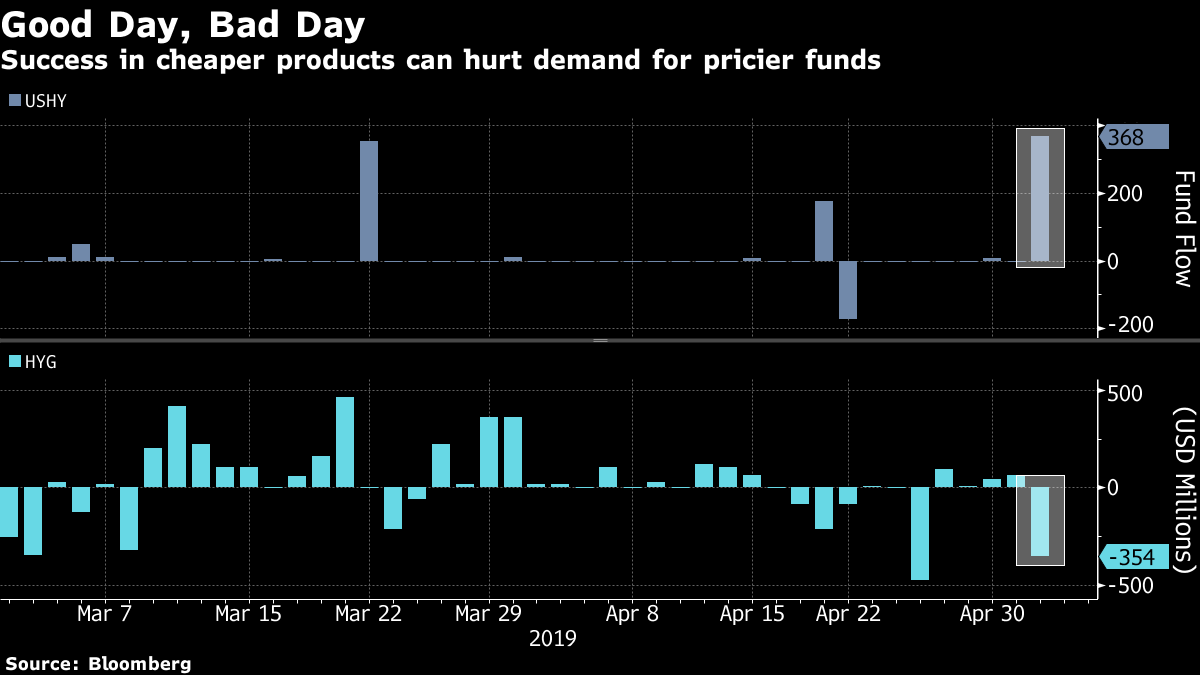
BlackRock Inc., the world's largest issuer of exchange-traded funds, is winning a battle to attract investors with lower fees, even as success takes its toll. The iShares Broad USD High Yield Corporate Bond ETF, ticker USHY, added a record $368 million Thursday, after discreetly slashing its fee in March. BlackRock's move came after State Street Corp. lowered the price of one of its junk funds, and was followed by Deutsche Bank AG's DWS Group two weeks later. USHY is the only one of the three funds — which now all charge $1.50 for every $1,000 invested — to add more than $50 million since the fee cuts, data compiled by Bloomberg show. Asset managers are reluctantly accepting lower revenue in exchange for market share as investors seek out the cheapest products. More expensive junk funds run by BlackRock and State Street lost money to withdrawals this week. (More:Blackrock exposed data on 12,000 financial advisers) "This is being driven by the fee compression," said Todd Rosenbluth, the director of ETF research at CFRA. "You get a snowball effect when there's money moving into the newer high-yield bond ETFs. It can generate greater interest from other investors because they see the trades were executed in a favorable manner and ask 'Why can't I do that too and pay less money?'" State Street's larger, pricier fund — the SPDR Bloomberg Barclays High Yield Bond ETF, known as JNK — saw almost 10 million shares worth about $356 million trade at 11:45 a.m. on Wednesday; less than one minute later, USHY printed a large buy order. Defections and cannibalization are growing risks for fund issuers. BlackRock steered into that trend in 2012 when it started a range of cheap "core" funds for buy-and-hold investors, while encouraging active traders to use more established (and liquid) funds that cost more. Some of those low-fee products are now surpassing their pricier siblings. USHY still has a long way to go in that respect. The fund manages $1.2 billion, about 8%of the assets overseen by the iShares iBoxx High Yield Corporate Bond ETF. That fund, which is known as HYG and costs over three times more, saw $354 million pulled on Thursday. (More: BlackRock pivoting to technology could serve as blueprint for other asset managers) "While we expect HYG will remain the vehicle of choice for professional traders and other investors, USHY is ushering in a new generation of bond ETFs that investors can also use in a variety of ways," said Melissa Garville, a spokeswoman for BlackRock.

Latest News

Federal judge dismisses Eltek manipulation lawsuit against Morgan Stanley Smith Barney

Nine-month electronic trading freeze and share lending program at the center of dismissed claim.

RIA wrap: Dynamic strikes South Carolina deal to reach $7B AUM milestone

Meanwhile, Rossby Financial's leadership buildout rolls on with a new COO appointment as Balefire Wealth welcomes a distinguished retirement specialist to its national network.

Rethinking diversification amid a concentrated S&P 500

With a smaller group of companies driving stock market performance, advisors must work more intentionally to manage concentration risks within client portfolios.

Merrill pays second settlement to former Miami Dolphins player, client of ex-broker

Professional athletes are often targets of scam artists and are particularly vulnerable to fraud.

Schwab touts AI as its biggest growth lever at investor day

The brokerage giant tells Wall Street it will use artificial intelligence to reach clients it has never been able to serve — and turn the technology's perceived threat into a competitive edge.

SPONSORED Beyond wealth management: Why the future of advice is becoming more human

As technical expertise becomes increasingly commoditized, advisors who can integrate strategy, relationships, and specialized expertise into a cohesive client experience will define the next era of wealth management

SPONSORED Durability over scale: What actually defines a great advisory firm

Growth may get the headlines, but in my experience, longevity is earned through structure, culture, and discipline


