

Wall Street firms are entering the world of exchange-traded funds like never before.
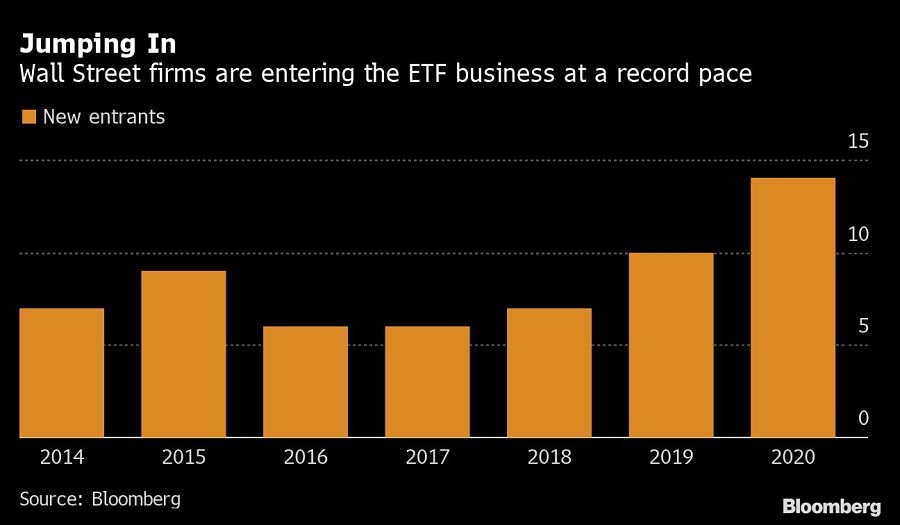
Despite a pandemic that’s ravaged global economies, a contentious presidential election and unprecedented stock volatility, a record 14 new issuers entered the ETF market this year, according to data compiled by Bloomberg Intelligence. That compares with 10 entrants in 2019 and seven in 2018.
Thank two big changes in the $5.2 trillion industry for the bump: new rules that made launches easier and the approval of a breed of funds that partially conceal their holdings -- luring active managers who like to keep their strategies under wraps.
“Eventually, every asset manager will probably have an ETF product,” said Elya Schwartzman, who spent nearly a decade at BlackRock Inc. before founding ES Investment Consulting. “There are very few out there that don’t have ETFs at least under their umbrella.”
Among the most dramatic new entrants was Dimensional Fund Advisors, which recently launched two actively managed products -- one focused on U.S. equities and the other tracking international stocks. Both have outpaced the S&P 500 since their debut last month. It was just the first step in the $527 billion manager’s plans to convert six of its tax-managed mutual funds into ETFs, for a total of nine offerings.
T. Rowe Price Group Inc. released four funds that only report their holdings once every quarter, in contrast to the daily disclosure of traditional ETFs. Bank of New York Mellon Corp. joined the industry, with the first ever no-fee U.S. fixed-income fund -- BNY Mellon Core Bond ETF, or BKAG. Leuthold Group, Fisher Investments Inc. and Tactical Fund Advisors also entered the market this year.
For Michael Winter, founder of Leatherback Asset Management, the ETF rule “put a light bulb on.” In November, his firm released the Leatherback Long/Short Alternative Yield ETF (LBAY), an actively managed fund that holds long positions in equities and other securities to seek attractive yields.
“It’s been mostly passive ETFs for years and years and years, and then active started trickling out,” Winter said. “Leatherback’s mission is to be that premier provider of active alternatives in the most optimal wrapper -- the ETF wrapper.”
Debuts from Wells Fargo & Co. and Federated Investors will potentially come to market in 2021, according to regulatory filings and company statements.
“We expect to see, now that we have more of a level playing field and fewer barriers to entry, increased interest in ETFs coming out,” said Sal Bruno, chief investment officer of IndexIQ.

Goldman Sachs retirement survey finds 83% want guaranteed income, while the annuities providing that income increasingly hold private credit.

The AI meeting assistant's Advisor Intelligence plugin turns client conversation data into annual reviews, tax scans and attrition alerts.

Chuck Roberts and Stifel have been facing scrutiny due to sales of structured products and structured notes.

Among other updates, the proposals would let advisors to regulated funds earn performance fees and allow interval funds to offer monthly repurchases.

What will financial advice look like 20 years from now? Evan Vladem explores how AI may transform wealth management while reinforcing the enduring value of human guidance, trust, and empathy.
As AI makes financial information more accessible than ever, Lana Hock explains why human judgment, trust, and empathy remain the qualities clients value most in a financial advisor
Northern Trust’s Ken Lassner shows advisors how to convert volatility into after-tax portfolio gains

