

A parade of money managers who converted mutual funds into exchange-traded funds in a bid to ride rampant demand for the newer, easier-to-trade structures are discovering it may not be so simple to tap the ETF boom.
More than one-third of converted funds have posted net outflows since they made the switch, according to data compiled by Bloomberg, while 61% have attracted less than $10 million each. In fact, only quant giant Dimensional Fund Advisors’ funds have seen significant positive net flows since converting. Even JPMorgan Asset Management, whose overall ETF business is booming, saw net outflows for its converted funds.
The underwhelming results put a damper on the accelerating mutual fund-to-ETF conversion trend as issuers try to recapture the attention of investors who have been spurning old-school mutual funds at a record clip and pouring money into tax-friendly ETFs.
“Just because you convert doesn’t mean the flows are going to come in,” said Eric Balchunas, senior ETF analyst at Bloomberg Intelligence. “The dog has to want the food in the bowl. If it’s a bad strategy, it won’t sell no matter what bowl it’s in.”
By converting an existing fund, issuers hope to bring an established track record and assets to the ETF market, giving each strategy a head start. They also aim to forestall investors from exiting the mutual fund.
That approach so far appears to be working for Dimensional. Its seven converted funds drew in a total $9 billion last year, helping the firm’s full lineup of 30 ETFs pull in roughly $25 billion total.
But the overall net inflows from newly converted funds demonstrates that success isn’t a given. Funds of all the other issuers combined saw a net outflow of $700 million last year.
Given the market volatility, the outflows across 32 ETFs with $9.9 billion in assets isn’t a disaster. Investors pulled $1 trillion from mutual funds last year, while adding $628 billion to ETFs, according to data compiled by Bloomberg Intelligence.
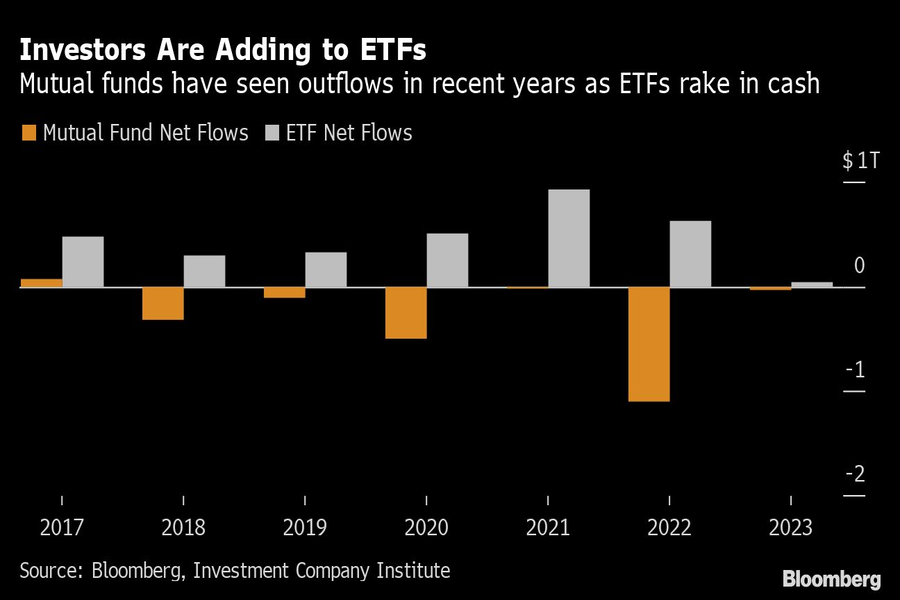
Due to this migration, issuers will keep the conversions coming. Bloomberg Intelligence estimates that about $1 trillion worth of mutual fund assets could be converted into ETFs over the next 10 years.
“You have to do something,” said Balchunas. “The ETF market is simply where the fish are biting. It’s the preferred vehicle of the vast majority of advisors and even investors at large.”
It’s still early days in the era of mutual fund-to-ETF conversions. The first ever switch of a U.S. mutual fund to an ETF took place almost two years ago, and there have been 39 conversions since then of assets worth roughly $67 billion, according to Bloomberg data. Fidelity and Neuberger Berman are among asset managers to reinvent products.
And a fresh catalyst for conversions may be on the horizon. A November Securities and Exchange Commission proposal may increase costs for some mutual funds, and in some cases cause issuers to consider converting funds to ETFs, according to Bloomberg Intelligence.
Yet, there remain headwinds for many fund issuers exploring a conversion. One is the entrenched position of mutual funds in the American retirement system, where their stability and fractional share trading are more valuable than their ETF counterparts.
“Mutual funds work really well in certain channels where ETFs may not work as well, such as in the 401(k) market,” said Deborah Fuhr, co-founder of ETFGI, adding that as money managers defend their profitable mutual fund businesses there’s not a lot of incentive for them to push ETFs in the 401(k) system.
A mutual fund may often have different share classes — for institutions, for pensions, for retail investors — with varying fees. That makes it more complicated to switch to an ETF, which has one share class.
“That’s why the conversion, while certainly a trend to watch, isn’t necessarily going to accelerate as quickly as some of the industry might expect,” said Holly Framsted, head of ETFs at Capital Group.

Goldman Sachs retirement survey finds 83% want guaranteed income, while the annuities providing that income increasingly hold private credit.

The AI meeting assistant's Advisor Intelligence plugin turns client conversation data into annual reviews, tax scans and attrition alerts.

Chuck Roberts and Stifel have been facing scrutiny due to sales of structured products and structured notes.

Among other updates, the proposals would let advisors to regulated funds earn performance fees and allow interval funds to offer monthly repurchases.

What will financial advice look like 20 years from now? Evan Vladem explores how AI may transform wealth management while reinforcing the enduring value of human guidance, trust, and empathy.
As AI makes financial information more accessible than ever, Lana Hock explains why human judgment, trust, and empathy remain the qualities clients value most in a financial advisor
Northern Trust’s Ken Lassner shows advisors how to convert volatility into after-tax portfolio gains

