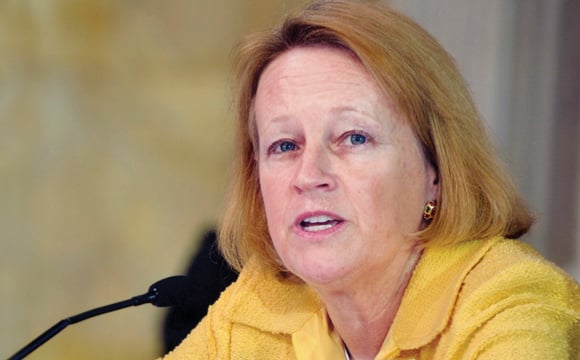
Securities and Exchange Commissioner Mary Schaprio on Friday showed no sign of backing down from her stance that the money market fund industry needs additional reform.. And she stood her ground at gathering of fund firms, no less.
“We have a legitimate concern over the risks posed by stable net asset values and it's not hypothetical,” Ms. Schapiro told a packed room of more than 1,500 attendees of the Investment Company Institute's General Membership Meeting in Washington. “We saw what happened in 2008. It had a profound affect on broker-dealers and financial advisers.”
Ms. Schapiro was referring to the infamous “breaking of the buck” by the Primary Reserve Fund in September 2008. The fund's holding of Lehman Brothers short-term debt as the bank collapsed caused its net asset value to fall below the coveted $1 share price and sparked a short-term run on money market funds. The
Federal Reserve and the Treasury Department stepped in as a result and guaranteed the $1 share price of money market funds.
“We know we don't have those tools anymore,” Ms. Schapiro said. “We have to step in and confront this head on.”
The mutual fund industry is resisting Ms. Schapiro's efforts to impose further regulation, arguing that it would hurt investors, impede financing for businesses and state and local governments and undermine the economic recovery.
Ms. Schapiro's speech on Friday appeared to do little to soften that resistance.
"The level of rhetoric was substantially diminished this time around, but it continues to be an ongoing issue," was all that Susan Wyderko, president of the Mutual Fund Directors Forum, would say about Ms. Schapiro's comments.
Karrie McMillan, general counsel for the ICI, was not available to comment on Ms. Schapiro's remarks
“I think the remarks Schapiro made stand on their own,” ICI spokeswoman Rachel McTague, wrote in an e-mail.
The two most popular potential solutions — depending on the audience, that is — are forcing money market funds to have a floating net asset value like other mutual funds or have a capital buffer in place to act as a backstop in case of any Lehman-like blow-ups.
Ms. Schapiro's comments suggest she favors the idea of floating NAVs.
“I want money market funds to be reflective of the fact that they are investment products and the value does fluctuate,” she said.
Still, she said that neither of those options are “set in ink” and won't be even if, or when, a formal proposal is put forward.
“We're always open to having discussions with the industry,” she said. “We're counting on the industry to engage constructively on solutions.”
The mutual fund industry has maintained that reforms enacted in 2010, which put restrictions on the length and quality of paper money market funds could invest in, among other things, were enough to shore up the funds.
“The reforms we put into place in 2010 were very positive and have worked well,” Ms. Schapiro said. “We still come in every morning when there's been a problem — like the sovereign debt crisis in Europe — and ask how are money market funds being affected?”
That question is one that keeps Ms. Schapiro up at night, she said.
“One of the things that happened after 2008, was commenters asking ‘where were the regulators?'” she said. “We can't sit by when we see systematic risks and not have a discussion about it. I see a problem, I think it's a threat to our system, I have to ask how we can try to fix it.”