

State Street Global Advisors is cutting fees on three corporate bond exchange-traded funds as it seeks to boost its share of the booming fixed-income ETF business.
The Boston-based issuer lowered the expense ratios to 0.04% from 0.07% for its short (SPSB), intermediate (SPIB) and long-term (SPLB) maturity focused corporate bond funds.
The reduction in fees is occurring as the use of such products is increasing among institutions, many of which have warmed to these types of ETFs following an embrace by the Federal Reserve, according to Bill Ahmuty, head of the SPDR fixed income group at State Street Global Advisors.
“A large catalyst coming out of the volatility of 2020 and Covid and this use of these funds in the Fed’s SMCCF program really helped as endorsements for fixed-income ETFs, and we continue to see an uptick in institutional usage, whether it’s insurance companies, asset managers,” and others, Ahmuty said in a phone interview, referring to the central bank’s Secondary Market Corporate Credit Facility, which was deployed to help support credit markets.
At one point last year, the Federal Reserve became one of the top holders in some of the world’s largest credit ETFs after it stepped into the market amid the coronavirus pandemic.
That’s helped push institutional players to see fixed-income ETFs as “a tool they can use,” Ahmuty said.
State Street’s move makes all three of those funds cheaper than similar products from competitors, including those from Vanguard, which charges 0.05% for its short (VCSH), intermediate (VCIT) and long-term (VCLT) corporate bond ETFs.
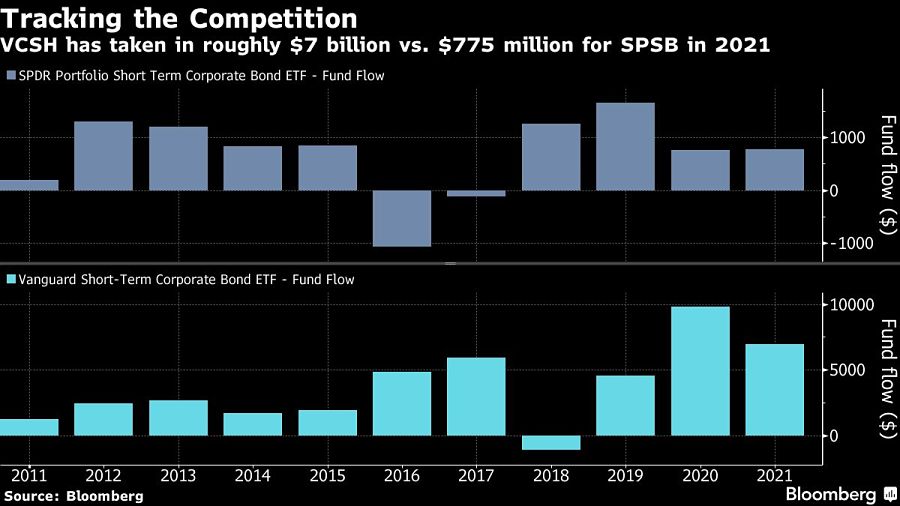
For comparison, VCSH has seen inflows of around $7 billion this year, data compiled by Bloomberg show, while State Street’s short-term product has taken in around $775 million in the same period. Investors have added almost $6.4 billion to Vanguard’s VCIT, while SPIB has seen an exodus of money so far in 2021.
That underscores how much more preferable one product can be over another in the eyes of large market participants. Ahmuty says State Street’s ETFs are now competitively priced and the company remains committed to reducing costs where possible.
As for the timing of the move, Ahmuty says that while equity markets are largely up this year, many fixed-income ETFs are lagging.
“So as we head into year-end, we see the opportunity for tax-loss harvesting with fixed-income ETFs,” he said. “A lot of folks always think of tax-loss harvesting as it relates to equity funds, but we see an opportunity here in fixed-income funds.”

Retiring RIA seller David Laidlaw alleges the Carnegie valued his stake on $11.7 million EBITA while pitching potential buyers on $21.3 million.

New tool gives RIAs and family offices AI help vetting private market deals, with some users reportedly halving review time.

Investors got projected returns dressed up as real ones, SEC says

Parents must still act to get the $1,000 federal seed and employer contributions, giving financial advisors a role in the rollout.

FINRA booted Rudy Anguiano from the industry for “conversion - the intentional and unauthorized taking of another person’s property.”
As AI makes financial information more accessible than ever, Lana Hock explains why human judgment, trust, and empathy remain the qualities clients value most in a financial advisor
Northern Trust’s Ken Lassner shows advisors how to convert volatility into after-tax portfolio gains

