

VanEck is breaking new ground in the nearly $80 billion municipal exchange-traded fund business with a product focused on sustainable investing.
Last Friday, the asset manager introduced an actively managed fund, the VanEck HIP Sustainable Muni ETF, which will focus on investments in projects that advance sustainability or those with “positive social, environmental and economic outcomes,” according to a statement from the company. It will trade under the ticker SMI.
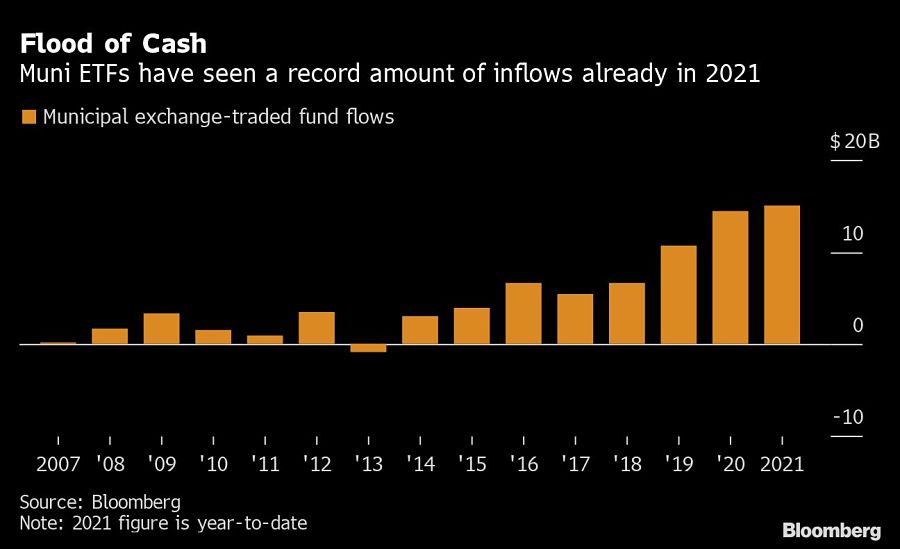
The fund will seize on growing demand for investments -- in both stocks and bonds -- that have a positive social or environmental impact. At the same time, municipal ETFs have lured a record amount of cash this year as investors seek out the tax-free securities to shield income from potentially higher levies under the Biden administration.
The fund, which will be managed by Jim Colby and Stephanie Wang, will add to VanEck’s existing muni ETF lineup, which has more than $7 billion under management. The company is partnering with research firm HIP Investor on the new product.
“Clients all across the board in every channel have been indicating interest in ESG broadly, but specifically an option they can use in an ETF format in this asset class,” Michael Cohick, senior ETF product manager at VanEck, said in an interview.
The fund enters a burgeoning corner of the fixed-income ETF industry focused on investments with a positive environmental or social impact. Last Thursday, Janus Henderson Group announced two sustainable ETFs dedicated to fixed income, buying corporate credit and other bonds. U.S. fixed-income ETFs that follow certain ESG criteria have amassed about $4.7 billion, according to Bloomberg Intelligence.
VanEck is using four different screening processes from HIP, which evaluates securities for their environmental and social impact, to determine whether debt is eligible for the fund. The filters take into account resilience to climate threats and proximity to opportunity zones that are typically home to lower-income and racially diverse populations, for example.
The fund, HIP Investor’s first co-branded ETF, uses a broad index with about 60,000 securities in it. After applying the four screens in early August, there were around 23,000 securities remaining, Cohick said. He noted the firm is seeking to construct a “highly sustainable” portfolio that maintains the yield and duration characteristics of the benchmark.
Initial holdings include debt of the state of Minnesota, which will likely become a “climate crisis destination” amid global warming, said R. Paul Herman, chief executive officer of HIP Investor. Another is a California school district that uses solar energy, which helps reduce energy costs and train students about taking climate action, he said.
The new ETF’s data-driven approach to bond picking will help make clear why securities are in the fund, Herman said.
“It can bring new transparency and accountability to the muni market,” he said.
Cohick said he expects the fund will gain traction with a variety of investors. The muni ETF industry is dominated by passively run products that follow an index, but more companies have launched actively run funds focused on state and local debt. This week, Pacific Investment Management Co. also introduced an actively managed muni ETF.
In its research, VanEck found that its new ETF strategy outperformed the two largest, passively run muni ETFs, Cohick said.
“We thought an active approach made sense for this fund, the novelness of it,” he said.
[More: Putnam launches its first ETFs]

Richardson firm joins as Kestra builds out its platform with new leadership, technology, and expanded planning tools.

Retiring RIA seller David Laidlaw alleges the Carnegie valued his stake on $11.7 million EBITA while pitching potential buyers on $21.3 million.

New tool gives RIAs and family offices AI help vetting private market deals, with some users reportedly halving review time.

Investors got projected returns dressed up as real ones, SEC says

Parents must still act to get the $1,000 federal seed and employer contributions, giving financial advisors a role in the rollout.
As AI makes financial information more accessible than ever, Lana Hock explains why human judgment, trust, and empathy remain the qualities clients value most in a financial advisor
Northern Trust’s Ken Lassner shows advisors how to convert volatility into after-tax portfolio gains

