
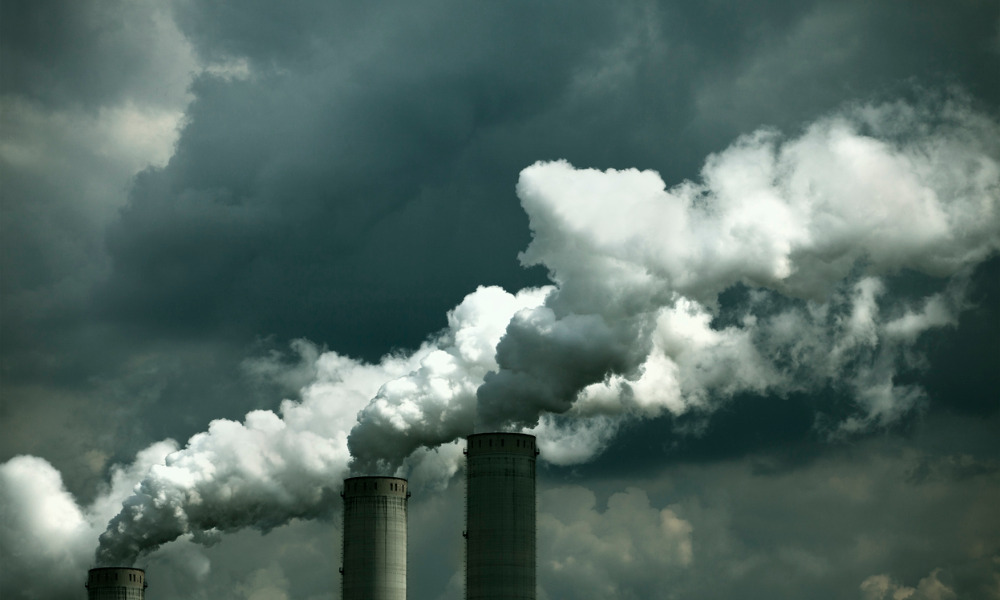
Much of the fossil fuel industry may be facing an era of credit downgrades if producers prove too slow to adapt to a low-carbon future, according to Fitch Ratings.
Oil and gas companies stand out as the most vulnerable issuers in an analysis by Fitch, which sought to gauge how businesses will cope with climate risks such as increasingly stringent emissions regulations.
Fitch’s models show that more than a fifth of global corporates across regions and sectors face a material risk of a ratings downgrade due to an “elevated” level of climate vulnerability over the coming decade. Half of those issuers are in the oil and gas industry, while coal and utilities also stand out as being particularly exposed to the risk of downgrades, the analysis shows.
What’s more, over half the global issuers potentially facing downgrades due to climate risk are currently investment grade, according to Fitch, which based its report on a sample of 715 companies.
The International Energy Agency estimates that global demand for oil will peak this decade. But other researchers warn that the tide may turn even sooner. According to Inevitable Policy Response, a forecasting group whose data was used in the Fitch analysis, peak oil may come in 2025, after which demand will sink more than 60% over the next two-and-a-half decades.
The scale of the demand slump ahead “is a very big number,” Sophie Coutaux, head of ESG for corporate ratings at Fitch, said in an interview. There’s now a “big question mark” as to whether producers will “be able to adapt,” she said.
The warning comes as much of the oil industry doubles down on its core business, after the war in Ukraine spurred an energy crisis that fanned fossil fuel prices. Oil majors have used cash flows inflated by temporarily higher prices to enrich shareholders with buybacks, and expand within their sectors through acquisitions.
But outsize fossil fuel profits are showing signs of waning. This week, BP Plc saw its share price slide after posting results that fell short of analyst estimates, due to weak gas earnings. And oil at $100, which some analysts had predicted just a few months ago, is now looking more remote.
BP’s interim chief executive officer, Murray Auchincloss, said on Tuesday that the company expects to “grow earnings through this decade.” He also said more of that growth now needs to come from clean energy, and “not the oil and gas side.”
A number of the world’s biggest oil and gas companies are hoping they’ll be able to achieve future emissions reductions by using carbon-capture technology that’s yet to be fully developed. However, Fitch warns that time may be running out for some in the industry to produce feasible emissions-reductions plans.
Some investment-grade issuers “have started to invest in low carbon,” but “the pace needs to be accelerated,” Coutax said.
The credit ratings industry has so far struggled to figure out how best to incorporate climate risk in its models, leaving fixed-income investors to largely navigate their own way through the new landscape. But according to the Institute for Energy Economics and Financial Analysis, there’s an ongoing debate inside the biggest ratings firms.
“Alarm bells have been sounding for months,” Hazel Ilango, an energy finance analyst focused on debt markets at IEEFA, said in a recent interview.
Amid criticism about the rating companies’ perceived foot-dragging, there are signs that climate risk has already been affecting credit scores.
Researchers at the European Central Bank have found that since the Paris agreement, companies most exposed to climate transition risk experienced a greater deterioration in their ratings compared with peers who were adapting at a faster pace. The ratings impact was greater in Europe than in the US, as Brussels pushes ahead with more aggressive climate regulations.
Separately, a report published by the Bank of Canada in July showed that investors pay a substantial premium when buying credit protection for companies facing a high level of credit transition risk. The premium ranges from 12 basis points to 20 basis points, with longer maturities resulting in a bigger extra cost.
“Firms that are better prepared for the transition to a low-carbon economy have a lower cost of capital and are more sheltered from the effects of transition policies,” the authors of the Bank of Canada study wrote.
Other ratings firms are also increasingly incorporating climate risk into their models. S&P Ratings says it considers regulatory and policy risk to be most relevant for a company’s credit profile. And the physical fallout of extreme weather is already triggering downgrades, according to S&P.
Meanwhile, international alliances are forming to demand drastic cuts in fossil fuel production, with the issue set to become a central debate at this year’s COP28 climate summit in Dubai.
The High Ambition Coalition — which counts the Marshall Islands, Austria and France among its members — is the latest to make such calls in the name of fighting climate change.
“Fossil fuels are at the root of this crisis,” the High Ambition Coalition said in a statement. “We must phase out all international public finance for fossil fuel development and power generation.”

Former Hightower COO and ex-Yieldstreet CTO headline wealth technology hires as advisor platforms push deeper into AI and private markets

Wealthy investors have saved only half of what they say they need, creating a wider retirement savings gap for advisors to address

Tax bill inertia, drastic near-term jumps in tax liabilities, and generationally consequential policy uncertainty will spook clients – that is, unless their advisor brings those lurking risks to light.

A six-advisor Vinings practice joins LPL's broker-dealer and RIA platforms, citing independence and succession planning support.

A new Transamerica Institute report finds most American workers feel outpaced by costs and advisors are reaching only a fraction of them.
Knighthead Life entered the market with a competitive MYGA. A strong launch earned advisor confidence and paved the way for FIAs.
As AI makes financial information more accessible than ever, Lana Hock explains why human judgment, trust, and empathy remain the qualities clients value most in a financial advisor

