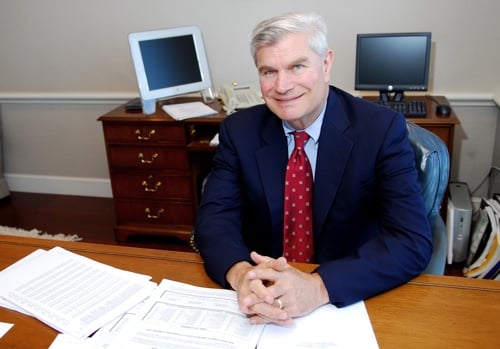
Ken Heebner is mired in his third straight year near the bottom of the mutual-fund return rankings, threatening his status as the top-performing U.S. stock-picker of the new century.
The $3 billion CGM Focus Fund, which Heebner runs from Boston, is the only domestic stock fund to trail at least 96 percent of peers in 2008, 2009 and again this year, according to research firm Morningstar Inc. The fund has lost 54 percent since June 30, 2008, compared with the 8.7 percent decline by the Standard & Poor's 500 Index, a proxy for the U.S. stock market and the fund's benchmark.
“He's been in all the wrong sectors at all the wrong times,” said Jonathan Rahbar, a fund analyst for Chicago-based Morningstar.
The nosedive rivals that of Bill Miller, the Legg Mason Inc. fund manager who beat the S&P 500 for a record 15 consecutive years, then dropped to the back of the pack in 2006 through 2008. Like Miller, Heebner has lost investors, with net withdrawals of $1.8 billion since August 2008, according to Morningstar. Unlike Miller, he lagged behind the rest of the market last year, gaining 10 percent while U.S. stock funds on average rose 33 percent. Miller's Value Trust was up 41 percent.
Even with the losses, CGM Focus returned an average of 17 percent a year in the decade ended May 31, the highest among more than 3,200 U.S. diversified mutual funds, Morningstar's data show. In second place was
Lord Abbett Micro Cap Value, which gained 14 percent.
Investors Turn Elsewhere
Steven Roge, who buys mutual funds for clients, said the ballooning of Heebner's assets in 2008, when CGM Focus had net deposits of $3.3 billion through August after soaring 80 percent the previous year, convinced him there were better places to invest.
“When a fund attracts assets that quickly, we worry about a manager's ability to handle it,” said Roge, whose Bohemia, New York-based firm, R.W. Roge & Co., oversees $200 million.
Heebner, co-founder of Capital Growth Management LP, wasn't available to comment, Martha Maguire, a spokeswoman for the firm, said in an e-mail. Capital Growth is part of Natixis Global Asset Management, a unit of French bank Natixis SA.
The 69-year-old Heebner is known for making concentrated bets in industries from homebuilding to commodities and for his willingness to shift gears quickly. He also bets on falling stock prices. In contrast, many funds don't pursue short selling.
Hurt by Financials
CGM Focus fell 6.3 percent this year through June 15 as the S&P 500 rose 0.9 percent, including dividends, according to data compiled by Bloomberg.
The fund was hurt in the period by declines in financial stocks and commodity producers. New York-based
Goldman Sachs Group Inc., its second-largest holding, lost 19 percent. Its third-biggest stake, miner Freeport-McMoRan Copper & Gold Inc. of Phoenix, dropped 16 percent. Ford Motor Co., the Dearborn, Michigan-based automaker and CGM Focus's top position, was up 16 percent.
Heebner in the first quarter bought new stakes in miners including Cleveland, Ohio-based Cliffs Natural Resources Inc. and BHP Billiton Ltd. of Melbourne, according to a May 14 filing with the U.S. Securities and Exchange Commission. He sold holdings in Internet companies Google Inc. of Mountain View, California, and Seattle-based Amazon.com Inc.
Metal and mining stocks accounted for 36 percent of his holdings as of March 31, the filing shows. Bank stocks represented 16 percent of the portfolio, the second-largest position. In addition to
Goldman Sachs, Heebner held Morgan Stanley and
Citigroup Inc., both based in New York, and Pittsburgh-based
PNC Financial Services Group Inc.
Financial Crisis
Returns started to falter in the second half of 2008, when Heebner's holdings of energy, metals and agriculture stocks began to tumble. After selling the commodity stocks, he bought financials, including insurers such as Hartford, Connecticut- based Hartford Financial Services Group Inc., according to filings with the SEC.
“The escalating financial crisis took its toll on these issues during the fall,” Heebner wrote in the fund's 2008 annual report. Financial stocks fell 38 percent in the fourth quarter of that year, following the bankruptcy of Lehman Brothers Holdings Inc. in September, Bloomberg data show. CGM Focus dropped 48 percent for the year, compared with a decline of 37 percent by the S&P 500.
Missing the Rally
Heebner sold his insurance holdings at a loss in the first quarter of 2009, he said in that year's annual report with the SEC. The timing hurt, as many of those stocks soared after the market reached a 12-year low in March. Hartford almost tripled in the final nine months of 2009.
Heebner's delay in shifting back to stocks that could benefit from the rebounding economy in 2009 “diminished the fund's overall performance,” he wrote.
When CGM Focus didn't bounce back in 2009, Brian Smith, a financial adviser based in Vienna, Virginia, decided to reduce his holdings. “It was too easy to find things that were moving up,” he said in a telephone interview.
Dennis Marin, who also owns the fund for clients, decided to stick with Heebner.
“Over the next three to five years our bet is that we will do well with him,” said Marin, president of Erie, Pennsylvania- based Wedgewood Investors Inc., which manages $600 million.
Hot to Cold
In May 2008, about a month before the fund's assets peaked at $10.3 billion, Fortune magazine called Heebner “America's hottest investor.” In the first seven years of the last decade, CGM Focus returned 32 percent annually while the S&P 500 gained less than 2 percent a year. Heebner has run the fund since it was created in 1997.
In 2000 and 2001 he profited by betting against technology stocks. At the same time he began buying homebuilders such as Miami-based Lennar Corp. ahead of the boom in construction and home prices.
By the start of 2005, before homebuilding stocks began their decline, he had sold them and moved into energy and commodity companies. The price of oil more than tripled between the end of 2004 and the middle of 2008, Bloomberg data show.
“Historically he has done phenomenally well knowing when to rotate,” said Rahbar of Morningstar.
The fund's wins and losses are magnified by its concentration. CGM Focus's top 10 holdings represented 73 percent of assets of as March 31, Morningstar data show. Its turnover ratio -- a measure of how much the portfolio changes in a year -- is 464 percent, more than four times greater than peers, Morningstar said.
The declines since 2008 “don't indicate Heebner has lost his talent or his expertise,” said Ronald Sugameli, manager of the $130 million New Century Alternative Strategies Portfolio, a mutual fund that invests in other mutual funds.
CGM Focus represented about 1.5 percent of Sugameli's fund as of May 31, Bloomberg data show.
While he expects Heebner's performance to bounce back, Sugameli isn't planning to boost his holdings of CGM Focus, he said in a telephone interview. Given the fund's volatility, Sugameli said, “it is best used in small doses.”