
Advisers play a critical role helping retirement investors and plan participants stay on track during periods of extreme market volatility like we’re witnessing at the current time. Making tactical moves such as rebalancing portfolios, replacing underperforming managers and managing taxes by matching gains and losses are all effective strategies to consider in the current environment.
However, despite the best efforts of advisers, emotions can run high at times like this, and end investors may be tempted to retreat or sell out of the market after a significant drawdown — locking in their losses and looking to reenter when the market feels "safer." Ultimately, knee-jerk reactions during periods of volatility can have a devastating impact on retirement outcomes.
Investors risk missing out through ‘loss aversion-induced’ selling
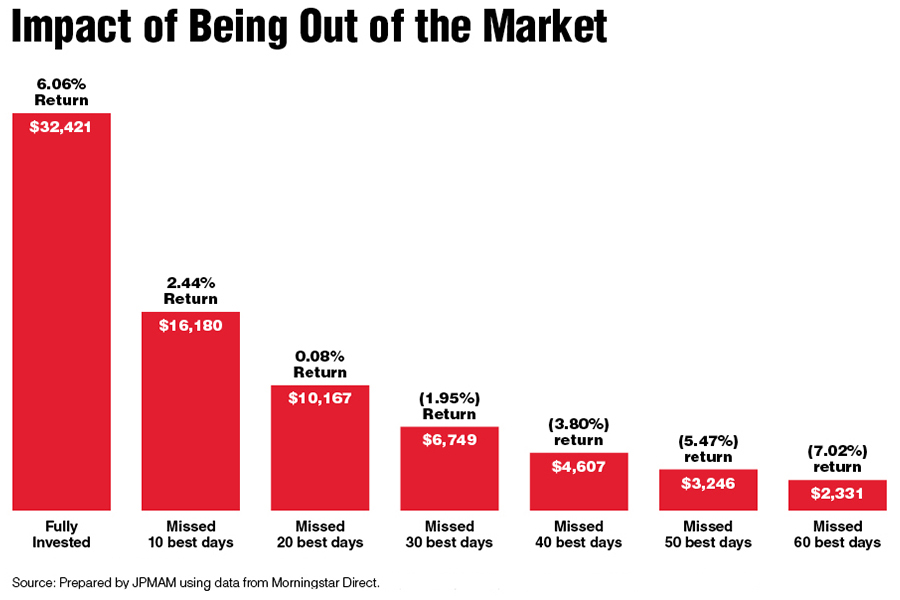
In my recent conversations with advisers, one point I highlight is just how closely the best days in the market often follow the worst, and how important being invested for those good days can be to the recovery of a client’s portfolio. While it’s easy to get caught up in the day-to-day market headlines, it’s important to focus on what history can teach us about the benefits of staying invested.
To help advisers demonstrate this point to anxious investors tempted to panic sell, we included a chart in the J.P. Morgan 2020 Guide to Retirement outlining the impact of missing out on the best days in the markets, comparing the returns of a $10,000 investment in the S&P 500 over the past 20 years. The chart clearly highlights the benefits of avoiding the temptation to pull out of the market and risk missing the days with greatest gains.
‘Best’ days often very close to the ‘worst’
Often a client’s first instinct will be to assume that the biggest upswings in markets occur at very different times than the most pronounced down days. If we look at market swings in recent times, however, 2019 saw six of the best days occur within two weeks of the worst days.
This trend has been even more pronounced in the COVID-19-impacted markets of 2020, where through April 13, that number has risen to as high as eight, with five of those best days occurring within just one week of a worst day.
Overwhelmingly, the worst days occur before the best days. On many occasions, our analysis shows that the worst days are followed the next day by one of the best days, meaning it’s literally impossible for an investor to reinvest in the market if they’ve pulled out after experiencing a poor return.
Advisers play a key role in supporting clients across the retirement finish line, and this is only magnified during times of significant volatility. It’s completely understandable that clients may look to take control and sell equities after a market drawdown to avoid additional losses. Yet historical data demonstrate that clients run a significant risk in missing out on market gains by letting emotion take over. Encouraging clients to stay invested through the worst and best days is the most likely to result in a successful retirement outcome.
Katherine Roy is chief retirement strategist at J.P. Morgan Asset Management.

South Carolina estate planning firm joins Osaic’s IBD network, citing succession planning tools and multigenerational growth resources.

A new SIFMA and KPMG study of more than 2,100 US investors finds satisfaction high, AI-only trust falling, and demand for human guidance growing across every generation.

Retail banks and private wealth firms scored 40 in Fitch's AI stress test, signaling possible one-notch downgrade risk under an adverse scenario.

Elsewhere, Wells Fargo Advisors adds a $400 million Morgan Stanley veteran in Naples as an ex-Cetera advisor goes independent with LPL.

According to a federal charges Bradley Heppner, 60, received more than $150 million in payments through funneling money from GWG Holdings to a shell company.
Knighthead Life entered the market with a competitive MYGA. A strong launch earned advisor confidence and paved the way for FIAs.
As AI makes financial information more accessible than ever, Lana Hock explains why human judgment, trust, and empathy remain the qualities clients value most in a financial advisor

