
Six weeks ago, the Federal Reserve raised rates and the Nasdaq hit a record five days later. This week the script flipped. On October 28, the Fed held its benchmark rate at 3.75 to 4 percent. The S&P 500 closed that day at 7,744, about 1 percent below its October 6 record, and the Nasdaq nearly 4 percent below its own. By the next morning, Alphabet was down 10 percent in premarket trading after reporting negative free cash flow.
At the index level, October looked quiet. Underneath, almost everything moved. Of the four signals from the last issue, the discount rate, valuation, breadth and the rest of the world, two held, one reversed in investors' favor and one is now fighting the dollar.
The vote was 10 to 2, and both dissenters, Governor Lisa Cook and Cleveland Fed President Beth Hammack, wanted another quarter-point hike. The statement said inflation “remains elevated” and upgraded growth to a “strong pace.” That is a pause, not a pivot. Fed funds futures still lean toward a December increase.
The 10-year Treasury, the discount rate the entire market runs on, peaked at 5.31 percent on October 5, then fell below 5 percent on October 22 in its biggest one-day drop since March 2023 as investors fled an AI selloff for Treasuries. It ended October 28 near 5 percent. A stock is worth its future profits discounted back to today, so a lower discount rate should help long-duration growth stocks the most. In October, it helped them the least. The market is now pricing technology on cash, not just rates.
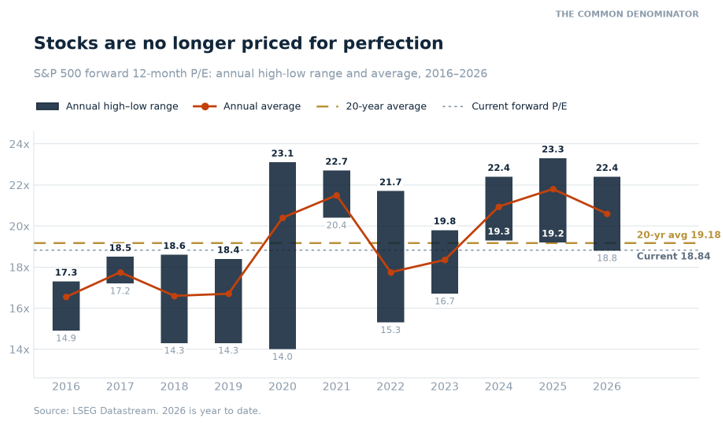
The S&P 500 got cheaper again. Its forward price-to-earnings ratio, what an investor pays today for a dollar of next year's expected profit, fell to 18.7 on October 23, according to FactSet, below the five-year average of 19.8, the ten-year average of 19.1 and the 22.5 of a year ago.
The earnings are delivering. Third-quarter growth is tracking at 29.5 percent, which would be the third straight quarter above 25 percent. Net profit margins of 14.9 percent are the second-highest in more than 15 years. Prices stalled; profits did not.
Concentration is the caveat. FactSet calculates that without Micron and Nvidia, third-quarter growth would fall from 29 percent to 20 percent. Alphabet showed the other side of the ledger: its free cash flow turned negative by $9.1 billion as it poured money into AI. Microsoft, which generated $18.6 billion of free cash flow on similar spending, rose more than 3 percent. The market is still paying for AI. It is now asking who can fund it out of their own pocket.
In the last issue, breadth had blinked. In October, it came back harder than at any point on record. As of October 27, the equal-weighted S&P 500, which gives all 500 companies the same slice, was beating the cap-weighted index by 4.1 percentage points for the month, the biggest reversal in favor of the average stock in Dow Jones Market Data's history. On October 22, the S&P 500 fell 1.4 percent even though 324 of its companies rose. Year to date, the equal-weighted index is back in front, 13.4 percent to 13.1 percent.
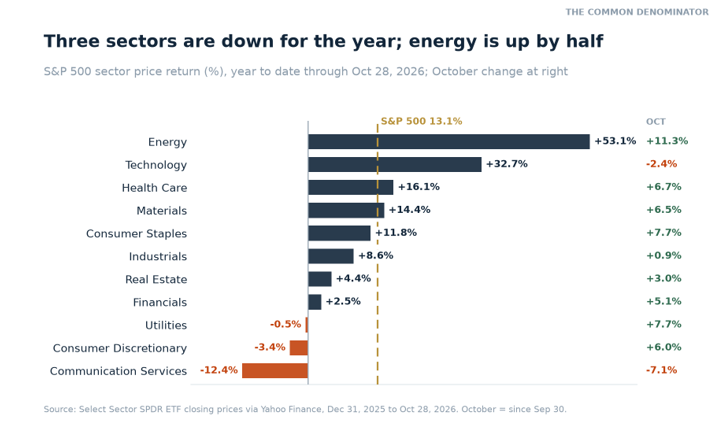
The sector scoreboard shows where the money went. Year to date, energy is up 53 percent on oil that topped $114 a barrel, and technology is up 33 percent despite losing ground this month. Health care, materials and consumer staples are up 12 to 16 percent, each adding 6 to 8 percent in October alone. On the other side, three sectors are in the red for the year: utilities, consumer discretionary and communication services, the last down 12 percent after losing another 7 percent this month.
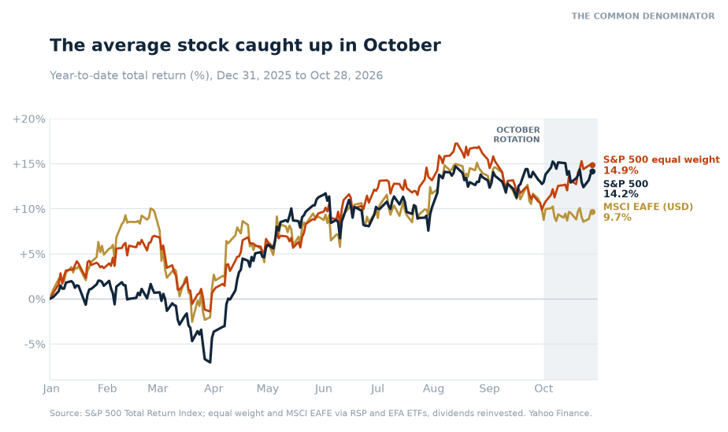
That is broadening up close: money leaving the most crowded trade for everything around it, while the index barely moves because its heaviest names are the ones being sold.
The fourth signal is the one that cooled. In 2025, international stocks beat U.S. large caps by the widest margin since 2007, helped by a dollar that fell 9.4 percent. This year the currency is working the other way. The dollar index hit its highest level since April 2025 on October 12, and Touchstone estimates currency has trimmed about 3 percentage points from the MSCI EAFE index's year-to-date return.
Through October 28, developed international stocks, measured by the largest MSCI EAFE fund, are up about 9.7 percent for the year including dividends, against 14.2 percent for the S&P 500. The case for owning them has not changed: a valuation discount, a different sector mix and a currency that can turn again. Most U.S. investors ended up all-domestic by default, not by decision. One strong-dollar quarter does not turn that accident into a strategy.
Rates still run through all four signals, but the path has changed. The Fed paused, and the 10-year slipped back to 5 percent. Valuations fell as earnings outran prices. Breadth returned as soon as yields eased, confirming that the average stock is a rate-sensitive trade. The rest of the world lost ground to a dollar that rose with U.S. rate expectations.
There is a second thread now, and it runs through cash. The companies the market rewarded in October either earn cash today, as in energy, staples and health care, or can fund their AI spending from their own operations. The ones it punished are spending faster than they earn. That is what a 5 percent discount rate does. It makes free cash flow the price of admission.
This is not a get-out or pile-in picture. It is a rotation picture. The case for owning more than the handful of names that carried the last cycle, and more than one country, rests on concentration and valuation, and October strengthened both. Three things will shape the next leg: this week's GDP and inflation reports, the remaining mega-cap earnings and the Fed's December meeting.
The market did not ignore the Fed in October. It listened, then went looking for companies that do not need it. The investors who will be surprised over the next year are not the ones who misjudged the direction of rates. They are the ones who never checked how much of their portfolio depends on it.
Taimi Bek is chief investment officer at Edgewater Family Wealth in Orlando, Florida, where he oversees investment strategy and portfolio management. He also writes The Common Denominator, a monthly newsletter focused on markets, economics, and portfolio strategy.
Disclaimer
Every investor's situation is unique, and you should consider your investment goals, risk tolerance and time horizon before making any investment. Prior to making an investment decision, please consult with your financial advisor about your individual situation.
The foregoing information has been obtained from sources considered to be reliable, but we do not guarantee that it is accurate or complete, it is not a statement of all available data necessary for making an investment decision, and it does not constitute a recommendation.
The foregoing is not a recommendation to buy or sell any individual security or any combination of securities. The stock indexes and sectors mentioned are unmanaged and cannot be invested into directly. Past performance is no guarantee of future results. The S&P 500 is an unmanaged index of 500 widely held stocks that is generally considered representative of the U.S. stock market. The S&P 500 Equal Weight Index includes the same constituents as the S&P 500, each weighted equally. The MSCI EAFE Index measures the performance of developed equity markets outside the U.S. and Canada. Sector returns are based on the Select Sector SPDR ETFs and are shown for illustration only. International investing involves additional risks such as currency fluctuations and differing financial accounting standards. Sector investments are companies engaged in business related to a specific sector and are subject to fierce competition and their products and services may be subject to rapid obsolescence. There are additional risks associated with investing in an individual sector, including limited diversification. There is no guarantee that these statements, opinions or forecasts provided herein will prove to be correct.
Any opinions are those of Taimi Bek and not necessarily those of Raymond James.
You should discuss any tax or legal matters with the appropriate professional.

The new rule was adopted despite objections from Stifel and Pontera, adding state weight to Fidelity and Schwab's restrictions on credential sharing.

Kai Conragan and Allan Smith join Farther's product and UX teams as the firm doubles down on advisor-first design.

The 70% time savings I expected from AI hasn't fully arrived, but the quality of our advice and our private markets platform have changed.

The J.C. Flowers-backed investor’s latest RIA deal adds five next-gen leaders to the Massachusetts firm’s ownership ranks.

Meanwhile, UBS and Raymond James talk recruiting.
Knighthead Life entered the market with a competitive MYGA. A strong launch earned advisor confidence and paved the way for FIAs.
As AI makes financial information more accessible than ever, Lana Hock explains why human judgment, trust, and empathy remain the qualities clients value most in a financial advisor

