
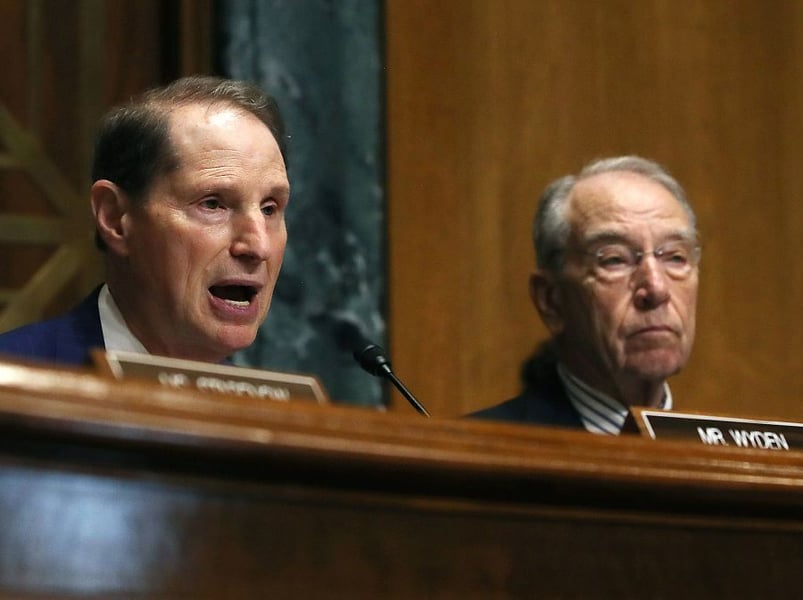
The top Republican and Democrat on the Senate Finance Committee said the Treasury Department “missed the mark” in new guidance that limits tax breaks for businesses that get their Paycheck Protection Program loans forgiven.
In a joint statement Thursday, Senate Finance Chairman Chuck Grassley and Democrat Ron Wyden said the Treasury is depriving some small businesses of much-needed economic relief by forcing them to choose between getting their PPP loans forgiven or claiming write-offs on expenses they covered with the loan money. The IRS published guidance on the issue Wednesday.
“Regrettably, Treasury has now doubled down on its position in new guidance that increases the tax burden on small businesses by accelerating their tax liability, all at a time when many businesses continue to struggle and some are again beginning to close,” Grassley and Wyden said.
The congressional reaction to the guidance puts additional pressure on the Treasury and Internal Revenue Service to allow taxpayers to claim the expense deductions. Grassley and Wyden encouraged the IRS to reverse its position.
The lawmakers said they are working to include language in year-end legislation clarifying that taxpayers qualify for expense deductions even if their loans are forgiven. That could be included in government spending legislation that Congress must pass by Dec. 11 before federal funding runs out.
Chris Moran, a tax attorney for law firm Venable, said, “the IRS guidance seems to be inconsistent with congressional intent” in the Cares Act, which created PPP loans for businesses struggling from the pandemic. The law stated that the forgiven loan won’t be taxed, but didn’t specify whether companies could still write off the expenses they covered with that money.
Excluding the forgiven loan from tax “is essentially meaningless if the expenses funded by the loan are nondeductible,” Moran said.
Still, many taxpayers aren’t expecting to get permission to claim the deductions, from the IRS or Congress, in the short term.
“I think most of them are, at least for now, resigned” to not getting the write-offs, Joe Kristan, a partner at the accounting firm Eide Bailly in Des Moines, Iowa. “They’d certainly like to be allowed by Congress to step in and allow their deductions, but they’re not counting on it.”

Eric J. Stone was fired by Fidelity in 2021 after facing claims he took loans from clients.

Chicago-based Curi Capital gets new majority owner as $14 billion RIA eyes acquisitions and expanded family office services

Partnership pairs organic lead detection with paid ad targeting to help end "spray-and-pray" marketing for growth-seeking advisory firms.

Jonathan Lewis joins the wealth management giant as it proceeds with a $2 billion AI and technology push for advisors.

A third-generation Pennsylvania firm with 24 advisors and $1.6 billion in client assets has left Cambridge Investment Research.
Northern Trust’s Ken Lassner shows advisors how to convert volatility into after-tax portfolio gains
Dan Biagini of American Equity says the steady decline of pensions, longer lifespans and a reset in interest rates are rewriting how advisors build retirement income

