
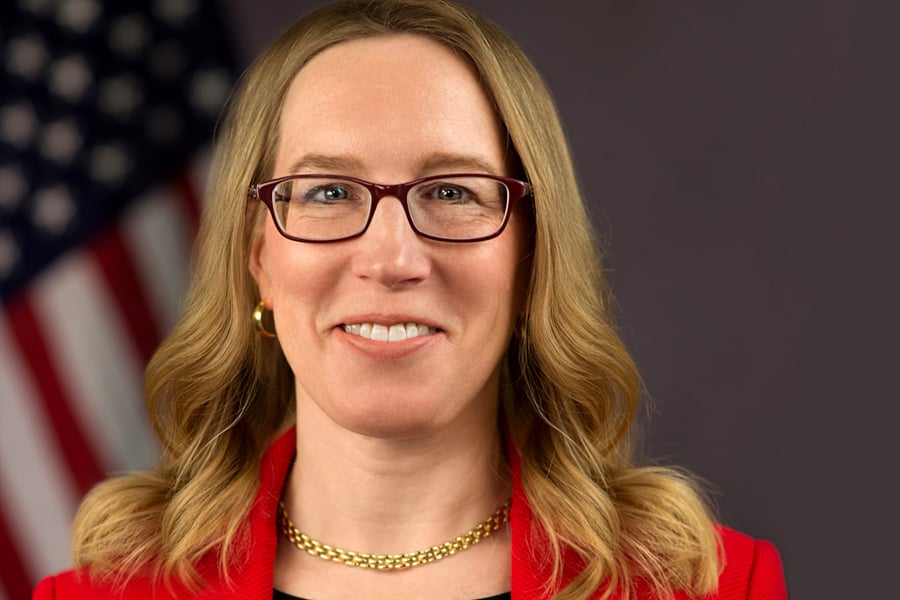
They weren’t as numerous as Martin Luther’s theses, but the 10 concerns raised by Securities and Exchange Commission member Hester Peirce about oversight of sustainable investing further illustrate that there’s likely to be a schism over the topic at the agency.
In remarks Tuesday at an online event sponsored by the Brookings Institution, Peirce outlined challenges the SEC faces as it proceeds toward mandatory environmental, social and governance disclosures by public companies.
The agency has put on its regulatory agenda proposed rules on climate-risk and human factor reporting that are due by October.
The push for rulemaking has come from Chairman Gary Gensler and the other two Democratic commissioners, Allison Herren Lee and Caroline Crenshaw. Their intensity on the topic aligns with the Biden administration’s government-wide push to address climate change.
The two Republican commissioners – Peirce and Elad Roisman – have expressed concerns about ESG regulations over the past several weeks.
At the Brookings event, Peirce outlined 10 “theses” that she said highlight the “real-life uncertainties and complications” of ESG rulemaking.
They included warnings that ESG rulemaking cannot establish agreed-upon models, methodologies and metrics, that many ESG factors don’t materially affect financial results, and that they are inherently political, putting the SEC on a slippery slope.
“To date, Congress has not granted authority to the SEC to address ESG issues for the purpose of promoting goals unrelated to the federal securities laws,” Peirce said. “Serious democratic legitimacy concerns arise when an independent agency expands its own authority.”
Rather than pursuing “a prescriptive ESG rule,” Peirce suggested the SEC updated guidance on how existing disclosure rules can better address ESG topics.
Peirce’s comments are another illustration of the gap between the agency’s Republican members and the Democratic commissioners, who see enhancing ESG disclosures as a demand from investors who are increasingly allocating assets to funds that use ESG factors.
“If Commissioner Peirce is starting from a position that these are political issues, it’s hard to see how she moves to the middle and comes to an agreement with her fellow commissioners,” said Bryan McGannon, director of policy and programs at US SIF The Forum for Sustainable and Responsible Investment.
The SEC often has advanced rule proposals and final rules on 3-2 or other kinds of split votes. It may have to do so again on ESG oversight.
“It’s hard to imagine there will be consensus given how far apart the different commissioners’ viewpoints are on this topic,” said Katie DeLuca, a partner at McGuireWoods. “I think this is such a high priority for the administration, they’ll push it through with a lack of consensus. I would not be surprised if we’ll see proposed rules by their deadlines.”
But during the rulemaking process, there will be ample opportunity for public comment. Peirce is providing a road map for those who want to pushback on ESG disclosure rules.
“Her remarks are bold and brave,” said Betty Huber, counsel at Davis Polk & Wardwell. “It was a clever, comprehensive speech in advance of the SEC’s anticipated rulemaking. Arguably, the speech provides ammunition for market participants who may not be keen on additional regulation in this space.”
Jonathan Drimmer, a partner at Paul Hastings, said he liked Peirce’s speech because it crystallized many of the concerns surrounding ESG rulemaking. For instance, she was right to highlight the difficulty of determining “good” ESG.
“How do you write a rule about what is good?” Drimmer said. “We are seeing the term ‘ESG’ being used frequently and fluidly. Understanding what it means is incredibly important. If the SEC can progress a discussion toward a consensus definition of ESG and its components, that would be a very positive development.”
The ESG debate is sure to continue because the investing strategy is becoming so popular. US SIF’s Trends Report 2020 showed that as of the end of 2019, investors were considering ESG factors across $17 trillion of professionally managed assets, a 42% increase over 2018.
“The market has moved way ahead of regulators in incorporating ESG into the investment process,” McGannon said. “The SEC is not going to lose momentum in getting more clarity around company disclosures.”

Chicago-based Mesirow Fiduciary Solutions adds flexPATH's plan-level outsourced fiduciary book, boosting its retirement market reach to $164 billion.

Also, Raymond James's employee advisor channel adds breakaways from Wells Fargo and Stifel, while UBS welcomes an ex-Morgan Stanley duo in Indiana.

It promised guaranteed principal and 10% monthly returns. The SEC says it invested nothing.

Ten years after entering the fee-based annuity market, MassMutual Ascend says nearly half its lifetime sales came in the past two years alone – but barriers remain among fee-only advisors.

Amplify, WealthReach, Zeplyn and Zocks have unveiled partnerships aimed at automating portfolio management, content creation, account opening, and client communication.
Northern Trust’s Ken Lassner shows advisors how to convert volatility into after-tax portfolio gains
Dan Biagini of American Equity says the steady decline of pensions, longer lifespans and a reset in interest rates are rewriting how advisors build retirement income

