
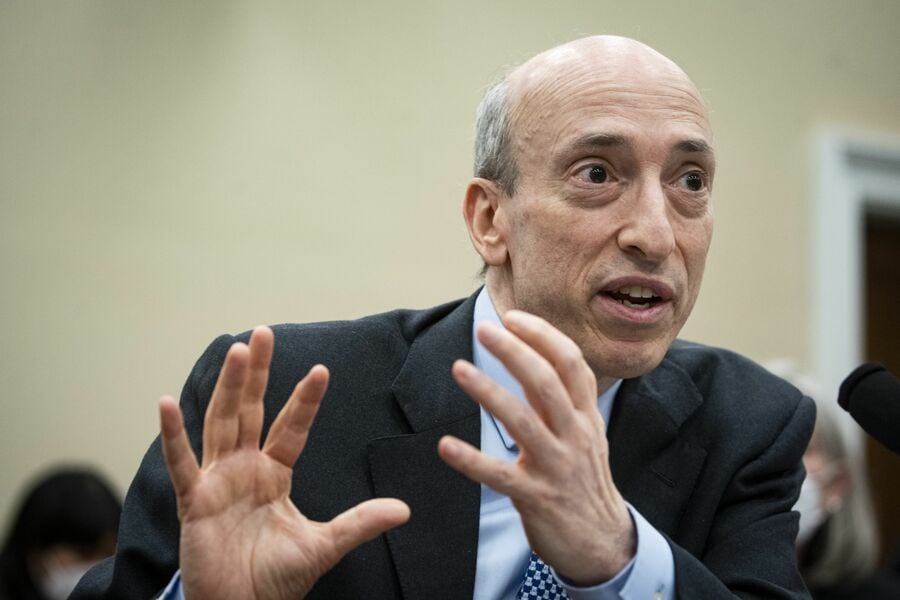
SEC Chairman Gary Gensler Thursday defended several recent rule proposals focused on environmental, social and governance investing before a group that is skeptical of some aspects of the agency’s work.
The Securities and Exchange Commission chief appeared at an Investment Company Institute conference in Washington a day after the SEC released proposals that would strengthen requirements for naming ESG investment products and beef up disclosures for investment advisers and investment companies about their ESG practices.
The agency’s goal is to give investors more and better information so that they can determine whether companies and investment funds are living up to their ESG promises, Gensler said.
“If we’re going to remain the best capital market in the world, how do we lend a bit more efficiency to this discussion going on between investors on one side and issuers on the other?” Gensler said at the ICI event, where he participated on a video screen via Zoom.
ICI, a major trade association representing the mutual fund industry, expressed misgivings about the SEC’s proposals in a statement Wednesday. The group said requiring some funds to disclose greenhouse gas emissions related to their holdings “seems to be unworkable.” It also urged the agency not to raise costs for investors.
In a Q&A with Gensler Thursday, ICI CEO Eric Pan also pressed him on another recent SEC proposal that would mandate disclosures by public companies on how they are impacted by and contribute to climate change. The proposal requires some companies to report Scope 3 greenhouse gas emissions produced in their supply chain. But Pan said there’s no reliable way to measure Scope 3 emissions.
“How do you get comfortable with that fact [that Scope 3 is hard to quantify] yet we should have it hardwired into the rule set?” Pan asked Gensler.
Gensler responded by saying the Scope 3 requirement targets companies that have made commitments to improving the climate, such as a net-zero pledge.
“If you’re making that affirmative statement to the public … measure something that you’re targeting,” Gensler said. “We’re not changing any materiality standard.”
Pan also asserted that requiring funds to disclose greenhouse gas emissions related to investments that comprise the fund would not be possible until the market sees how the climate-risk disclosure rule develops.
“You might be setting up for a future lawsuit, so I’m not going to comment beyond what’s in the actual document,” Gensler said of the ESG disclosure proposal. “Please read the rule. It addresses that question in the preamble. This is a separate rule proposal. It stands on its own.”
Although the discussion was tough for a Q&A between a conference host and a regulator, it was also amiable. Gensler said he wanted to hear from the approximately 600 people in the audience about the ESG proposals. The agency is taking public comment on each of them.
“Get out the keyboards,” Gensler said. “Tell us what works, what doesn’t work.”
The ICI comment letters likely will point out many areas of the proposals with which the group disagrees. Gensler said he also wants to hear from individual investors, issuers and others connected to the markets.
“We get more richness in what’s going on,” Gensler said. “Don’t just rely on the ICI … because the ICI has to work its politics.”
Gensler also tried to put the ESG proposals in perspective, saying they represent just three out of 30 rulemakings the SEC has proposed. He noted that his predecessor, former SEC Chairman Jay Clayton, made about 70 proposals.
“I think you’re going to lap Jay Clayton,” Pan said.

New Nationwide Retirement Institute survey reveals eight in ten Americans agree Social Security needs fixing and how.

Advisor-led adoption has been rapid for tasks from translating annuity contracts into plain English to speedy webinar prep.

Austin, Texas headquartered firm taps former BlackRock managing director following an internal leadership shuffle.

InvestmentNews reported in 2017 that the IRS was scrutinizing the tax shelter land deals, called syndication conservation easements.

Advisors gain a second workflow for 401(k) guidance as the fintech expands beyond bulk rebalancing, backed by new policy research on advice access.
Northern Trust’s Ken Lassner shows advisors how to convert volatility into after-tax portfolio gains
Dan Biagini of American Equity says the steady decline of pensions, longer lifespans and a reset in interest rates are rewriting how advisors build retirement income

