
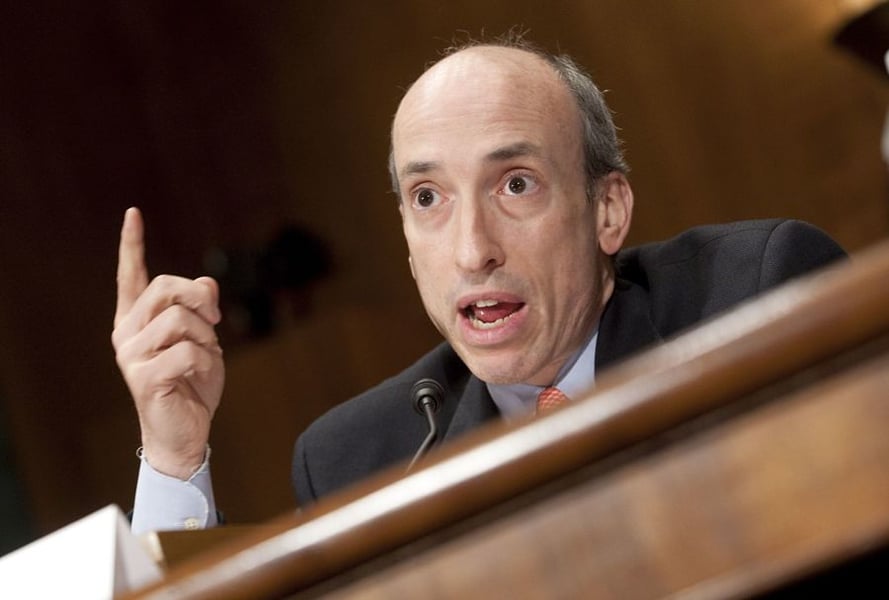
Wall Street’s main regulator is signaling that the Biden era will spell tougher oversight for cryptocurrencies and blank-check companies, two of the white-hot market’s most talked about asset classes.
Securities and Exchange Commission Chairman Gary Gensler told lawmakers Wednesday that special purpose acquisition companies and digital coins posed significant policy and investor-protection questions. He referred to SPACs, shell companies that list on stock exchanges for the purpose of buying other firms and making them public, as “blank-check IPOs.”
The financial world has been anxiously waiting to see how Gensler will steer the SEC at a time when retail investors have helped drive markets to record highs. Crypto enthusiasts, who had been hoping the regulator would take a more accommodative approach to digital coins, have thus far been disappointed — and on Wednesday, they got more of the same.
“I look forward to working with fellow regulators and with Congress to fill in the gaps of investor protection in these crypto markets,” Gensler said in remarks prepared for a House Appropriations Committee subcommittee. He raised concerns about everything from crypto exchanges to decentralized financial platforms.
On equity markets, Gensler discussed how the SPAC boom — along with the surge in IPOs and direct listings — placed a “a lot of demands on the SEC’s limited resources.” He said that the agency has spent significant time on the issue, citing guidance issued last month for how firms should account for warrants held by early investors in SPACs.
“Beyond the real demands on SEC resources, the surge of SPACs raises a number of policy questions,” Gensler said. “First and foremost, are SPAC investors being appropriately protected? Are retail investors getting the appropriate and accurate information they need at each stage — the first blank-check IPO stage and the second target IPO stage? Second, how do SPACs fit in to our mission to maintain fair, orderly and efficient markets? It could be the case that SPACs are less efficient than traditional IPOs.”

FINRA's proposed rule filing would create a new 10-day fraud delay and nearly triple the maximum hold period for exploited senior investors

Fueled by a recent shot in the arm from private equity firm Carlyle, MAI adds a $490 million Atlanta RIA as it keeps building out its national footprint.

“Todd Burkhalter organized what is likely the largest Ponzi scheme in Georgia history,” said one FBI official.

With experience from Goldman Sachs and TD Ameritrade, the RIA's newest SVP hire adds to a recent wave of executive departures from hybrid Osaic.

Chicago-based Mesirow Fiduciary Solutions adds flexPATH's plan-level outsourced fiduciary book, boosting its retirement market reach to $164 billion.
Northern Trust’s Ken Lassner shows advisors how to convert volatility into after-tax portfolio gains
Dan Biagini of American Equity says the steady decline of pensions, longer lifespans and a reset in interest rates are rewriting how advisors build retirement income

