
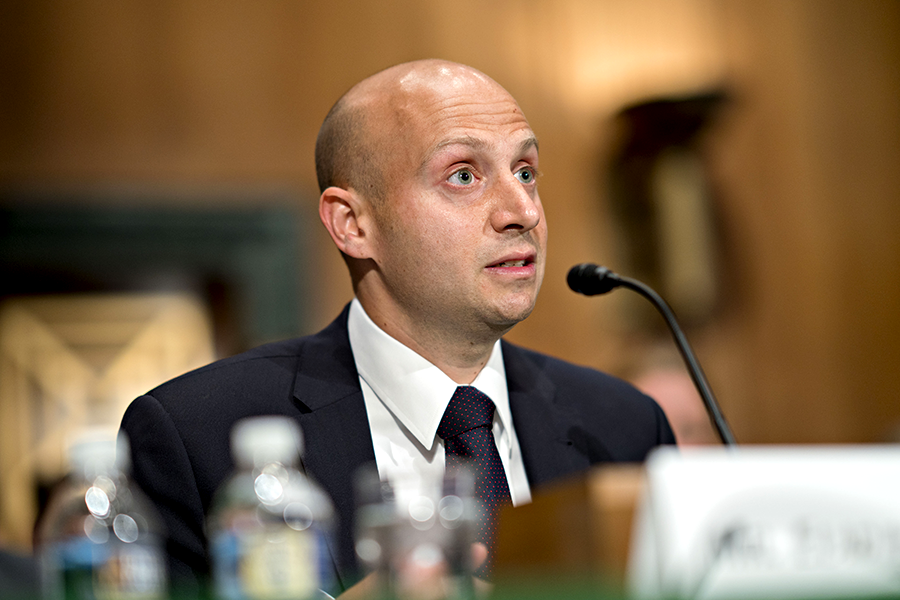
Elad Roisman, one of two Republicans on the U.S. Securities and Exchange Commission, said Monday that he plans to step down by the end of January.
His departure will leave Hester Peirce as the only GOP commissioner at the agency as Gary Gensler pursues an ambitious rule-making agenda that is opposed by some business groups. Gensler, who took over in April, is joined by Democrats Allison Herren Lee and Caroline Crenshaw.
Roisman, who has been a commissioner since 2018, played a key role in Trump-era efforts by the SEC to rein in proxy advisory firms and to make it easier for companies to block submissions from newer stockholders who don’t own many shares. He pushed back on the agency’s efforts under Gensler to undue those changes.
“It has been the utmost honor to work alongside my extraordinary SEC colleagues, who care deeply about investors and our markets,” Roisman, who briefly served as acting chair of the SEC at the end of the Trump administration, said in a statement. He didn’t say what he plans to do next.
Roisman, who is an attorney, previously worked as a staffer on the Senate Banking Committee and as a lawyer for the New York Stock Exchange early in his career.

InvestmentNews reported in 2017 that the IRS was scrutinizing the tax shelter land deals, called syndication conservation easements.

Advisors gain a second workflow for 401(k) guidance as the fintech expands beyond bulk rebalancing, backed by new policy research on advice access.

New data shows most people do not have enough saved to cover costs and are not fully utilizing their accounts.

Firms announce new recruits this week, with teams overseeing hundreds of millions in client assets switching affiliations.

It’s the 12th deal for Stratos since SEI's investment and follows 11 acquisitions worth $4.8B in 2025.
Northern Trust’s Ken Lassner shows advisors how to convert volatility into after-tax portfolio gains
Dan Biagini of American Equity says the steady decline of pensions, longer lifespans and a reset in interest rates are rewriting how advisors build retirement income

