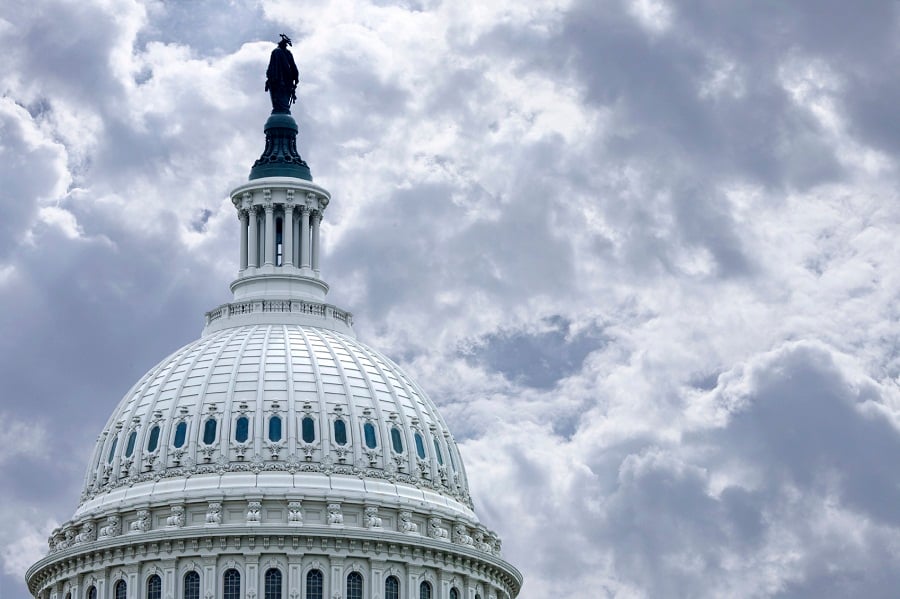
Forget China and the Fed. Washington becomes the focus with Sept. 30 deadline for funding looming.
A federal government shutdown early next month could be the next catalyst to inject volatility into financial markets.
Congress must pass legislation by Sept. 30 to keep the government operating in the new fiscal year, which begins on Oct. 1. It has failed to come up with a budget and may have to turn to a so-called continuing resolution that funds agencies at roughly their current level.
But such a resolution — even a short-term one that lasts until December — is no certainty.
Conservative Republicans are pushing House Speaker John Boehner, R-Ohio, and Senate Majority Leader Mitch McConnell, R-Ky., to include a provision that would defund Planned Parenthood, a move Democrats resist. Democrats want to raise domestic spending levels, something that causes Republicans to recoil.
And so once again, Congress finds itself on the brink of triggering a government shutdown. The expiration of highway funding in October and the debt ceiling in November adds heat to the bubbling cauldron.
“We're likely to see some [market] volatility as Congress wrestles with these deadlines,” said Andrew Friedman, principal at The Washington Update. “I think there's still a high risk of shutdown because [Mr.] Boehner may cater to conservative Republicans and not introduce a [continuing resolution] that would pass with Democratic support.”
Investment advisers, who have been keeping their eyes on China and the Federal Reserve, now have to turn their attention to Capitol Hill. Even if there is a short-term continuing resolution, it only pushes the conflict into the holiday season.
'ROUGH SEAS' FOR ADVISERS
“The next couple months are going to be rough seas for advisers in terms of greater political risks to the markets,” said Duane Thompson, senior policy analyst at Fi360, a fiduciary consulting firm. “Most advisers are going to tell clients to buckle their safety belts.”
Mr. McConnell has said that Republicans won't let the government close nor will they allow a default on the debt. But he also wants to extract concessions for such a decision, according to Jason Rosenstock, a partner at Thorn Run Partners, a government-relations consulting firm.
“[Mr.] McConnell and the White House are on a path to a game of chicken,” Mr. Rosenstock said. “It's likely to be a bumpy ride to the edge again.”
If there is a confluence of deadlines in December, Mr. Friedman said that it won't rival the tension and importance of fiscal-cliff negotiations in late 2012 that reset many tax policies.
“This is all manufactured deadlines,” Mr. Friedman said. “This is about Congress not getting its work done.”
Although there may be fireworks in December, the crisis is likely to burn out rather than damage markets for a protracted period, according to Mr. Thompson.
“It's nothing that's going to be long-lasting,” Mr. Thompson said.
In fact, when the markets start to decline in response to political battles in Washington, it might be a good time for advisers and investors to jump in.
“Congress will solve these problems,” Mr. Friedman said. “We're not going to default on the national debt. It could be a buying opportunity.”