
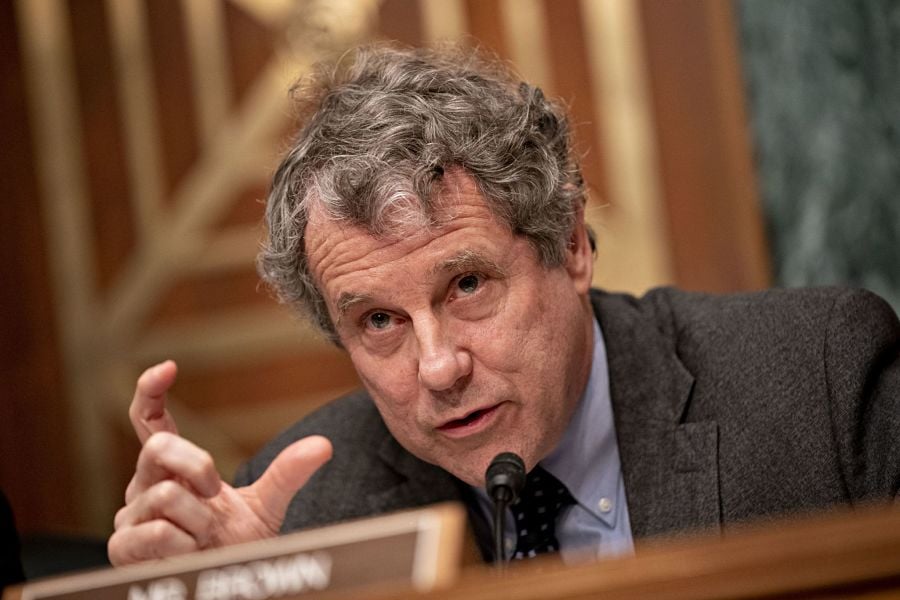
Senate Banking Committee Chairman Sherrod Brown ripped Wall Street at a high-profile hearing featuring the top executives at the six largest U.S. banks, saying it’s “past time” for the industry to step up and help struggling workers.
Brown, a Ohio Democrat, opened the proceedings Wednesday with a blistering attack on how banks operate, arguing that their business model is “built on short-term profits at the expense of long-term growth for everyone.” He challenged the chief executives to “be as good to the American people as the nation has been to you,” noting that taxpayers spent billions to rescue banks during the 2008 financial crisis.
When employees get sick or lose their jobs, they “don’t get a taxpayer bailout.” Brown said. “And they all remember that Wall Street did.”
The remarks set the tone for what’s expected to be hours of tough questions over issues ranging from workforce diversity to minority lending and executive pay.
The hearing is the first time the bank CEOs have been called before the panel -- and, much to the chagrin of some in the industry, it may also not be the last. Brown’s title for the event: ”Annual Oversight of Wall Street Firms.”
Among the bank CEOS testifying is Citigroup Inc.’s Jane Fraser, the first woman to lead one of the U.S.’s biggest banks. Appearing with her are JPMorgan Chase & Co.’s Jamie Dimon, Goldman Sachs Group Inc.’s David Solomon, Bank of America Corp.’s Brian Moynihan, Morgan Stanley’s James Gorman and Wells Fargo & Co.’s Charles Scharf.
In their opening statements, the executives pointed to the leading role that big banks played in getting out billions of dollars in government stimulus and assistance for businesses and homeowners jolted by coronavirus. As for their own firms, the leaders noted, they remain well-capitalized and didn’t struggle during the market turmoil caused by Covid-19.
U.S. banks have thrived during the pandemic, with the Federal Deposit Insurance Corp. putting out a report Wednesday that showed the industry made $76.8 billion in the first quarter, shattering all previous profit records. Much of the earnings came as lenders released reserves that were set aside last year for potential losses that never materialized.
Democrats weren’t the only lawmakers criticizing banks Wednesday, as Republicans pointedly questioned decisions to curtail lending to politically unpopular businesses such as gun manufactures and oil companies. Sen. Pat Toomey, the top GOP member of the Banking Committee, said corporations shouldn’t pursue social agendas that risk hurting shareholder returns.
JPMorgan Chase & Co.’s Dimon is the longest-serving of the bank CEOs who testified Wednesday, but to the Senate’s biggest critic of Wall Street, he’s also “the star of the overdraft show.”
Massachusetts Democrat Elizabeth Warren lit into Dimon as she sought to make the point that banks kept charging onerous fees to customers struggling during the pandemic -- even as regulators in Washington eased rules for lenders. JPMorgan, Warren claimed, made almost $1.5 billion from overdrafts last year, seven times more per account than its competitors. Still, it didn’t automatically waive the penalties as the government had suggested.
Dimon sharply disputed Warren’s analysis and said JPMorgan dropped its overdraft fees for customers who requested relief.
“I think your numbers are totally inaccurate,” he told the senator as the two talked over each other in a contentious exchange about penalties banks assess when consumers withdraw more cash than they have in their accounts.
Warren, who said banks collectively took in $4 billion in overdraft fees last year, accused Dimon of ducking her question and asked him to return the money. He refused.
“You and your colleagues come in today to talk about how you stepped up and took care of customers during the pandemic, and it’s a bunch of baloney,” replied Warren.

Most voters 50-plus in swing districts favor candidates backing a caregiver tax credit, as caregiving drains retirement savings

New F2 Strategy research finds more firms growing without M&A, yet one-third still lack a defined growth process.

Shadow AI, weak oversight, and no formal policy highlight why advisory firms are more exposed to cyber risk than they realize.

Meanwhile, DPL Financial Partners adds two annuity executives and Prime Capital Financial hires a Mid-Atlantic retirement plan consultant.

Andrew Komarow pleaded guilty Thursday in federal court in Hartford to defrauding three financial services companies of close to $3.3 million.
Knighthead Life entered the market with a competitive MYGA. A strong launch earned advisor confidence and paved the way for FIAs.
As AI makes financial information more accessible than ever, Lana Hock explains why human judgment, trust, and empathy remain the qualities clients value most in a financial advisor

