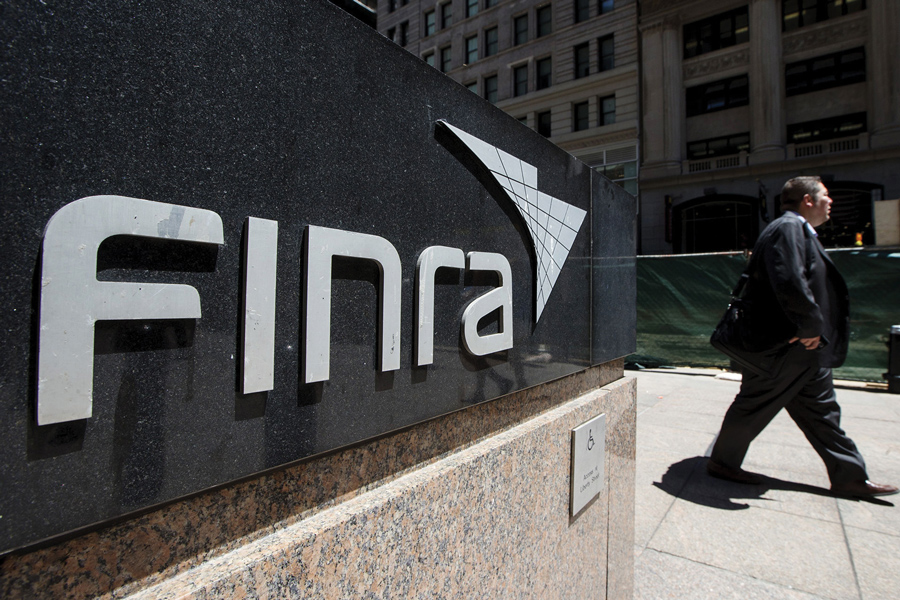
Better Markets, a group that promotes financial reform, blasted Finra's proposals to crack down on firms that employ high-risk brokers, calling them too weak.
In an
April 30 regulatory notice, the
Financial Industry Regulatory Authority Inc. made several proposals to place additional controls on brokers who have long disciplinary histories.
Finra has been under pressure for years to crack down on recidivist brokers, sometimes known as rogue brokers.
Earlier this week, Massachusetts Secretary of the Commonwealth William Galvin
opened an investigation of 10 broker-dealers in connection with private-placement sales after a recent Wall Street Journal study found that a high percentage of brokers with disciplinary records conduct such transactions.
Finra's proposals won't remedy the problem, according to Better Markets.
"Finra's release gestures in the right direction, but Finra must do significantly more to reduce the number of bad brokers and the prevalence of recidivism," three Better Markets officials, including president and CEO Dennis M. Kelleher,
wrote in a June 29 comment letter. "Finra must go far beyond this proposal to credibly claim that it is serious in its intention not just to hold brokers accountable, but also to protect investors from brokers who have demonstrated a proclivity to violate the law."
The proposals include allowing a Finra hearing panel to impose restrictions on firms and brokers while a disciplinary matter is under appeal to the National Adjudicatory Council; requiring firms to impose heightened supervision of a broker while Finra is considering statutory disqualification, and increasing registration requirements for firms seeking to hire high-risk brokers who have one or more criminal actions or two or more "specified risk events."
The comment period ended June 29. Finra received
nine letters.
Mr. Kelleher wrote that the Finra proposals don't match up to a
June 2017 speech by Finra president and chief executive Robert W. Cook in which Mr. Cook said that there is "zero room for bad actors" in the financial markets.
"In stark contrast to 'zero room,' however, this release tinkers on the margins by, essentially, making it a little bit costlier for firms to hire bad brokers, and by making them jump through an additional hoop before they can hire brokers with checkered pasts," Mr. Kelleher wrote.
Other groups were more supportive of the Finra proposals. The Public Investors Arbitration Bar Association said that they represented progress.
"PIABA supports the proposed rules since we agree that the proposed rules would benefit the investing public by imposing additional restrictions while strengthening existing controls over high-risk brokers and their employing firms," PIABA president Andrew Stoltmann wrote in a
June 28 comment letter.
The Securities Industry and Financial Markets Association sought changes on some "procedural issues" but overall backed the proposal.
"SIFMA is supportive of the proposed amendments because we are committed to protecting investors and ensuring confidence in our markets through effective supervision," Bernard V. Canepa, SIFMA vice president and assistant general counsel, wrote in a
June 24 letter.
After reviewing the comments, Finra could revise the proposal. Final Finra rules must be approved by the Securities and Exchange Commission.