

President Joe Biden is poised to unveil a plan that would raise taxes on the income, investments and estates of the wealthiest Americans to levels not seen in more than four decades, a move that will trigger intense debate in Congress about whether and how to address income inequality.
Biden’s “American Families Plan,” itself featuring the biggest expansion of federal support for lower-income and middle-class Americans in decades, will be offset by a series of tax increases on the wealthy, administration officials say. The president will unveil his program in a Wednesday night speech to Congress.
To pay for a bill that could top $1 trillion, Americans earning over $400,000 will face higher marginal income tax rates. Those taking in $1 million or more will get hit with a levy of up to 43.4% on their capital gains. The last time rates got close to that, Jimmy Carter was president.
Biden is also likely to propose increases in the number of Americans subjected to the estate tax. He campaigned on closing popular tax breaks, including a provision that lets appreciated assets go untaxed when they are inherited, along with eliminating the carried-interest tax break, which lets private equity managers cut their Internal Revenue Service bills.
Republicans are likely to oppose the tax increases en masse, but the White House is also risking a struggle with Democratic lawmakers. Some of those from New York, New Jersey and other high-tax states in particular were already mobilizing to demand relief for their constituencies even before Biden’s official announcements. With the 50-50 Senate and a narrow margin in the House, monthslong negotiations loom.
Biden’s individual tax measures, coming on top of corporate tax hikes released last month that go to pay for his $2.25 trillion infrastructure-focused “American Jobs Plan,” could also pose a test for markets. News of the capital-gains measure sent stocks sliding Thursday, before a Friday rebound.
“The administration’s policies are no longer so unambiguously positive now that it is pursuing tax hikes on corporates, individuals and investors to fund stimulus 2.0 (infrastructure) and 3.0 (social programs),” JPMorgan Chase & Co. strategists led by John Normand wrote in a note Friday on market implications.
Democrats are eager to raise taxes on high-earners whom they say have been able to pay less than their fair share of the burden for decades, and further benefited from President Donald Trump’s 2017 tax cut, while investment in public services and the social safety net have languished.
Republicans counter that higher rates would depress economic activity. While they’re open to talks on a slimmed-down, targeted infrastructure package, a group of them last week suggested offsetting the cost with fees and repurposing unspent Covid-19 relief money.
“President Biden’s proposed capital-gains tax increase would dissuade investment, leading to slower economic growth while limiting worker productivity and wage growth,” Sen. Pat Toomey, a Pennsylvania Republican, said in statement.
Without the GOP, Biden will need to craft a deal with his own party’s lawmakers. Some Democratic moderates, such as West Virginia Sen. Joe Manchin, have said they want to limit the size of the tax increases.
A bigger constituency Biden will need to woo is a group of House lawmakers, mostly representing districts in New York, New Jersey and California, who demand an expansion of a tax deduction that Trump limited in 2017. More than 20 Democrats have said they won’t vote for Biden’s plan unless the $10,000 cap on state and local tax, or SALT, deductions is addressed.
That bipartisan group, which organized into a congressional caucus earlier this month, will have even greater cause given the concentrated effect on wealthy taxpayers in their districts of the tax proposals on capital Biden is set to unveil.
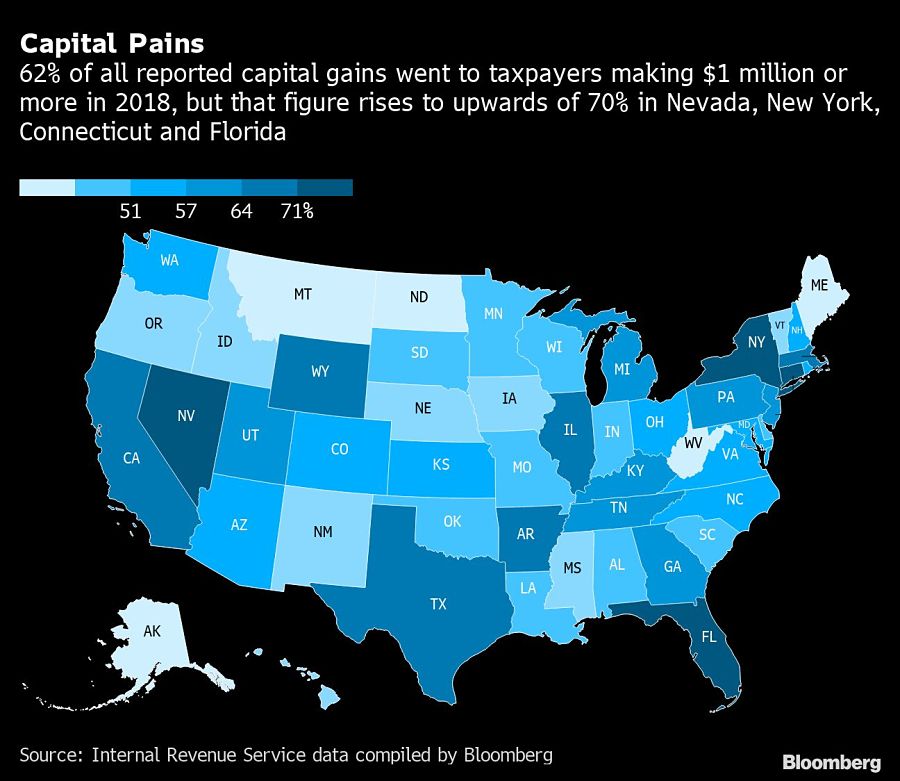
California and New York are the No. 1 and No. 2 states where millionaires, who would be affected by the capital gains proposal, reside, according to IRS tax return data. Lawmakers say without a more generous SALT deduction, their residents will flee to low-tax states, such as Florida or Texas.
“With backing from our recently announced bipartisan SALT Caucus in the House, it’s clear any package that does not address the SALT deduction cap will not move,” Rep. Mikie Sherrill, a New Jersey Democrat, said in a tweet Thursday.
The tussle with the White House, which has telegraphed there won’t be a repeal of the SALT cap in Biden’s proposals, will likely be an expensive battle to resolve. The cost of a full removal of the SALT cap is $88.7 billion a year, and advocates are pushing for a multiyear repeal.
The trade-offs for a bigger SALT tax break could end up meaning even more tax hikes, doing more to harm than help the New York-New Jersey-Connecticut area, said Erin Sykes, chief economist for Nest Seekers International, a real estate brokerage firm.
“This capital gains increase would make the struggle so much more for the Northeast to recover after Covid,” she said. “The negotiation of SALT doesn’t really help anybody all that much because the high-net-worth individuals will be paying more taxes through their businesses.”
The SALT deduction has also generated some controversy because a full restoration of the tax break would largely benefit the wealthy -- more than half of the tax savings would go to those making more than $1 million, according to the nonpartisan scorekeeper the Joint Committee on Taxation. That’s criticism from some Democrats. Progressive Rep. Alexandria Ocasio-Cortez of New York called it a “giveaway to the rich” and said that Biden’s infrastructure package shouldn’t be held hostage to a full repeal of the SALT cap.

Retiring RIA seller David Laidlaw alleges the Carnegie valued his stake on $11.7 million EBITA while pitching potential buyers on $21.3 million.

New tool gives RIAs and family offices AI help vetting private market deals, with some users reportedly halving review time.

Investors got projected returns dressed up as real ones, SEC says

Parents must still act to get the $1,000 federal seed and employer contributions, giving financial advisors a role in the rollout.

FINRA booted Rudy Anguiano from the industry for “conversion - the intentional and unauthorized taking of another person’s property.”
As AI makes financial information more accessible than ever, Lana Hock explains why human judgment, trust, and empathy remain the qualities clients value most in a financial advisor
Northern Trust’s Ken Lassner shows advisors how to convert volatility into after-tax portfolio gains

