
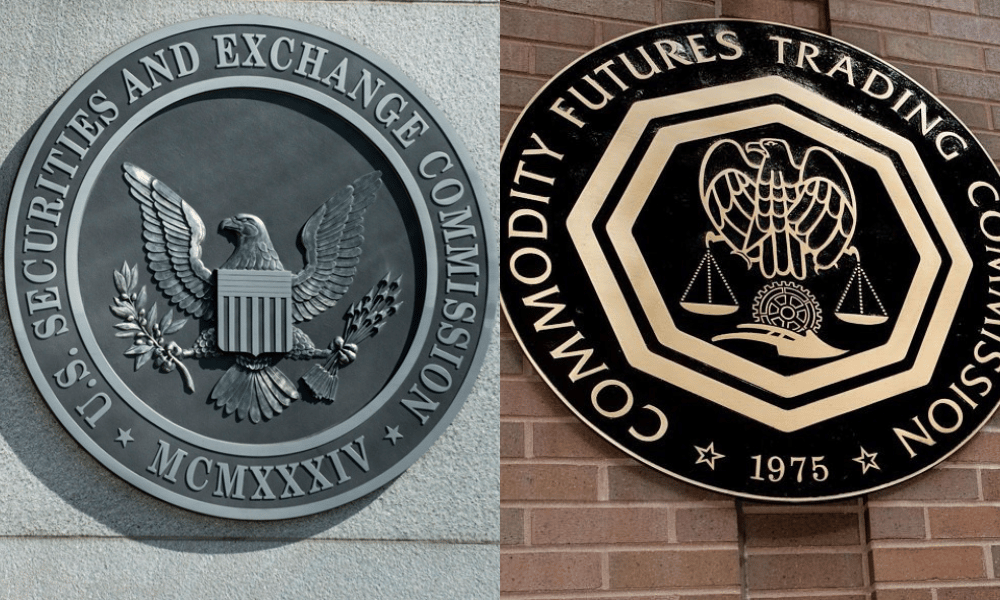
Two of the United States’ most influential financial regulators have agreed to deepen collaboration, unveiling what they describe as a historic memorandum of understanding intended to strengthen coordination and reduce friction between their respective rulebooks.
The Securities and Exchange Commission and the Commodity Futures Trading Commission said Wednesday that their agreement formalises how they will share information, consult on policy initiatives and coordinate enforcement where their responsibilities intersect.
The arrangement is designed to improve regulatory efficiency while maintaining robust protections for investors, customers and the broader financial system.
While various arms of government can often clash in turf wars – the CFTC recently made a robust claim on regulation of the fast-growing predictions markets – it’s not the first time the two financial regulators have collaborated. Last year, they proved they could play nicely when they teamed up to help make certain spot crypto products market ready.
Officials from the SEC and the CFTC have framed the pact as a significant step towards ending long-standing tensions over jurisdictional boundaries, particularly as technological change and the growth of digital asset markets have blurred the lines between securities and derivatives oversight.
SEC Chairman Paul S. Atkins said the updated framework reflects a recognition that fragmented regulation has imposed costs on market participants and weakened the United States’ competitive position.
“For decades, regulatory turf wars, duplicative agency registrations, and different sets of regulations between the SEC and CFTC have stifled innovation and pushed market participants to other jurisdictions,” he said. “This updated Memorandum of Understanding will serve as a roadmap for a new era of harmonization between the agencies - one that is critical to support US leadership in this next chapter of financial innovation.”
The MOU sets out practical mechanisms for cooperation, including regular engagement between leadership and staff, coordinated approaches to emerging risks, and efforts to avoid inconsistent or overlapping regulatory requirements where possible.
CFTC Acting Chairman Caroline D. Pham said the agreement underscores a shared commitment to modernise supervision in response to market evolution. She noted that closer alignment can help regulators address novel financial products more effectively while providing greater certainty for firms operating across multiple regulatory regimes.
The MOU also highlights plans to collaborate on data-sharing and market surveillance initiatives, as well as to consult on potential rulemakings that may affect both securities and derivatives markets. By establishing clearer channels for communication, officials believe the agencies can respond more quickly to market disruptions and policy challenges.
While the memorandum does not change the statutory mandates of either regulator, it is expected to shape how both agencies approach oversight of complex financial instruments that do not fall neatly into traditional categories.
Market participants have long called for greater clarity on how overlapping rules should be applied, particularly in fast-growing sectors such as digital assets. Regulators say the new framework aims to provide a more predictable environment that encourages innovation while maintaining strong safeguards.
The agreement takes effect immediately, with both agencies pledging continued engagement to ensure the cooperative approach evolves alongside the financial markets they supervise.

The products in question were a mix of sophisticated, complex and potentially volatile offerings.

Winstone Wealth Partners joins Concurrent from Raymond James, pushing the RIA platform's assets past $23 billion this year.

Senior Democrats including Senator Bernie Sanders urge a DOJ and FBI investigation into thousands of allegedly fake comments backing DOL's private-assets 401(k) rule.

Total US retirement holdings jumped 7.9% in the second quarter, with 401(k) balances and IRA contributions both climbing despite lingering economic unease

Megadeals are surging in 2026, but small and mid-market transaction volume remains well below historical norms.
As AI makes financial information more accessible than ever, Lana Hock explains why human judgment, trust, and empathy remain the qualities clients value most in a financial advisor
Northern Trust’s Ken Lassner shows advisors how to convert volatility into after-tax portfolio gains

