Federal bank regulators failed to stop shoddy lending and excessive risk-taking at Washington Mutual Inc. for years because they were too chummy with WaMu executives, a Senate panel says.
WaMu's primary regulator, the Office of Thrift Supervision, failed to properly oversee the bank, according to a report released Thursday by the Permanent Subcommittee on Investigations. The OTS' lax oversight led to WaMu's failure, the biggest by a U.S. bank, the report says.
"OTS' failure to act allowed Washington Mutual to engage in unsafe and unsound practices that cost borrowers their homes, led to a loss of confidence in the bank and sent hundreds of billions of dollars of toxic mortgages into the financial system," contributing to the financial crisis, the report says.
Panel chairman Sen. Carl Levin, D-Mich., says the OTS' chief, John Reich, called the bank his "biggest constituent" when preparing for a meeting with WaMu CEO Kerry Killinger.
Reich did not respond to calls for comment Thursday evening.
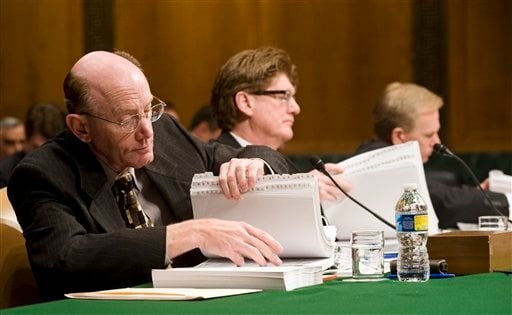
The panel released some findings of an investigation Thursday, in advance of a hearing it will hold Friday on regulatory oversight of WaMu. It will hear from former and current officials from OTS and the Federal Deposit Insurance Corp. Among them will be Reich,
FDIC Chairman Sheila Bair and current OTS chief John Bowman.
Levin said the OTS was too forgiving with WaMu after agency regulators found glaring problems with its lending and risk management starting in 2002. He called the relationship a "clear conflict of interest," since the OTS is funded by fees from regulated banks including WaMu.
WaMu's fees accounted for 12 to 15 percent of the OTS' budget, more than any other bank's, the report says.
The OTS oversaw WaMu "on a collaborative basis, not a regulatory basis," said Levin, who chairs the Permanent Subcommittee on Investigations.
WaMu was a major player in subprime mortgages between 2002 and 2008, when it failed and the government seized it at the height of the financial crisis. The staff report says OTS recognized major problems at WaMu starting in 2002 but relied on the bank to correct the issues voluntarily. WaMu repeatedly failed to do so, but the OTS never forced a change, the report says.
Fueled by the housing boom, Washington Mutual's sales to investors of subprime mortgage securities leapt from $2.5 billion in 2000 to $29 billion in 2006. The 119-year-old thrift, with $307 billion in assets, was sold for $1.9 billion to JPMorgan Chase & Co. in a deal brokered by the FDIC.
The
FDIC administers the fund that insures regular bank deposits and has backup oversight of all insured banks. The agency was critical of WaMu's practices and pressed the OTS to take tougher action, the report says. It says OTS blocked the FDIC's efforts to perform its own examinations.
A separate report issued jointly by the inspectors general of the Treasury Department and the
FDIC faulted the two agencies for infighting that delayed action. But it says OTS bears more blame because it blocked the FDIC's examiner from accessing information needed to assess the bank's strength.
"OTS' supervision did not adequately ensure that WaMu corrected those problems early enough to prevent a failure of the institution," the inspectors general wrote.
Former WaMu executives and regulators criticized the OTS' oversight in interviews Thursday.
"The regulators did not possess the right technical resources or expertise to oversee the complexity of institutions" like WaMu, said Clifford Rossi, a top risk officer at WaMu in 2007 who worked at OTS in the 1990s.
As a result, Rossi said, OTS provided "by far the softest" oversight of any federal bank regulator.
Committee staff said the
FDIC could have gone further in using its backup authority to conduct its own examinations of WaMu. And Levin said the two agencies engaged in "a turf war" during the summer of 2008 as the financial crisis spread.
OTS spokesman William Ruberry said the OTS has adopted the inspectors general's recommendation that it track examiners' reports more closely. He would not comment on the subcommittee findings, because he said the panel had not provided its report to the OTS.
At a hearing Tuesday, lawmakers aimed tough questions at Killinger and other former WaMu executives. Killinger rejected most of the accusations. He argued that WaMu was sold off rather than propped up by the government because it wasn't part of an elite club of Wall Street banks that he said influences the government.
Levin retorted Thursday that WaMu was part of another, equally dangerous club: Banks that chose to be regulated by the OTS to take advantage of its perceived lax oversight.
The hearings follow an 18-month investigation by the Senate Homeland Security and Governmental Affairs subcommittee. It found that WaMu's lending operations were rife with fraud, including fabricated loan documents. It also concluded that management failed to stem the deception despite internal probes.
Levin has said the panel will decide after the hearings whether to make a formal referral to the Justice Department for possible criminal prosecution. Justice, the FBI and the Securities and Exchange Commission opened investigations into Washington Mutual soon after its collapse.