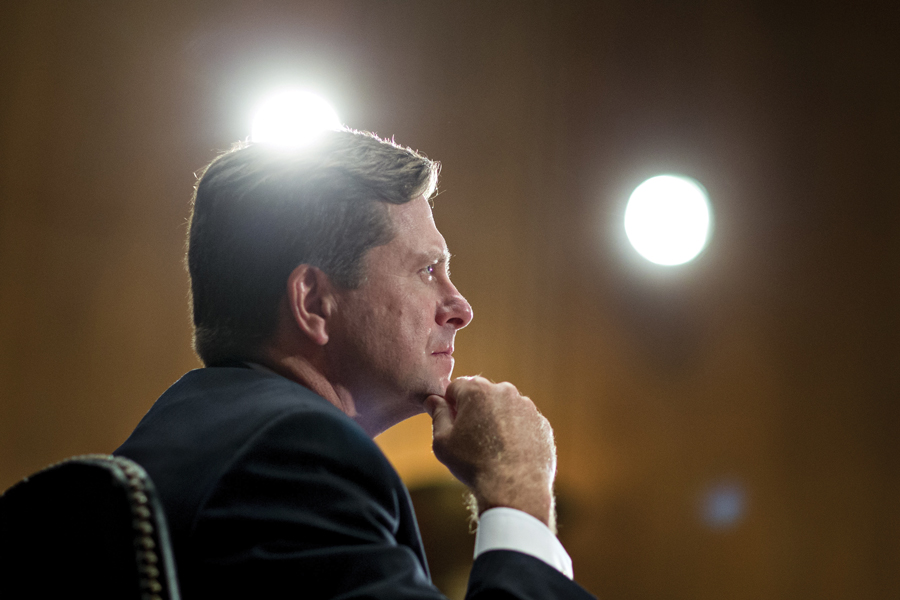
Securities and Exchange Commission chairman Jay Clayton defended the agency's investment advice reform proposal Thursday on Capitol Hill, in the face of skeptical questioning from Democrats.
In a
hearing of the House Financial Services Committee, the panel's two highest-ranking Democrats — Reps. Maxine Waters of California and Carolyn Maloney of New York — expressed reservations about the SEC proposal because it would not impose a uniform fiduciary standard for retail investment advice.
Instead, it would keep adviser and broker regulation separate and strengthen the broker standard, by requiring brokers to act in the best interests of their clients. Currently, investment advisers must act as fiduciaries for their clients while brokers are held to a suitability standard.
Ms. Maloney said the SEC rule falls short of the Labor Department's fiduciary rule, which died Thursday after a federal appeals court issued a mandate making effective its March decision to kill the measure.
"I am concerned that the SEC's proposed rule is not as strong as it should have been and is not as strong as the Department of Labor's fiduciary duty rule," Ms. Maloney said.
Ms. Waters told Mr. Clayton the best way to protect investors is to implement a uniform fiduciary standard that harmonizes adviser and broker rules.
In response to Ms. Waters, Mr. Clayton said the SEC rule seeks to clarify the differences between advisers, whom he described as having a "holistic" relationship with clients, and brokers, who have an "episodic" relationship with customers.
He said the SEC proposal would illuminate for investors the methods of compensation for each type of financial professional, while curbing incentives that can skew advice.
"There is no conflict-free relationship," Mr. Clayton said. "Disclosing [conflicts], mitigating them, making sure everybody understands what the motivations are ... that's what I want to do in this space," Mr. Clayton said.
Another Democrat, Rep. David Scott of Georgia, said the SEC proposal's requirements on disclosure, care and conflicts of interest are causing financial firms to scratch their heads.
"This complexity makes it difficult for the investment industry to discern what we need, which is a clear path to compliance," Mr. Scott said.
Rep. Ann Wagner, R-Mo., pressed Mr. Clayton on whether the agency would release the investor testing of the proposal's disclosure provisions — a question that is also on the minds of many investor advocacy groups.
"I expect that the results of the investor testing will be publicly available in some form," Mr. Clayton said.
After the hearing, he told reporters there is no time line for dissemination.
"We want to follow a very transparent process," Mr. Clayton said. "I don't know when it's going to be completed."
Just as he did recently in a Senate hearing, Mr. Clayton also declined to provide a timetable for when the SEC will complete the advice reform rules, which are open for public comment until Aug. 7.
"I'm not going to set a specific date," Mr. Clayton told Rep. Andy Barr, R-Ky. "We should not take forever."