
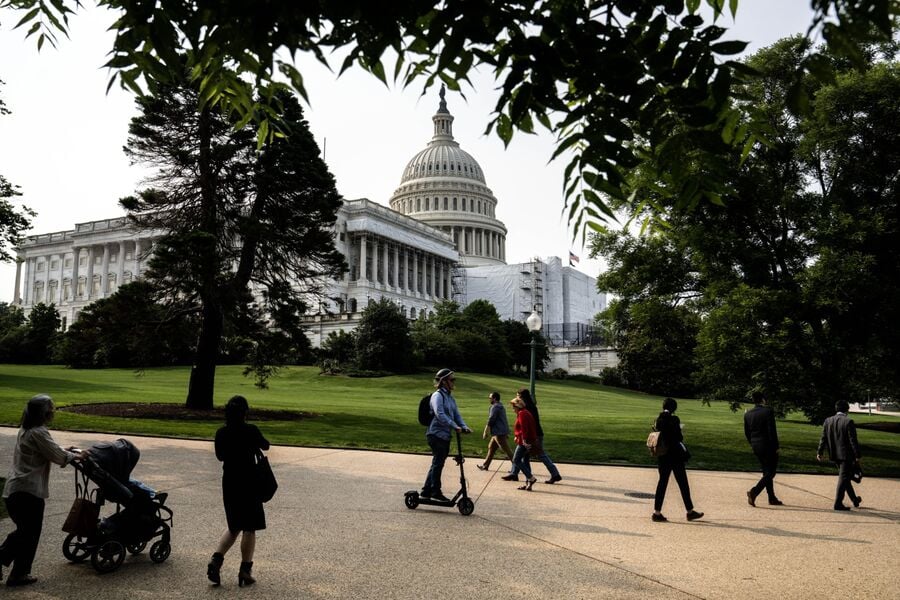
U.S. congressional leaders announced a deal on a top-line spending level for the current fiscal year, lessening the chances of a partial government shutdown on Jan. 20.
Senate Majority Leader Chuck Schumer, a Democrat, and House Speaker Mike Johnson, a Republican, negotiated the deal, clearing the way for the appropriations committees in both chambers to negotiate detailed spending bills now that they have an overall limit for the amount those bills can spend.
The deal sets the cap for the 12 annual spending bills at $1.59 trillion and Republicans have agreed a set of budget moves that Democrats demanded to spare immediate cuts to domestic agency budgets. These moves, which conservatives have decried as “gimmicks,” could lead some Republicans to refuse support.
Yet the deal lacks an agreement to block all conservative policy riders, so the chance of a fight over demands such as defunding investigations into former President Donald Trump could still cause an impasse later.
Johnson presented the deal to his colleagues in a letter Sunday.
“After many weeks of dialogue and debate, we have secured hard-fought concessions to unlock the FY 24 topline numbers and allow the Appropriations Committee to finally begin negotiating and completing the twelve annual appropriations bills,” the letter says.
The U.S. is facing two government shutdown deadlines, after Jan. 19 and Feb 2. Without fresh appropriations, the departments of Agriculture, Transportation, Housing and Urban Development, Energy and Veterans Affairs would shut down on Jan. 20. Republicans and Democrats have been at odds over the spending level, stalling all of the 12 appropriations bills.
President Joe Biden welcomed the agreement and called on Republicans to “fulfill their basic responsibility to fund critical domestic and national security priorities.”
“The bipartisan funding framework congressional leaders have reached moves us one step closer to preventing a needless government shutdown and protecting important national priorities,” Biden said in a White House statement.
A June law lifting the U.S. debt ceiling set a spending cap of $1.59 trillion for discretionary spending. A so-called side deal between President Joe Biden and former House Speaker Kevin McCarthy would have allowed $70 billion in accounting moves to be used to achieve the cuts required by the cap.
Representative Chip Roy, a conservative Republican from Texas, said on social media platform X that Sunday’s accord was “terrible” and “gives away the leverage accomplished in the (already not great) caps deal.”
Democrats said they secured the same amount of domestic funding allowed by the debt-ceiling “side deal.“
“By securing the $772.7 billion for non-defense discretionary funding, we can protect key domestic priorities like veterans benefits, health care and nutrition assistance from the draconian cuts sought by right-wing extremists,“ Schumer and House Democratic leader Hakeem Jeffries said in a statement.
By allowing the $70 billion in side-deal moves, the effective cap is $1.66 trillion.
The deal presented Sunday includes $16 billion in offsetting spending cuts above the debt-ceiling agreement to take effect in 2024. That includes speeding up $10 billion in cuts to the Internal Revenue Service and canceling an additional $6 billion in unspent Covid-19 pandemic funds.
A Senate Democratic aide said the Covid cuts “should have no significant impact” on efforts to fight the virus and don’t apply to developing future vaccines.
Not allowed under the deal is an effort by Senate appropriators to spend $14 billion above the cap by designating that regular spending as an “emergency,” the letter says.
The deal would also prevent other types of budget moves that count phantom cuts to entitlement spending to meet the cap.
A shutdown could still happen if lawmakers fail to agree on spending levels for those federal agencies that shut down after Jan. 19, or on whether some conservative policy demands will be added.
Some conservatives are pushing Johnson to use the shutdown deadline to force Biden to accept changes in border policy. But until now, Republican leaders have called for dealing with the border issue as part of a separate request by Biden for some $61 billion in aid to Ukraine.

The proposal would end decades of paper-first delivery rules, but keeps a paper opt-out and draws early praise from fund and annuity industry groups.

The Trump accounts are “generationally changing” and bring financial literacy to youth, said IRS chief Frank Bisignano.

The Kansas-based RIA giant's latest purchase extends a run of specialized acquisitions that has defined its growth strategy through 2026.

Deal adds a $299 million tax-and-wealth practice as the RIA aggregator advances acquisition strategy around integrated financial and tax planning.

Large and mega plans show strongest appetite, but fee confusion persists.
Northern Trust’s Ken Lassner shows advisors how to convert volatility into after-tax portfolio gains
Dan Biagini of American Equity says the steady decline of pensions, longer lifespans and a reset in interest rates are rewriting how advisors build retirement income

