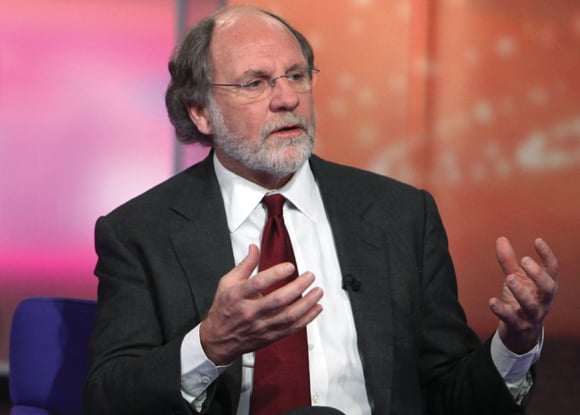
Despite high unemployment, meager economic growth in the U.S. and Europe's sovereign debt crisis, Jon Corzine remains bullish on the future of the financial markets.
Speaking Tuesday in Chicago at a meeting of the Managed Funds Association, the former Democratic senator and governor of New Jersey described himself as an optimist and added: “It's a great time to be leading a financial institution.”
Less than three months ago, Mr. Corzine took over as chairman and chief executive of futures and options brokerage MF Global Holdings Ltd.
“Risk creates opportunity, and 75 days ago I saw a great opportunity to intermediate risk and create opportunity,” he said.
Mr. Corzine told the audience, largely made up of representatives from the
hedge fund and managed-futures industries, the financial regulatory reform legislation moving through Congress is necessary.
“We all know Wall Street participated in a lot of asymmetrical risk taking,” he said. “The financial institutions and the regulators embraced opacity.”
While Mr. Corzine generally backs the Obama administration's push for regulatory reform, he doesn't agree with every piece of the legislation, and, what's more, has concerns about how new laws will be applied.
“I'm more in favor of financial reform than if we did nothing or a lot less,” he said. “I think we're in the right zone with regard to this legislation, but the greatest risk not the legislation, but how it gets implemented.”
Mr. Corzine, who co-authored the Sarbanes-Oxley Act of 2000 while serving in the Senate, said the financial reform effort will provide much-needed transparency.
He acknowledged that “tighter oversight of consumer finance is long overdue,” but explained that he does not support the idea of eliminating proprietary trading practices that enable brokerage firms to trade their own assets.
“The idea of prohibiting prop trading or to spin off derivative books is not attacking the problem, because it is virtually impossible to separate prop capital from client capital [in a brokerage operation],” he said. “The troubling part is, if we get too aggressive [parts of the financial services industry] might even go offshore.”
As for the prospects of an economic recovery, Mr. Corzine's outlook wasn't all rosy. He said many of the biggest issues that led to the “Great Recession” remain.
“Middle-class America is in an incredible squeeze, and I don't think we would have even had a Great Recession if it weren't for the incredible search by the middle class to achieve [financial] success,” he said. “Our middle-class income level is not keeping pace with the cost of life, and that is a challenge that will continue to exhibit itself in our politics and in our financial reform.”
Mr. Corzine expects the November mid-term elections to favor more conservative candidates.
“Tea party or unionized, the people are mad as hell,” he said. “People are disturbed about all the government bailouts, and voters are on a short fuse.”
Mr. Corzine, a former chairman of The
Goldman Sachs Group Inc. who described himself as a “recovering politician and recidivist banker,” said he plans to teach at Princeton University in the fall about the “lessons learned in 2008 and 2009.”