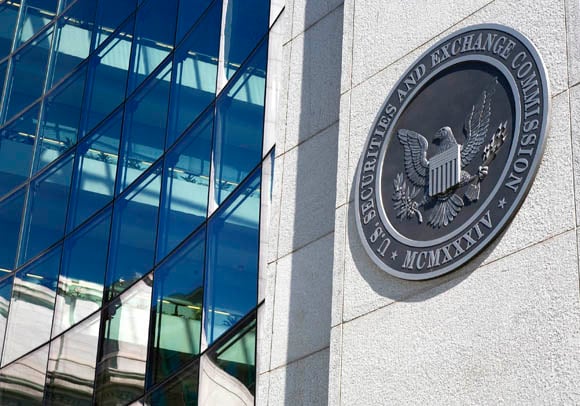
New report supports assertions that large number of ex-commission employees represent outside clients before the agency
A study released today by a watchdog group raises questions about whether the migration of SEC staff members to companies the agency regulates undermines the agency's ability to protect investors.
The report, written by the Project on Government Oversight, shows that 219 former Securities and Exchange Commission employees filed 789 statements with the agency between 2006 and 2010 indicating they were going to represent an outside client before the commission.
The watchdog group said that some SEC alums returned to the agency on business for their new employers – including law firms and financial companies -- “within days” of the employee's departure from the SEC.
Data for the study was culled from 800 statements provided by the SEC after the oversight project filed a Freedom of Information Act request.
The study notes that the “vast majority of statements” by former SEC employees show that they were not involved in the matters that they were pursuing in their post-commission jobs.
However, the study reinforces criticisms that the
SEC has been too cozy with the financial industry. The SEC inspector general has said that the pipeline between the SEC and financial companies has undermined enforcement actions involving The Bear Stearns Cos. Inc. and the alleged Ponzi scheme involving financier Allen Stanford.
“The high concentration of former SEC employees at certain firms does not necessarily mean that these firms and their clients are exerting undue influence on the commission,” the report states. “However, there have been several recent reports and studies that point to instances in which former SEC employees appear to have exerted undue influence on current commission staff, or in which the temptations of traveling through the revolving door appear to have weakened SEC regulatory and enforcement actions.”
An SEC spokesman countered that even though the agency cannot dictate where former employees go next, it does impose a number of restrictions when their new job brings them back to the commission.
If they worked “personally and substantially” on a matter involving specific parties, they are permanently barred from representing anyone on the same issue before the SEC, according to spokesman John Nester.
If the matter was part of the employee's official responsibility within one year of leaving the agency, he or she cannot represent anyone on the matter for two years. Some senior officials are subject to a one-year “cooling off” period in which they cannot appear before the SEC on behalf of anyone.
In addition, the agency requires former employees to file notices for two years before appearing before the commission.
“The SEC has a rigorous program to help departing employees meet not just the letter, but also the spirit of the law,” Mr. Nester wrote in an e-mail.
These rules notwithstanding, the agency will continue to get heat from Capitol Hill.
“Today, the SEC's revolving door seems to be more active than ever,” Sen. Charles Grassley, R-Iowa, said in a statement. “Revolving-door restrictions that apply to the rest of government must be made to apply to the financial regulatory agencies. Along with restrictions, there should be public disclosure of where these former financial regulators are working and what issues they are working on.”