Democrats sent a massive Wall Street regulation bill to the full Senate on a party line vote Monday after a temporary retreat by Republicans that still left the bill's chances for bipartisan passage in doubt.
In a surprise move, the Senate Banking Committee met briefly to approve the bill 13-10, but not before Republicans jettisoned more than 300 amendments they had planned that could have put their imprint on the measure. Senators had been expecting a long week of votes and debate, only to find themselves voting as they were still easing into their seats.
Despite a conciliatory tone struck by the committee's Democratic and Republican leaders, the development did nothing to mend the partisan divide over the legislation and adds even more uncertainty to Congress' ability to pass a sweeping rewrite of financial regulations this year.
The Senate would not take up the bill until April at the earliest.
President Barack Obama applauded the committee's vote, declaring: "We are now one step closer to passing real financial reform." But Obama said he would seek to strengthen the bill, a stance that would certainly complicate efforts at bipartisanship.
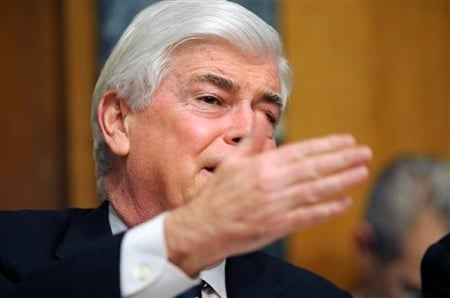
In their opening remarks before the committee vote Monday, committee chairman Christopher Dodd, D-Conn., and the committee's top Republican, Sen. Richard Shelby of Alabama, chose to sound optimistic about the bill's prospects.
"We will have reform this year," Dodd said.
"I just don't believe we're quite there yet," Shelby cautioned.
Dodd unveiled his bill last week, 18 months after Wall Street's spectacular failures helped plunge the nation into the worst
recession since the Great Depression. The legislation would give the government unprecedented powers to split up firms considered a threat to the economy, put together a council of regulators to watch for risks in the financial system and create an independent consumer watchdog.
Shelby said seeking changes in committee would have been pointless. He said he hoped he and Dodd would find agreement before the bill reaches the Senate floor.
Democrats and Republicans are mostly split over the need for an independent consumer entity. But other issues also divide the parties, including how to regulate complex trading instruments and what firms should be exempt from new rules.
Edward Yingling, head of the American Bankers Association, issued a statement opposing the bill, citing the consumer protection provision and Dodd's decision to concentrate the Federal Reserve's regulatory oversight on large financial institutions.
The decision to move swiftly through committee made it much more difficult to predict what the Senate would ultimately do with the legislation.
Sen. Bob Corker, R-Tenn., said that after months of negotiations by Dodd and his committee, Monday's vote was "unorthodox." Corker negotiated with Dodd for a month before their talks ended without an agreement.
Earlier, on CNBC, Corker suggested the bill may need a new environment.
"It's probably true that we have a better opportunity with a different cast of characters, the full Senate, to do something that is sound policy-wise," he said.
The Obama administration kept up pressure on Congress, with Treasury Secretary Timothy Geithner declaring Monday that the country faced a "defining moment" in the battle to overhaul financial oversight.
"The test we face is whether we can enact real reforms that provide strong protection for consumers, strong constraints on risk taking by large institutions and strong tools to protect the economy and taxpayers from future crises," Geithner said in remarks to the American Enterprise Institute, a conservative think tank.
"We will not accept a bill that does not meet that test," Geithner said.