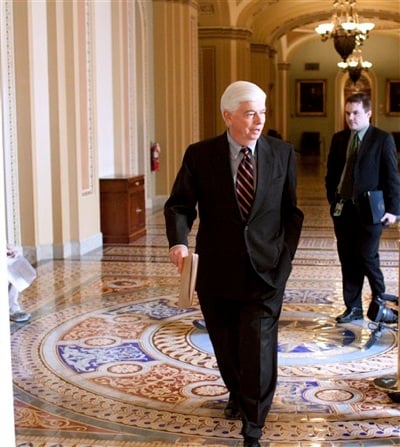
With one eye on the calendar and the other on elusive bipartisanship, Senate Banking Committee Chairman Christopher Dodd plans to offer his own version of a sweeping overhaul of financial regulations without Republican support.
Dodd said Thursday he would release his proposal on Monday and begin the committee's work on the bill the week of March 22.
"Clearly, we need to move along," he said.
His decision immediately complicated the prospects for a Senate bill already months in the making, and it raised new questions about Congress' ability to respond to a financial crisis that erupted more than 18 months ago with the collapse of Lehman Brothers.
Four weeks of negotiations between Dodd, D-Conn., and Republican Sen. Bob Corker had closed differences over key provisions, including consumer protections, but details on that and other sticking points remained unsettled.
"As time moves on, you just limit the possibilities of getting something done, particularly a bill of this magnitude and this complexity," Dodd said.
Senate Majority Leader Harry Reid, D-Nev., said Thursday he hoped the Senate would act on a bill by Memorial Day.
Dodd's surprise decision to move without a final deal comes during an era of high partisanship in Congress that has entangled health care, blocked progress on climate change and energy legislation, and angered a public with an increasing disdain for incumbents.
Congress and the administration have been trying to assemble an overhaul of regulations since last summer in hopes of preventing a recurrence of the 2008 Wall Street meltdown. It has not been an easy task. The House passed its version of a bill in December on a party-line vote.
"It will continue to be a challenge to reach a bipartisan deal," said Scott Talbott, the chief lobbyist for the Financial Services Roundtable, an association of the banking industry.
Corker on Thursday said he and Dodd had made significant progress and had agreed in principle on consumer protections, one of the most contentious issues. He described himself as disappointed in Dodd's decision but said he expected Dodd's proposal would be more moderate than a bill Dodd drafted late last year.
"There has been no breakdown. Like, none," he said. "What happened was you're on the five-yard line, the lights went out."
Still, Corker blamed Dodd's rush to propose a new bill on the current dispute over health care and pressure on Dodd to offer a bill before the Senate puts the health care bill through a bitterly partisan fast-track process. "I understand the pressure that he is under," Corker said.
Dodd, who is retiring when his term ends in January, said the attention to health care was one of several factors driving the clock on financial regulations. He pointed out that this is an election year, and that there few opportunities ahead to get a bill through committee, pass it in the Senate and then reconcile the differences with the House version.
But Corker said that with a spring recess beginning on March 28, it would be a "travesty" if Dodd were to insist on getting the bill through the committee in one week.
Despite lingering differences, some key aspects of the legislation have bipartisan support. Those include a mechanism for take over and dismantling large, failing firms and forcing the financial industry to cover the costs, and to create a "systemic risk" council that includes the Treasury and the
Federal Reserve to look out for firms and practices that could pose a risk to the entire financial system.
Dodd needs Republican support to get the 60-vote margin he needs to overcome delaying tactics. Earlier this year, Dodd tried to negotiate with the committee's ranking Republican, Sen. Richard Shelby of Alabama. When those talks stalled, Dodd turned to Corker, a junior senator from Tennessee.
In a statement Thursday, Shelby signaled that Dodd would now have to deal with all the committee Republicans as bloc. "As long as we remain focused on policy and not politics, an agreement is still very possible. The Republican members of the committee stand united and ready to work with Chairman Dodd toward that goal," he said.
Even if Corker and Dodd had settled their differences over a Consumer Financial Protection Agency, it could still emerge as a stumbling block. The president has made such an independent agency a central provision in the bill. The House version provides for such a stand alone agency, which would regulate institutions that offer credit, mortgages or other consumer financial products.
Republicans, bankers and many in the business sector oppose a separate agency, saying it would add another layer of regulation and bypass existing bank regulators.
Corker and Dodd had agreed to place such an agency inside the Federal Reserve. Corker said the latest agreement would have permitted bank regulators, under certain conditions, to appeal to a government risk council that would have the power to reject new consumer rules. The agency, however, would not have had enforcement powers.
Several Democrats on the Banking Committee have insisted on a freestanding agency, and others have demanded that the agency have autonomous powers to write regulations. But Dodd was unlikely to retreat too far from the common ground he had found with Corker.