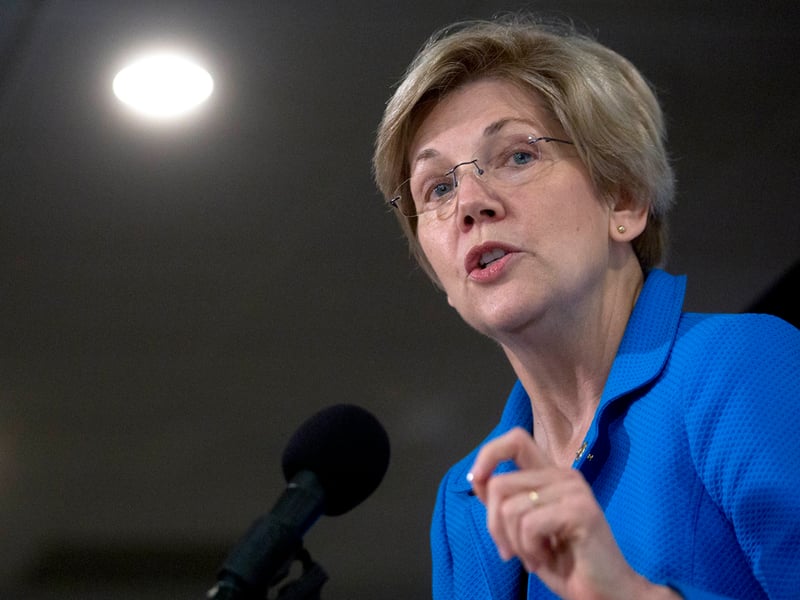
Wall Street influence is undermining the Securities and Exchange Commission's work on its investment advice proposal, Sen. Elizabeth Warren, D-Mass., said Tuesday.
Ms. Warren cited the "soft corruption" of the revolving door that causes SEC commissioners to regulate with an eye toward working in the financial industry at the end of their terms.
"It undercuts the ability of our regulatory agencies to do their jobs," Ms. Warren said in a
press conference at the National Press Club, where she
introduced a bill designed to curb government corruption that includes a provision targeting corporate capture of regulators. "It means instead that they're there to kowtow to their past and future employers."
She said the agency's investment advice proposal, which would require brokers to act in the best interests of their clients, is an example of problematic corporate influence.
Ms. Warren and other Capitol Hill Democrats wanted the SEC to propose a uniform fiduciary rule for investment advice, similar to the vacated Labor Department fiduciary rule. They argue the SEC rule is too weak.
"Has it affected … the fiduciary rule?" Ms. Warren said in reference to the revolving door between working in the industry and for its regulator, and its effect on the coming SEC advice rule. "Yes, of course it has. Who do you think has been in there on the fiduciary rule saying 'no, no, no, no, no'? It's been some of the biggest players in the industry who don't like the idea that there is a regulatory body that would say something as shocking as when somebody gives investment advice, the advice should be geared toward making sure the customer is going to prosper rather than the investment adviser."
The SEC declined to comment.
Agency officials have held about 70 meetings regarding the advice proposal, according to a
list on its website. Most of them have involved industry officials — or lobbyists representing them — but commissioners and agency staff also have met with a number of investor and investment adviser advocates.
SEC chairman Jay Clayton and SEC staff also have
conducted several roundtables about the proposal designed to elicit feedback from investors. The agency also has
developed a form that allows the public to comment on the proposal through a mobile phone. The comment period on the proposal closed on Aug. 7.
Ms. Warren pointed to Mr. Clayton's predecessor, Mary Jo White, as an example of someone whose trips through the revolving door from Wall Street to Washington and back again hampered regulation.
Ms. White, a former U.S. Attorney for the Southern District of New York, served as SEC chairwoman from 2013 to 2017. She worked at the law firm Debevoise & Plimpton, which represents many Wall Street clients, just before being appointed to the SEC by President Barack H. Obama. Ms. White returned to the firm after leaving the agency.
While in office, Ms. Warren said Ms. White failed to follow through on congressionally mandated rules on corporate disclosure of campaign spending.
"She does the lightest touch of regulation … then whizzes right through the revolving door and is out representing those same folks again," Ms. Warren said. "This is not a Republican-only problem."
Ms. White declined to comment.
Ms. Warren, who has been mentioned as a possible 2020 presidential candidate, faces a big challenge getting her bill, or even parts of it, approved. Republicans hold a majority in the Senate and the House.
But she said she is taking action because corruption is eroding American's faith in Washington.
"Our government systematically favors the rich over the poor, the donor class over the working class, the well-connected over the disconnected," she said. "This is deliberate, and we need to call this what it is: corruption, plain and simple."