
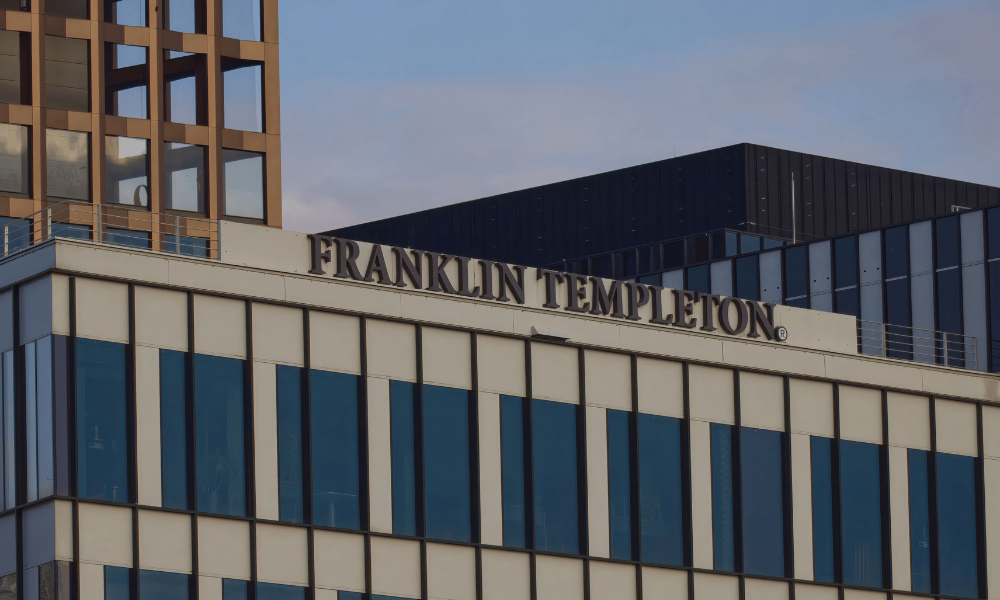
A former Franklin Templeton portfolio manager alleges he was fired after flagging that a colleague rigged the firm's "rules-based" cat bond fund to override sell signals.
That is the central claim in a lawsuit filed on April 26 in the U.S. District Court for the Southern District of New York. According to the filing in Strah v. Franklin Resources, Inc., No. 1:26-cv-03428, Jordan Strah says his employer punished him for blowing the whistle on what he describes as securities fraud inside the Franklin K2 Cat Bond UCITS Fund.
The defendants — Franklin Resources, Inc., K2 Advisors, LLC, and K2/D&S Management Co., LLC, collectively referred to in the filing as Franklin Templeton — have not yet responded in court.
What Strah says he found
Strah, who joined K2 Advisors in January 2022, claims that in June 2023 he noticed his then-manager, Michael Rich, had bought a catastrophe bond that the fund's screening system had earlier flagged as a "NO BUY." Working backward through saved spreadsheets and a database, Strah says he found that inputs had been tweaked — some by overwriting risk metrics, one by hardcoding over a formula — to flip the system's output to "BUY."
The bonds Strah identifies in the filing include Lower Ferry Re 2023-1, Baldwin Re 2023-1, Res Re 2023-1, and Solomon Re 2023-1. He says the username "mrich" was logged next to several of the disputed entries in the firm's RMS Miu risk platform.
The prospectus angle
For Investment News readers, this is the part that matters. Strah alleges the overrides cut directly against what the Franklin Templeton Alternative Funds prospectus promises investors: a "systematic, proprietary rules-based process" that screens and scores catastrophe bonds. Discretionary buys dressed up as systematic outputs, the filing argues, were a flat-out lie to fund investors — and the rules-based pitch was being used to bring in new clients.
How the firm allegedly handled it
Strah says he escalated through K2's risk and compliance team, then to Rich's manager Lilly Knight and K2 chief investment officer Rob Christian in an August 2023 meeting. According to the filing, the two told him compliance had finished its review and labeled the discrepancies "inconclusive." Strah says Christian remarked, "if it walks like a duck, swims like a duck, and quacks like a duck, sometimes it's not a duck," and that Knight then suggested he resign.
Strah says he refused, kept pressing, and eventually raised the issue with Franklin Resources general counsel Thomas Merchant in February 2024 and K2 chief compliance officer Bjorn Davis in April 2024. Rich was terminated on May 13, 2024, the filing says.
What happened next
After Rich's exit, Strah says he was running the UCITS fund himself — handling trading, pricing, audits, investor presentations across Europe, and a redraft of the investment procedures — but was never named to the prospectus. He claims he was placed under Knight's supervision (the same person who he says had told him to resign), got what he calls an inaccurate performance review in February 2025, and was let go on March 25, 2025 as part of a reduction in force.
The filing pushes back hard on the RIF label, noting Strah was the only person with the systems access and asset-class knowledge to run the strategy day-to-day. He filed with OSHA on April 2, 2025 and, after more than 180 days without a final decision, brought his Sarbanes-Oxley and New York Labor Law § 740 claims to federal court.
The takeaway for advisors and asset managers
The allegations are unproven, and Franklin Templeton has not filed a response. No court has ruled. But the filing is a useful prompt on three fronts wealth and asset management compliance teams already know well: the integrity of inputs behind any systematic strategy, how a "no findings" outcome on a whistleblower report gets documented, and how reporting-line changes after a complaint look in hindsight — especially during a corporate integration like the 2024 absorption of K2 Advisors into Franklin Templeton Investment Solutions.

As Robinhood and Schwab roll out AI agents and assistants, a new survey finds advisors still edge out chatbots in terms of client trust.

See which platforms and providers earned 5-Star recognition this year

Meanwhile, a multigenerational Cambridge team has hopped to LPL in Michigan, and Cetera's run of Commonwealth recruitment continues in New Jersey.

TIAA survey finds 53% of Americans worry about running out of money, as AI and medical advances scramble retirement income planning.

Two wirehouse veterans choose advisor-owned model as independents target ultra-high-net-worth clients beyond portfolio management.
As AI makes financial information more accessible than ever, Lana Hock explains why human judgment, trust, and empathy remain the qualities clients value most in a financial advisor
Northern Trust’s Ken Lassner shows advisors how to convert volatility into after-tax portfolio gains

