
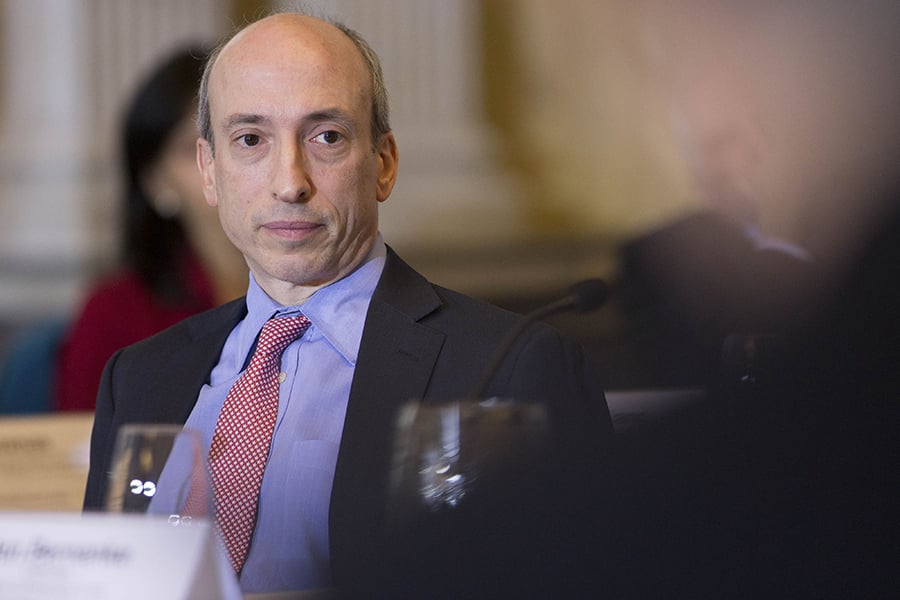
It’s not the number of proposals on SEC Chair Gary Gensler’s agenda that make it aggressive. It’s the speed with which he got out of the gate and the goal of the rulemaking roster.
That was the message that came out of Gensler’s appearance Thursday before the Senate Banking Committee. As expected, he took heat from Republicans for what they characterized as a set of priorities that is too broad and complex.
Gensler explained during the hearing and afterwards to reporters that under his immediate predecessor, Jay Clayton, the Securities and Exchange Commission promulgated 62 final rules. Former SEC Chairs Mary Schapiro and Mary Jo White completed about 50 and nearly 40 rules, respectively. The current SEC agenda is at 52.
But Gensler has moved farther faster on his priorities than past chairs. The SEC released 34 rule proposals in the first 18 months of his tenure.
“We might have been a little sooner getting them out to propose,” Gensler said during the hearing.
It’s also the substance of his agenda that could be creating friction, Gensler told reporters.
“We have a real vision here,” he said in an impromptu press conference in a hallway outside the hearing room. “This vision is about driving efficiency, integrity and resiliency in these [financial] markets and trying to not take anything for granted.”
Gensler added: “That’s what this chair is about. It’s not about the numbers [of proposals]. I don’t care about the numbers.”
The reason his agenda may be causing heartburn Wall Street is because he wants to reduce the cost of financial intermediaries — those he describes as being in the middle between investors and stock issuers — by increasing competition and transparency.
A former Goldman Sachs official, Gensler knows that zeroing in on that part of the financial market can trigger resistance.
“I always think of finance in the following way: Issuers and investors are the two ends of the hourglass,” Gensler said. “Finance stands at the neck. You kind of put your hand out and get a few grains of sand as they go by. That’s what I did when I was on Wall Street.”
Gensler said that U.S. financial markets are the gold standard for the world and that his agenda is focused on keeping them at that level.
“I want to take the years that I’m given in this job to enhance our capital markets for working families but also geopolitically,” he said. “I don’t take for granted that we’re going to have the largest economy in the world forever.”
But Sen. Mike Rounds, R-S.D., criticized Gensler for pursuing a sprawling agenda that doesn’t take into account the potentially negative “cross-sector effects” of overlapping, simultaneous rulemakings.
Gensler said the SEC is being careful not to create more problems than it solves. “We do consider those cross issues and sometimes we even reopen proposals for that reason,” he told Rounds.
The pushback from Republicans is a good sign, said Senate Banking Committee Chair Sherrod Brown.
“Republicans on this committee have bellyached about your ambitious agenda,” Brown said. “If Wall Street and its allies are complaining, it probably means you’re doing your job.”

Retiring RIA seller David Laidlaw alleges the Carnegie valued his stake on $11.7 million EBITA while pitching potential buyers on $21.3 million.

New tool gives RIAs and family offices AI help vetting private market deals, with some users reportedly halving review time.

Investors got projected returns dressed up as real ones, SEC says

Parents must still act to get the $1,000 federal seed and employer contributions, giving financial advisors a role in the rollout.

FINRA booted Rudy Anguiano from the industry for “conversion - the intentional and unauthorized taking of another person’s property.”
As AI makes financial information more accessible than ever, Lana Hock explains why human judgment, trust, and empathy remain the qualities clients value most in a financial advisor
Northern Trust’s Ken Lassner shows advisors how to convert volatility into after-tax portfolio gains

