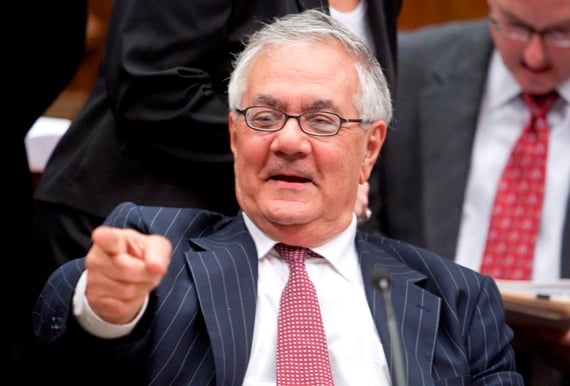
Rep. Barney Frank, the leading proponent of universal fiduciary duty for retail investment advice, announced today that he will retire from Congress in 2013.
Mr. Frank, 71, said he would rather spend 2012 fighting Republican efforts to derail the financial reform law that bears his name than run for a reconfigured district that encompasses 325,000 new constituents and a large swath of new geography near the Rhode Island border.
In a written statement, Mr. Frank, D-Mass., said that he contemplated retiring after his current term, following the enactment of the massive Dodd-Frank law — the most comprehensive reform since the Great Depression to laws governing the financial markets.
“But with the election of a conservative majority in the House, I decided that my commitment to the public policies for which I have fought for 45 years required me to run for one more term,” Mr. Frank said. “I was — and am — concerned about right-wing assaults on the financial reform bill, especially since we are now in a very critical period when the bill is in the process of implementation.”
In addition to defending Dodd-Frank, Mr. Frank will focus on reducing the military budget to achieve deficit savings in the time he has left on Capitol Hill.
“My concern for these two issues today cuts very much … in favor of forgoing a year-long full-time election campaign and instead focusing the next year on those two issues in Congress,” Mr. Frank said.
First elected to Congress in 1980, Mr. Frank is the highest-ranking Democrat on the House Financial Services Committee. He had to relinquish his chairmanship of the panel when Republicans took control of the House in January following the 2010 election.
This year, he has warned that his GOP counterparts are trying to undermine the Dodd-Frank law by denying adequate funding to the Securities and Exchange Commission and by insisting on stringent cost-benefit analyses of new regulations designed to slow or stop their implementation.
Mr. Frank was the champion of a section of the law that gives the SEC the authority to impose a universal fiduciary duty on retail investment advice. It would require that brokers act in the best interests of their clients — a more stringent level of than the suitability they now must meet.
“The only reason that provision was in the bill is because of his insistence that it be there,” said Barbara Roper, director of investor protection at the Consumer Federation of America.
With his departure from Congress set for 2013, Mr. Frank still has a whole year in which to exert his influence on the SEC. The agency has delayed consideration of a fiduciary regulation until sometime next year.
“If we haven't managed to move forward by [the end of 2012], then there's not much he could have done to help,” Ms. Roper said.
In addition to advocating for fiduciary duty, Mr. Frank also has been a bulwark against efforts to establish a self-regulatory organization for investment advisers.
During House debate in 2009 on what became the Dodd-Frank bill, Mr. Frank squashed an amendment by Rep. Spencer Bachus, R-Ala., that would have extended the reach of the
Financial Industry Regulatory Authority Inc. to include investment advisers affiliated with a broker-dealer.
It's not clear where Mr. Frank stands on draft legislation introduced by Mr. Bachus in September that would authorize one or more adviser SROs.
David Tittsworth, executive director of the Investment Adviser Association, said that Mr. Frank brings a sophisticated approach to dealing with policies affecting the sector. He also employs a mordant sense of humor to throw opponents off balance.
“People would agree — whether they're conservative or liberal — Barney is a force to be reckoned with and definitely a character,” Mr. Tittsworth said. “He's a very knowledgeable and experienced legislator. He's a very funny guy.”
Even groups that fought with Mr. Frank over his eponymous financial reform bill praised him for taking their side on some issues.
For instance, the Labor Department indicated that it will re-propose a rule that would significantly expand the definition of “fiduciary” for retirement plan advisers just days after receiving a letter from Mr. Frank asking the agency to back down.
“We are grateful for his leadership on the Department of Labor fiduciary issue, where he played a pivotal role in helping us get the proposed rule withdrawn, and helped preserve Americans' access to affordable advice on their [individual retirement accounts],” Financial Services Institute Inc. president Dale Brown said in a statement.
The next two Democrats in line after Mr. Frank on the Financial Services Committee are Rep. Maxine Waters, D-Calif., and Rep. Carolyn Maloney, D-N.Y. Wall Street is wary of the liberal Ms. Waters, while some fiduciary advocates are leery of Ms. Maloney's tendency to be sympathetic toward Wall Street.