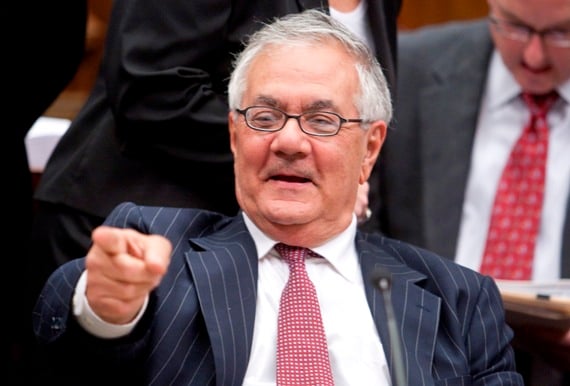
Rep. Barney Frank announced this week that he is retiring from Congress at the end of 2012 rather than running for re-election — in part because he wants to concentrate on defending the massive financial reform law that bears his name.
The Massachusetts Democrat and 30-year congressional veteran will have more time to try to shape implementation of the Dodd-Frank Act's provisions on investment advisers. He'll start by resisting draft legislation that would establish one or more self-regulatory organizations for adviser oversight.
That was proposed in September by House Financial Services Committee Chairman Spencer Bachus, R-Ala. As ranking Democrat on the panel, Mr. Frank likely will be influential in his last year in office in rallying Democrats against the provision.
“I'm skeptical of self-regulatory agencies,” Mr. Frank said at a Capitol Hill press conference yesterday. “I would not want to detract at all from the responsibilities of public agencies.”
It's not clear when a formal bill will be introduced, although it could be any day now. The measure responds to a Dodd-Frank-mandated study by the Securities and Exchange Commission that recommended three ways for the agency to increase investment-adviser examinations: allow the SEC to charge user fees for exams, establish an SRO to regulate advisers, or expand the reach of the
Financial Industry Regulatory Authority Inc. to include advisers who are dually registered as brokers.
Each of those options requires congressional authorization. Mr. Bachus — and other Republicans — favor an SRO because they are not convinced the SEC can adequately regulate advisers. They criticize the SEC for missing Bernard Madoff's Ponzi scheme, which bilked investors out of $50 billion. They also point to SEC statistics that show that the agency has the resources to review only about 8% of the nearly 12,000 registered advisers annually.
Mr. Frank pointed out that Republicans have resisted giving the SEC the increased funding called for in the Dodd-Frank law. They then engage in what Mr. Frank refers to as a self-fulfilling argument: An SRO is required because the SEC doesn't have the resources to police advisers.
“I have an answer to that,” Mr. Frank said. “Give the public agencies enough money.”
Under House rules, the majority party — in this case, the GOP —has almost complete control. When it wants to promote a bill, the Republican majority can put it on the agenda and get it passed. Nonetheless, if Democrats are united in their opposition, they can send a signal to the other side of Capitol Hill — where the Senate is controlled by Democrats — about sentiment toward the bill.
That's why Mr. Frank likely will continue to have influence until his final day in office. He is acknowledged by Democrats and Republicans as a consummate legislator who knows where the pressure points are for Republicans, his caucus and Wall Street.
“If the Republicans want to do message bills, they can do them with Republican-only votes in the House, but they won't pass the Senate,” said Barbara Roper, director of investor protection at the Consumer Federation of America. “But if they want legislation, they need to be able to show they have bipartisan support. Congressman Frank is the dealmaker.”
For the last 13 months of his congressional career — before he heads back to Massachusetts to teach, write and perhaps finish his Harvard doctorate — Mr. Frank won't have to worry about raising millions of dollars for a tough re-election campaign or travel a reconfigured district introducing himself to about 325,000 new constituents.
Instead, he can concentrate on stopping Republicans from dismantling Dodd-Frank. He said the biggest threat is the election of a GOP president whose appointed regulators would want to scuttle the law.
But if most of it can be implemented in the next year, he believes Dodd-Frank will be preserved.
“The best time to strangle something is at the beginning,” Mr. Frank said. “Financial reform is popular.”