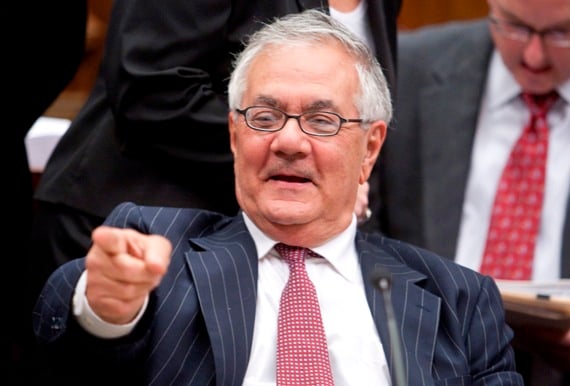
Ten days before the first anniversary of the passage of the Dodd-Frank financial reform law, one of its authors said implementation has been stalled by a lack of funding from Congressional Republicans.
Massachusetts Rep. Barney Frank., ranking Democrat on the House Financial Services Committee, said the GOP has not made a frontal assault on Dodd-Frank because doing so would be politically dangerous in the aftermath of the financial crisis.
“It is still too popular,” Mr. Frank said. “So, they're coming at it sideways.”
The political atmosphere on Capitol Hill has changed since the bill was approved. Republicans took control of the House in the November elections and significantly increased their Senate minority.
Republicans have used their new leverage to try squeeze the budgets of the Securities and Exchange Commission and the
Commodity Futures Trading Commission, Mr. Frank said.
“They have had an impact by having the SEC and CFTC underfunded,” Mr. Frank said. “That's a serious problem. I do not see this coming from the financial institutions. I see this coming from the ideology of the Republican Party.”
“I am struck, at least in public, how little advocacy there has been for substantial changes,” Mr. Frank said today at a press conference at the National Press Club in Washington. The bill is “holding up very well,” he added
If the Democrats had maintained their House majority, they probably would have moved a supplemental appropriations package early in the year that would have provided about $200 million to the regulators for Dodd-Frank implementation.
The 849-page law mandates 400 rule making requirements and 73 studies, according to an analysis by Davis Polk Wardwell LLP. As of July 1, agencies have finalized 38 rules, proposed 121 and missed 26 deadlines.
“If [financial regulators] had been fully funded in February and March, we'd be a lot further along,” Mr. Frank said.
In June, the House Appropriations Committee approved a bill that would freeze SEC funding at its fiscal year 2011 level, $1.19 billion, which is $74 million higher than its fiscal 2010 appropriation, but $200 million less than the Obama administration's budget request.
The committee's Republican majority voiced concerns about the SEC's management of its operating budget, information technology procurement, renting of leased space and its ability to produce accurate financial statements. They also said that all federal agencies had to tighten their belts in an atmosphere of federal budget cutting.
The GOP denies it is trying to starve Dodd-Frank implementation to death.
“Both the SEC and the CFTC are actually operating with more funding in their budgets today than they had a year ago,” said Jeff Emerson, a spokesman for the House Financial Services Committee Republicans. “So it's very strange to hear these charges that the lack of progress in drafting Dodd-Frank rules is somehow because of funding. It's not.”
In a statement in the Capitol Hill publication Politico today, Rep. Spencer Bachus, R-Ala., chairman of the House Financial Services Committee, said that Dodd-Frank regulation was contributing to the sluggish economic recovery.
“When you add the mountain of new rules required by Dodd-Frank to those of Obamacare, plus the threat of higher taxes caused by Washington's spending spree, you get an astounding level of apprehension and plunging confidence for employers and their customers,” he said. “You get uneasiness among banks that flows down to businesses and consumers in the form of tight credit. The disastrous consequences for our economy are real.”
Mr. Frank counters that the law that bears his name will prevent another financial crisis like the one in 2008 that catalyzed the
recession. He said the measure curtails risky loans, tightens derivatives regulation, increases consumer protections and ends financial institution bailouts.
“Yes, it is disruptive because we had to disrupt a rotten system, which collapsed,” Mr. Frank said.