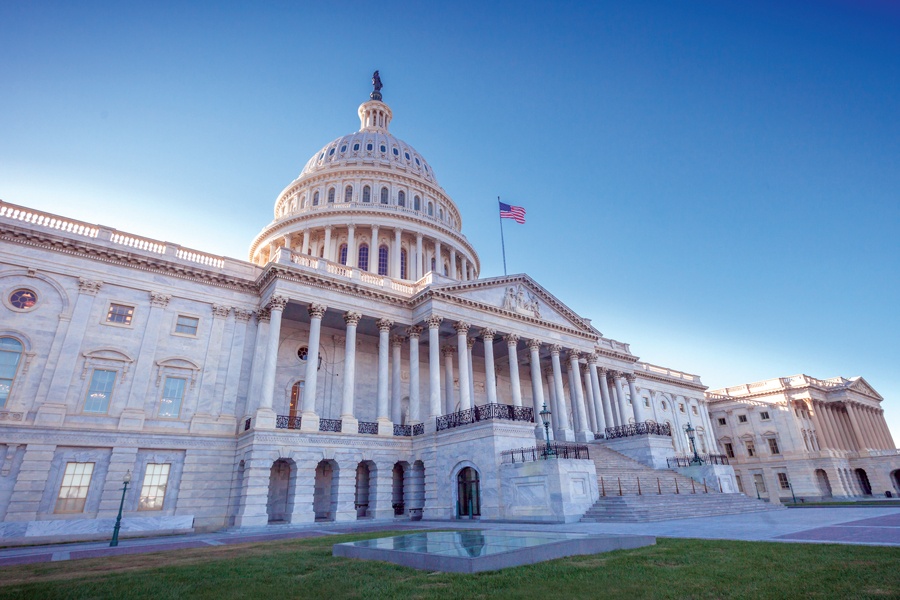
Legislation to boost retirement savings might gain support.
Since the markets hate uncertainty, they had nothing but love for last Tuesday's midterm election results. With Democrats winning the House, and Republicans adding to their majority in the Senate, the Dow closed up 389 points and the S&P 500 jumped about 31 points Wednesday. There may be more to come. InvestmentNews senior columnist Jeff Benjamin has reported on the positive historical gains in stocks in the two quarters following midterms.
But what can we glean about adviser issues in Congress, given its now bipartisan control, as well as the fact that more states will be led by Democratic governors in 2019?
Senior reporter Mark Schoeff wrote a cover story in October on the upshot of this scenario unfolding, and again reported last Wednesday on what is likely to change.
Rep. Maxine Waters, D-Calif., is likely to become chairwoman of the House Financial Services Committee, and Rep. Richard Neal, D-Mass., could become chairman of the House Ways and Means Committee — two panels with jurisdiction over issues central to financial advisers.
(More: Here's how a Democratic House will affect financial advisers)
Ms. Waters has been critical of the direction the Securities and Exchange Commission is taking with its advice-standards proposal. She particularly thinks Regulation Best Interest, the part of the rule package related to broker standards, is too weak. Having a thorough debate on the rule, or even just a hearing in which the agency's chairman Jay Clayton discusses his ultimate goal and answers tough questions, could be healthy given the serious ramifications of advice reform on the industry and investors. But the odds of the rule being significantly adjusted based only on congressional concerns are slim. Changes based on public comments and the recent RAND test results of a disclosure form within the rule package could already be in the offing.
An area that could see greater movement is legislation to boost retirement savings. Workplace programs such as 401(k) plans and the use of annuities within them have drawn support across the aisle. Democrats will likely want some early wins in terms of passing important legislation, and Mr. Neal is known to be a strong advocate for reforms that help average Americans put away more money for retirement. This is an important topic on which advisers can help inform their congressional representatives, and ensure unintended consequences are not slipped into well-meaning bills.
But these and other issues, like additional tax cuts (don't count on it) or legislation to bolster the broker protocol (who knows?) aren't areas where advisers are likely to struggle most with a new House and several new senators. Rather, it's the "new" part that could prove a real challenge.
The ins and outs of this very segmented financial advice industry are not easy to grasp. Newbies in Congress will have a lot to learn, period. Advocates for the industry — having spent years building solid relationships with senators and representatives who are now retiring or losing their seats — will have to begin anew educating lawmakers on what exactly a financial adviser does and how the decisions before Congress can take this profession and its investing clients in a positive or negative direction. It'll be a long road ahead.
(More: The midterm elections: What's at stake for financial advisers)
And we haven't even talked about the shift in governorships — a net six seats were gained by Democrats. How will this affect state securities regulation of financial advisers? It's possible we could see more momentum for fiduciary regulations in statehouses, especially if work on the SEC rule stalls.
Two distinct periods lie before us. The lame-duck session could involve more activity than usual as one party sees a loss of total control before them in a few short months. Then we'll move into the 116th Congress in January, which will be more diverse than any in U.S. history, though still far less than the population at large. Whether great change or gridlock is ahead for the coming split Congress, a check on government power is something this country has thrived under since its first legislative session 229 years ago. There's no reason to think we won't still.